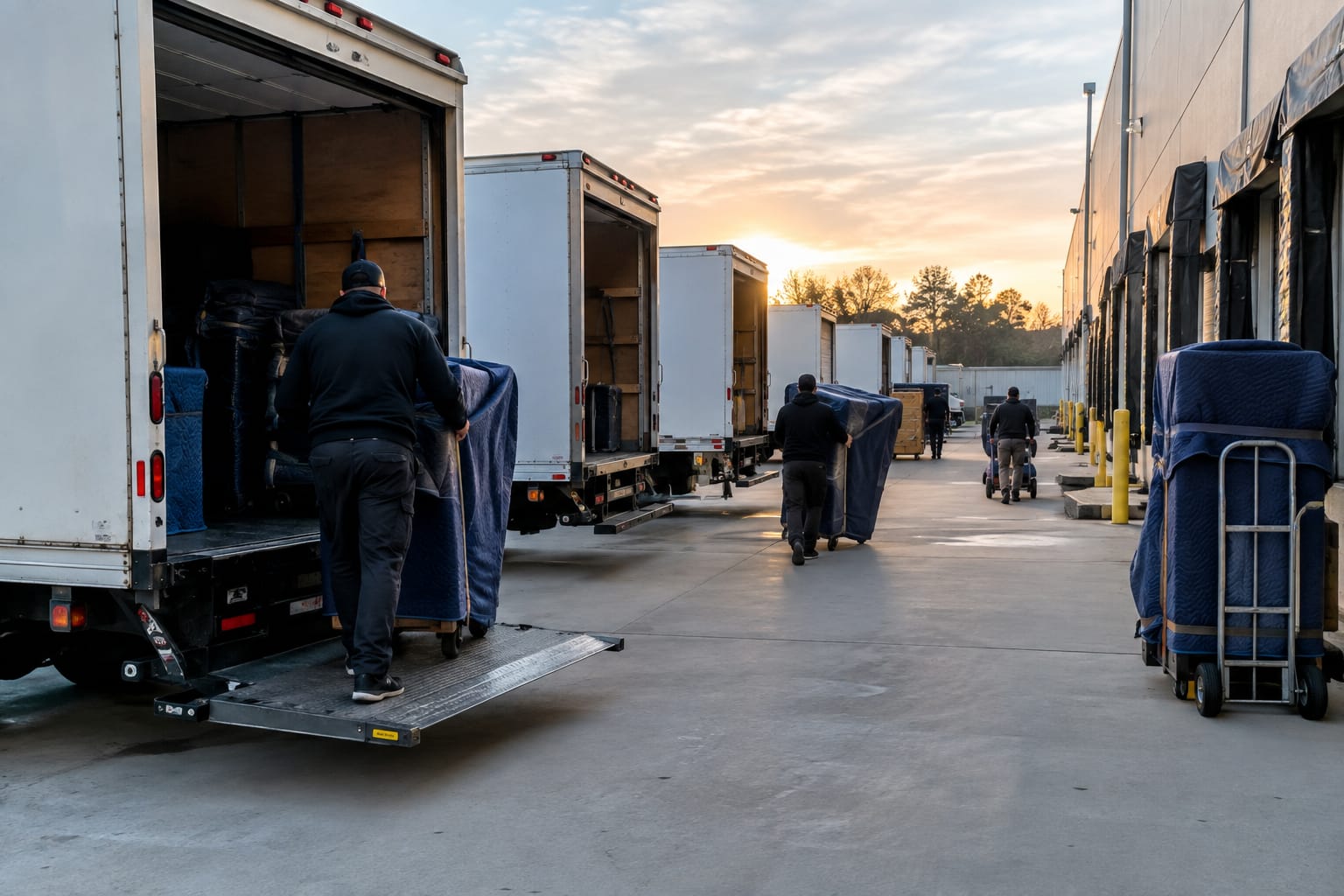

Moving companies that still operate on paper quotes, whiteboard scheduling, and phone-based dispatch are competing at a structural disadvantage. Moving company digital transformation is no longer a luxury reserved for large-fleet operators — it is the operating threshold separating businesses that scale from those that plateau. For operators navigating the going digital moving industry shift, understanding the correct adoption sequence determines whether transformation succeeds or stalls. This guide documents the proven approach — from initial operations audit through data-driven decision-making — that mid-size moving operations use to modernize completely within 90 to 180 days.
Key Takeaways
| Point | Details |
|---|---|
| CRM adoption lifts booking rates significantly | Booking rate improved from 28% to 41% after structured CRM tracking and automated follow-ups — a 13-point gain from the same lead volume with no new acquisition costs |
| Automation recovers substantial admin time | Office teams recover 13 hours per week after switching to automated dispatch — equivalent to more than half a full-time employee's weekly productive output |
| Software ROI arrives within a quarter | Mid-size operators reach full ROI within 60–120 days of complete adoption when processing 40 or more jobs per month |
| Lead response speed is the highest-leverage change | Cutting response time from 6 hours to 22 minutes is the single highest-leverage operational change documented across moving company transformation case studies |
| Culture determines adoption outcomes | The American Moving and Storage Association identifies operational inefficiency as the primary driver of revenue plateaus — closing this gap requires genuine team buy-in alongside the right tools |
What Digital Transformation Actually Means for Moving Companies

For a moving company, digital transformation means replacing disconnected paper and phone-based processes with integrated software that tracks leads, manages estimates, coordinates crews, and surfaces business data — all in one connected workflow. It does not require an enterprise IT budget or a large internal technology team.
The American Moving and Storage Association identifies operational inefficiency as the primary driver of revenue plateaus among mid-size movers. Modernizing a moving business closes this gap by reducing manual steps, improving response times, and creating real-time data visibility where none previously existed.
Q: What does digital transformation mean for a moving company?
A: For a moving company, digital transformation means systematically replacing paper-based and phone-dependent workflows — estimates, scheduling, dispatch, follow-up — with connected software that reduces manual errors, improves response speed, and generates actionable business data. A mid-size operation that completes this transition can expect a measurable impact on booking rate within 90 days of full adoption.
The key distinction is sequencing. Most operators who struggle with moving company technology adoption attempt to digitize everything at once. Successful moving business modernization follows a proven order: estimates first, then CRM and lead management, then dispatch automation, then analytics. Each layer builds on the one before it and creates the data that subsequent layers require.
Step 1: Audit Your Current Operations and Identify Paper-Based Bottlenecks
Before selecting any software, map every workflow that currently depends on paper, whiteboards, or phone calls. This audit reveals where delays accumulate, where errors repeat, and where staff time is consumed by tasks that software handles automatically.
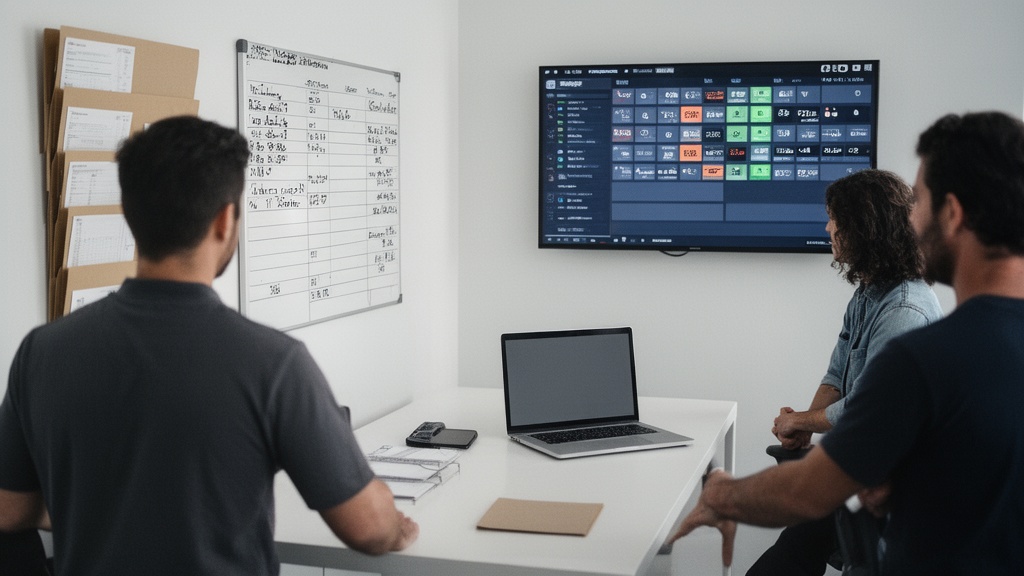
Moving operations are labor-intensive by nature. The Bureau of Labor Statistics tracks transportation and material moving occupations as one of the largest employment categories in the transportation sector, and labor represents the largest cost variable in any job's margin calculation. Any technology that reduces administrative burden per job directly affects profitability.
Common bottlenecks in pre-digital moving operations:
- Estimates generated manually and delivered by email, creating 18–24 hour response gaps
- Crew schedules maintained on whiteboards with no real-time update capability
- Lead follow-up handled ad hoc, with no systematic contact history tracking
- Job documentation collected on paper and re-entered manually into billing systems
- No visibility into which lead sources produce the highest conversion rates or revenue per job
This audit produces a prioritized bottleneck list, ranked by revenue impact. Bottlenecks that delay lead conversion rank first. Administrative inefficiencies that consume staff time rank second.
Pro Tip: Before evaluating any software, calculate the fully-loaded cost of each manual task — staff hourly rate multiplied by weekly hours spent. This converts abstract inefficiency into a concrete dollar figure and builds the internal case for technology investment with numbers that hold up in budget conversations.
The audit also establishes the baseline metrics that will measure success later: current booking rate, estimate turnaround time, lead response time, and admin hours per week. Without this baseline, ROI calculations remain guesswork. To digitize moving company operations effectively, document the current-state workflow before selecting tools — process maps surface bottlenecks that experienced staff no longer consciously notice.
Step 2: Digitize Your Estimation and Quoting Process First
Estimation is the front door of every moving business and the point where most revenue is lost — not because of pricing, but because of speed.
A landmark Harvard Business Review study on service lead response time found that businesses responding to inquiries within an hour are dramatically more likely to convert prospects compared to those who wait hours or days. This finding applies directly to moving quote delivery — a customer requesting three estimates books with whoever responds first.
Digital estimating — through video survey tools, structured intake forms, or AI-assisted quoting — compresses turnaround dramatically. Understanding how AI is changing the way moving companies generate estimates provides a practical overview of current tools and adoption patterns across the sector.
Q: Where should a moving company start with digital transformation?
A: Start with estimation and quoting. A documented case study confirms that digital estimating cuts turnaround from 24 hours to under 2 hours — a change that immediately improves competitiveness before any CRM or dispatch work begins. Going digital in the moving industry should follow this sequence: estimates first, then CRM, then dispatch automation, then analytics.
The case study data is specific: after implementing digital estimating, quotes left the office within 2 hours of inquiry instead of 24. That single change improved competitive position against every local competitor still running manual estimates. Digital estimation also creates structured data — cubic footage, job distance, access complexity, crew size — that trains pricing decisions over time and reveals which job types yield the highest margin.
Step 3: Adopt a CRM to Centralize Leads and Customer Data
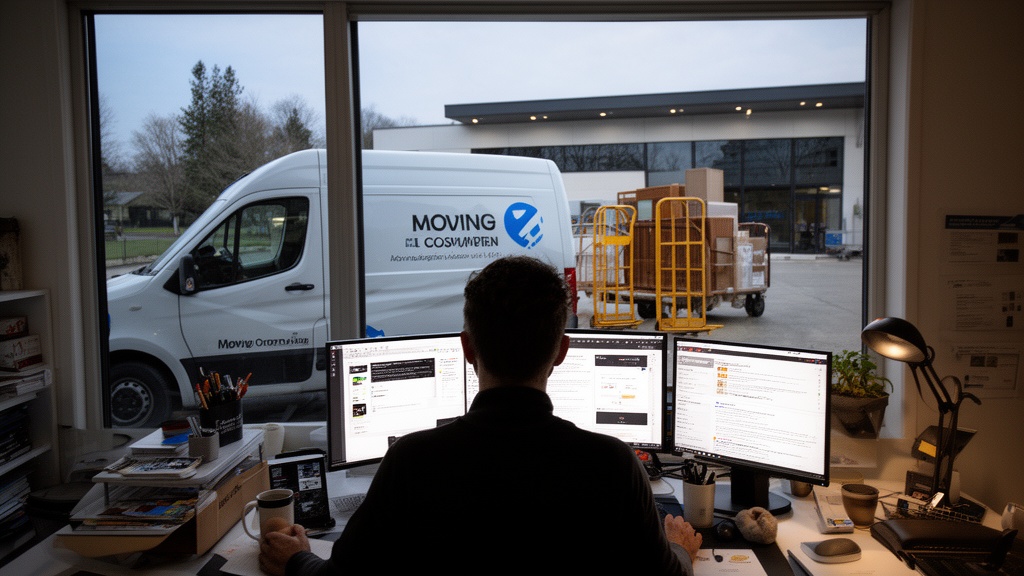
A CRM platform built for moving companies does more than store contact information. It creates a structured pipeline that moves every lead through defined stages: inquiry received, estimate sent, follow-up scheduled, booked, completed, reviewed.
Without a CRM, lead follow-up is inconsistent. Some prospects get called back promptly; others fall through the cracks when the office gets busy. This inconsistency directly suppresses booking rates and means revenue is being left on the table from existing lead volume.
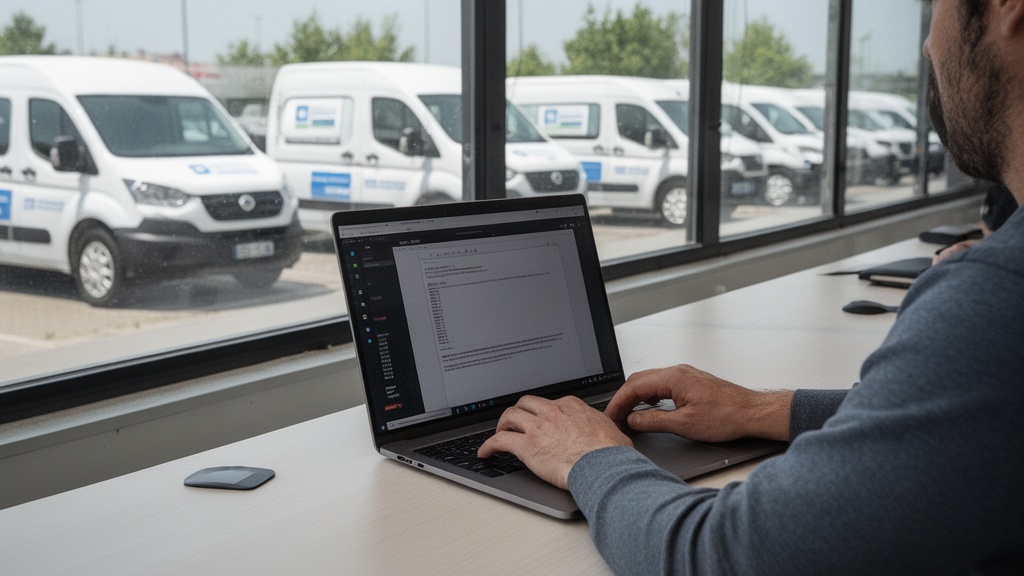
The impact of structured CRM adoption is well-documented. Booking rates climbed from 28% to 41% after implementing structured CRM lead tracking and automated follow-ups — a 13-point gain generated from the same monthly lead volume, with no new acquisition costs.
CRM adoption also surfaces source attribution data that moving companies rarely track manually. One operator discovered that referrals converted at nearly twice the rate of Google Ads leads — a finding that prompted a referral incentive program within 90 days that produced a strong positive return within 60 days of launch. Referral share of leads grew by 19 percentage points over 12 months.
Pro Tip: Configure lead source tracking in the CRM before the first lead enters the system. Most operators assume paid search outperforms referrals on a per-lead basis — source attribution data consistently shows the opposite. Discovering this early reshapes the marketing budget allocation and accelerates the path to positive ROI.
The automation layer within a CRM handles the follow-up cadence without manual intervention. Leads that previously fell through on a busy weekend now receive a structured follow-up sequence automatically. This is how cutting average lead response time from 6 hours to 22 minutes becomes operationally sustainable rather than dependent on individual effort.
Step 4: Automate Scheduling, Dispatch, and Customer Communications
Manual dispatch — coordinating crews by phone, tracking job status on whiteboards, calling customers with arrival windows — is the highest-labor process in most moving operations. Automation here recovers the most staff time and produces the most visible operational improvement.
After implementing automated dispatch, office teams recover 13 hours per week — equivalent to more than half a full-time employee's weekly productive output — without adding payroll headcount. Post-job paperwork time falls from an average of 25 minutes per job to under 8 minutes when crews use mobile apps for real-time status updates.

Automated customer communications add a separate layer of compounding value. Appointment confirmation texts, arrival window updates, and post-move review requests all run without manual effort once configured. This reduces no-show rates and improves customer satisfaction scores simultaneously.
The dispatch layer also generates crew utilization data. A dashboard that flags available scheduling windows when utilization drops below a threshold enables the sales team to prioritize same-week bookings — converting idle crew capacity into revenue rather than letting it expire.
For a category-by-category view of the digital tools for moving companies that belong in each layer of this technology stack, the moving company technology stack guide covers each integration point in practical detail. Moving company software implementation at this layer requires clear crew training before launch — crews who understand that mobile job details eliminate the need to call the office for updates adopt it willingly.
Step 5: Use Data and Analytics to Drive Every Business Decision
Data is the compounding return on digital transformation investment. Every digitized workflow generates structured records. Over months, those records produce patterns that no manual system can surface.
The most actionable analytics outputs for moving operations:
| Metric | What It Reveals | Action It Enables |
|---|---|---|
| Booking rate by lead source | Which acquisition channels convert at the highest rate | Reallocate marketing budget toward high-converting sources |
| Revenue per crew day by job type | Which job categories yield the best margin per hour | Schedule more high-margin jobs during prime crew windows |
| Estimate turnaround time | Speed gap versus local competitors | Identify bottlenecks in the quote delivery process |
| Lead response time | Whether follow-up is timely and consistent | Set automated task triggers for slow initial responses |
| Job cycle time by category | Crew efficiency variation across job types | Optimize crew composition and route sequencing |
One operator used job-type revenue data to shift scheduling from short-notice residential jobs toward long-distance commercial moves — a change that increased revenue per crew day by 18% within 12 months, without crews working additional hours.
The key AI-driven technology trends reshaping the moving industry include predictive analytics for scheduling optimization and demand forecasting tools that improve crew utilization planning. These represent the next capability layer above basic KPI dashboards.
For a broader view of how analytics and AI-powered operations intersect, the resource on transforming the moving industry with AI documents how leading operators use data to maintain competitive separation from slower-moving rivals.
Managing Team Resistance and Change During the Transition

Technology resistance is the most common reason digital transformation stalls in moving companies. Crews accustomed to phone-based dispatch view mobile apps as surveillance. Office staff who have managed leads manually for years see CRM adoption as added work rather than work replacement.
Research from McKinsey consistently identifies people and culture issues — not the technology itself — as the primary barrier to successful digital transformation across industries. Moving companies are no different.
Approaches that consistently reduce resistance:
- Start with a pilot crew. Digitize one crew's dispatch workflow before rolling out company-wide. Early adopters become internal advocates for the rest of the team.
- Frame it as burden reduction. Show crews how mobile job details eliminate the need to call the office for schedule changes, directions, or job updates.
- Involve team leads in tool selection. When dispatch coordinators help choose the scheduling software, resistance drops significantly because they have ownership over the outcome.
- Set a formal 90-day review point. Teams accept new workflows more readily when there is a planned checkpoint to surface concerns before they harden into permanent resistance.
- Celebrate early wins publicly. When the first crew reduces post-job paperwork from 25 minutes to under 8 minutes, share that result across the entire operation.
Moving company technology adoption succeeds when leadership demonstrates the workflow personally — not by mandating compliance from a distance. Prosci's change management benchmarking shows that projects with active and visible executive sponsorship are significantly more likely to meet their stated adoption targets. In a moving company context, this means the owner or operations manager uses the dispatch app personally on day one.
How to Measure Whether Your Digital Transformation Is Working
A successful moving company digital transformation produces measurable results within 90 days of full adoption. The three-phase ROI arc is predictable: time savings materialize first (days 1–60), conversion rate improvements follow (months 2–3), and cost reductions compound as error rates fall in months three and beyond.
| KPI | Pre-Transformation Baseline | 90-Day Target |
|---|---|---|
| Lead response time | 4–8 hours | Under 30 minutes |
| Estimate turnaround | 18–24 hours | Under 2 hours |
| Booking rate | 25–a significant share | 38–a significant share |
| Admin hours per week | 20–25 hours | Under 12 hours |
| No-show rate | 5–8 per month | Under 3 per month |
Operators who track these KPIs consistently report software payback periods of 60–120 days when processing 40 or more jobs per month. Direct monthly savings of approximately USD $1,181 — spanning reduced admin labor, fewer no-shows, lower estimate error rates, and eliminated paper costs — consistently exceed the cost of a software subscription.
If metrics are not improving by day 60, the issue is almost always adoption — staff reverting to old workflows — not the software itself. The remedy is additional training and visible leadership engagement with daily workflow compliance, not a tool change.
Pro Tip: Create a shared KPI dashboard visible to every manager from day one. When booking rate, response time, and estimate turnaround are visible without pulling a report, underperformance surfaces immediately — before it becomes a months-long trend that requires a root cause analysis to untangle.
One documented case study completed full moving company software implementation in three weeks: two weeks of pipeline configuration and data migration, followed by one week of team training. First measurable revenue results arrived in month three. Use this timeline as the resource allocation anchor when planning the transition.
For operators exploring end-to-end platform options, digital solutions for movers covers the full integrated approach that connects estimating, CRM, and dispatch in a single operational workflow.
Related Articles
- Transforming the Moving Industry With AI: What's Changing Now — Understand how AI is redefining competitive dynamics across estimating, dispatch, and customer management in the moving sector.
- AI-Driven Technology in the Moving Industry: Key Trends — A detailed look at the technology trends most likely to reshape how moving companies compete over the next several years.
- Best Moving Company Software: Complete Buyer's Guide — A category-by-category comparison of the leading software platforms for moving operations of every size.
- Best CRM for Moving Companies: In-Depth Comparison — A head-to-head comparison of the top CRM platforms designed specifically for moving company sales workflows.
- AI-Powered Moving Estimates: The Complete Guide for Movers — A practical guide to implementing AI-assisted estimating, from tool selection through team adoption.
Recommended Resources
Ready to see it in action?
Book a free 20-minute demo and explore how Virtual Estimate can help your business.