

The moving industry runs on estimates. Every job starts with one, and the accuracy and speed of that estimate determine whether a moving company wins or loses the booking. AI-powered moving estimates are changing this equation fundamentally — compressing the time from inquiry to quote from days to minutes while improving the consistency that prevents profit-killing surprises on moving day. This guide explains how AI estimation technology works, what it delivers for moving companies, and how to evaluate the tools now available.

| Point | Details |
|---|---|
| Response speed drives conversion | AI estimates deliver in 10–30 minutes vs. 12–48 hours for manual processes — directly impacting close rates |
| Accuracy rivals in-home surveys | AI systems apply standardized weight and cubic footage values, removing estimator-to-estimator variability for standard residential moves |
| Estimator productivity multiplies | Moving companies report handling significantly more virtual estimates per day vs. 3–5 in-home visits — without additional staffing |
| Fewer day-of disputes | Shared, customer-confirmed itemized inventory reduces post-move weight disputes and chargebacks |
| Industry context | The US moving sector is highly fragmented with tens of thousands of active operators — see types of moving estimates and how to choose the right one for a full breakdown of estimate formats |
What Are AI-Powered Moving Estimates?
AI-powered moving estimates use machine learning and computer vision to analyze a customer's inventory — via video walkthrough, photo uploads, or structured questionnaires — and generate a detailed, itemized quote automatically. Unlike traditional estimates requiring a trained estimator to visit the home or manually review footage, AI estimation software processes visual data in real time, cross-referencing item dimensions and weight against a database of thousands of household goods.
The result is a structured estimate: a room-by-room inventory with item counts, total estimated weight, cubic footage, and a price range based on route, crew requirements, and selected service type. These automated moving estimates are typically delivered within minutes of a customer's request.
Two main platform types exist. Most moving estimate software AI operates either as virtual video tools — where the customer records or streams a room-by-room walkthrough — or as AI-assisted questionnaire systems — where structured forms and predictive models generate inventory estimates from customer inputs. Mature platforms combine both approaches for higher accuracy.
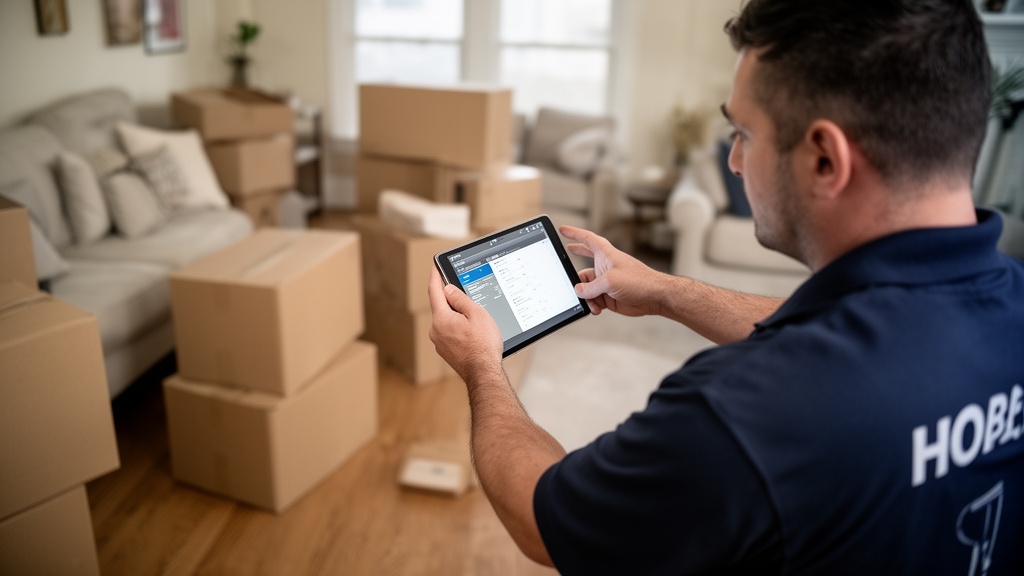
Understanding all estimate options — binding, non-binding, and virtual — is critical context before deploying AI tools. A deep comparison of types of moving estimates and how to choose the right one helps align your AI workflow with the right format for each job type.
How AI Estimation Technology Works for Moving Companies
AI estimation technology for moving companies applies computer vision and natural language processing to every stage of the estimate workflow. Here is the standard process sequence:
- Customer initiates a virtual walkthrough — via smartphone video, upload, or live video call
- Computer vision scans each room — identifying furniture types, approximate dimensions, and item counts
- The AI engine cross-references a trained inventory database — matching detected items to known weight and cubic footage values
- The system generates a structured estimate — with line-item detail, total weight, move complexity score, and price range
- The estimator reviews and adjusts — most platforms allow human override before delivery
- The quote is delivered to the customer — often automated, via email or SMS

The underlying models are trained on large datasets of household item images. Mature AI estimation technology platforms recognize hundreds of distinct furniture types, appliances, and box categories with high confidence. Accuracy improves with every completed move that feeds validated data back into the model.
Pro Tip: Choose a platform that allows estimators to flag exceptions — oversized items, specialty goods like pianos or safes — for manual review. AI handles standard inventory efficiently; experienced estimators add value on the edge cases that affect pricing most.
Moving companies integrating virtual estimate AI are also connecting it to their CRM and lead management systems, creating a seamless workflow from initial inquiry to confirmed booking without manual data re-entry.
AI vs. Manual Estimates: Accuracy, Speed, and Cost Compared
The case for AI estimation rests on three measurable dimensions: accuracy, speed, and cost-per-estimate. Understanding these trade-offs clearly is the starting point for any deployment decision.

Accuracy. Manual estimates vary based on the individual estimator's experience and attention. AI-generated estimates pull from a standardized, continuously updated database — removing the variability introduced when different estimators assess identical inventory differently. The primary accuracy driver for AI is the quality of the customer's video or photo input. Platforms with guided capture workflows (step-by-step prompts walking customers through each room) significantly reduce poor-quality submissions.
Speed and lead conversion. Research published in Harvard Business Review found that companies responding to inquiries within one hour are seven times more likely to qualify the lead than those waiting even two hours. For moving companies, this is direct: a customer receiving an AI estimate within 10 minutes of their inquiry is far more likely to book than one waiting for a next-morning callback.
Cost per estimate. Manual in-home estimates require a trained estimator, travel time, and scheduling coordination. AI-powered virtual estimates reduce this overhead substantially. Moving companies processing estimates at scale report that AI-assisted workflows allow the same estimating team to review many more leads per day — without proportional staffing increases.
| Metric | Manual In-Home Estimate | AI-Powered Virtual Estimate |
|---|---|---|
| Time to deliver | 1–3 days (scheduling + travel) | 10–30 minutes |
| Estimator travel required | Yes | No |
| Scalability | Limited by staff capacity | Scales with lead volume |
| Consistency | Varies by estimator | Standardized across all jobs |
| Customer convenience | Low — requires home visit | High — self-serve video on any device |
| Cost efficiency at scale | Higher per estimate | Lower per estimate at volume |
For moving companies evaluating their full technology stack and software options, AI estimation ranks among the highest-ROI technology additions available today.
Key Benefits of AI-Powered Estimates for Your Moving Business
The operational benefits of AI moving estimates extend well beyond faster quotes. Moving companies deploying them systematically report improvements across four core areas.
1. Higher lead-to-booking conversion rates. Speed is the primary driver. Customers soliciting moving quotes typically contact three to five companies simultaneously. The company that responds with a detailed, professional estimate first captures a disproportionate share of bookings.
2. Reduced day-of disputes. Detailed AI estimates include itemized inventory that the customer reviews and confirms before move day. This shared documentation reduces "I didn't know that was extra" disputes — a major driver of negative reviews and chargebacks in the moving industry.
3. Scalable capacity during peak season. Manual estimation creates a capacity ceiling. During summer peak, a company limited to a fixed number of in-home estimates per day turns away leads beyond that ceiling. AI-assisted virtual estimates remove this constraint, allowing companies to quote every inbound lead regardless of volume spikes.
4. Better pricing accuracy. Consistent inventory methodology produces more accurate weight and cubic footage estimates, which translates to better job costing, fewer underpriced jobs, and improved margins. See pricing strategies for moving companies and how to maximize profitability for more on how AI-powered estimation accuracy connects directly to bottom-line performance.
Pro Tip: Track estimate-to-book conversion rate separately for AI-assisted estimates versus manual estimates during the first 90 days after deployment. This single metric tells you more about the technology's real ROI than any vendor benchmark.
Connecting AI estimation to AI-powered moving estimate solutions that include integrated booking and payment capabilities removes the final friction point between quote delivery and confirmed job.
How to Use AI Estimates to Win More Moving Jobs
Winning more moving jobs with AI estimation isn't just about speed — it requires deploying the technology strategically across the full sales funnel. High-performing moving companies are applying it in three specific ways.
Instant-response lead capture. The most effective deployment connects AI estimation directly to the company's website inquiry form. When a customer submits a move request, the AI workflow launches automatically — prompting a guided video walkthrough or questionnaire — and delivers a preliminary estimate within minutes. This eliminates the "we'll call you to schedule" step that leaks leads before first contact.
Professional estimate presentation. AI-generated estimates arrive as structured documents with room-by-room breakdowns, service options, and clear pricing. This level of presentation signals organizational quality — a significant trust signal for customers committing to a major life event with a company they've never used.
Behavior-triggered follow-up. Customers who receive an instant moving quote via AI but haven't booked within 24 hours can be automatically flagged for personalized follow-up. Digital marketing strategies for moving companies increasingly incorporate behavior-triggered outreach that consistently outperforms generic drip campaigns.

Understanding how to conduct a virtual pre-move survey step by step is the operational skill underlying every AI estimate deployment. Estimators who know how to guide customers through a quality video walkthrough consistently get better AI outputs and more accurate final quotes.
McKinsey's research on AI in customer-facing workflows documents that businesses embedding AI into quote generation and lead management report faster sales cycles and higher customer satisfaction than those using AI only in back-office functions.
What to Look for in AI Moving Estimate Software
Not all moving estimate software AI delivers equally. Moving company operators should assess these criteria when evaluating platforms:
| Evaluation Criterion | What to Look For |
|---|---|
| Computer vision accuracy | Platform trained on diverse real-world household environments, not just staged demo footage |
| Guided capture workflow | Step-by-step prompts that help customers provide usable video or photo input |
| Estimator override capability | Human review and adjustment available before every quote delivery |
| Integration depth | Native connection to CRM, booking system, and payment platform |
| Mobile-first design | Customer-facing tools work on any smartphone with no app download required |
| Data security | Customer video and inventory data handled with appropriate encryption standards |
| Reporting and analytics | Conversion tracking, estimate accuracy reporting, and revenue attribution built in |
Beyond accuracy, the best platforms include workflow automation — automated estimate delivery, follow-up scheduling, and booking confirmation — that reduce the manual coordination burden on your sales team.
Pro Tip: Request a pilot with your own move data before committing to any platform. Run 20–30 AI-assisted estimates alongside your current process and compare the outputs side by side. Real performance data from your own leads beats any vendor demo scenario.
Explore AI-powered moving estimate solutions that bundle estimation, CRM, and booking automation in a single integrated workflow. The Virtual Estimate AI platform is designed specifically for moving companies and covers virtual survey, AI estimation, and automated lead management in one system.
Real-World Results: What Moving Companies Are Experiencing
The adoption curve for AI estimation in the moving industry is accelerating. Companies that implemented virtual moving estimates report measurable gains in three areas.
Lead response time. Companies previously taking 12–24 hours to deliver estimates are now delivering them within 15–30 minutes. Given that research consistently shows lead intent drops sharply within the first hour of inquiry, this speed improvement translates directly to more booked jobs without increasing lead spend.
Estimator productivity. The most consistent operational benefit is a structural increase in estimates processed per day without additional hiring. Estimators shift from conducting a handful of in-home visits daily to reviewing and approving a much larger number of AI-generated virtual estimates — fundamentally changing per-person output capacity.
Reduction in post-move disputes. Moving companies using AI estimation with customer-confirmed inventory reports see fewer day-of weight disputes, because the customer reviewed and approved the itemized list before move day — creating a shared record that both parties reference.
The moving company CRM complete operations guide covers how companies integrate AI estimates into broader operations systems to capture the full efficiency gain across the booking-to-delivery workflow.
Reducing moving costs with AI technology extends beyond the estimate itself — AI-driven job costing and routing optimization compound the savings from more accurate initial pricing.
MIT Sloan Management Review's research on artificial intelligence in business operations documents that companies deploying AI in customer-facing processes consistently report improved satisfaction metrics within the first year of implementation — a pattern that aligns with what early-adopting moving companies are experiencing in the field.
How to Get Started With AI-Powered Moving Estimates
Implementing AI estimation doesn't require a full technology overhaul. The path to adoption follows four clear stages.
Audit your current estimate workflow. Map each step from lead receipt to quote delivery. Identify the bottlenecks — usually scheduling coordination and manual data entry — that AI eliminates entirely.
Evaluate 2–3 platforms. Focus on platforms built specifically for the moving industry rather than generic AI tools. Industry-specific training data produces significantly better item recognition for household goods than general-purpose computer vision.
Pilot with a defined lead segment. Start with inbound website inquiries or a specific service type (local moves, for example). Run the AI workflow in parallel with your standard process for 30 days before committing to full deployment.
Train your estimating team. AI estimation shifts the estimator's role from data collector to reviewer and advisor. Train your team on guiding customers through quality video walkthroughs and handling edge cases — specialty items, complex access situations — that the AI flags for human review.
The customer experience implications of moving to virtual estimates are worth understanding before full rollout. For most customers, a guided virtual survey is more convenient than an in-home visit — but how you communicate the change matters significantly for adoption.
According to the American Trucking Associations, the moving and storage segment is one of the most fragmented in the transportation services industry. In a market this competitive, the moving companies deploying AI estimates moving jobs forward — with instant responses and professional presentation — are building a structural advantage over those still relying on next-day manual processes.
Related Articles
- Types of Moving Estimates: Choosing the Best Option — Compare binding, non-binding, and virtual estimate formats to choose the right approach for each job type.
- How to Conduct a Virtual Pre-Move Survey: Step-by-Step Guide — Practical guide for running effective virtual surveys that feed accurate AI-generated estimates.
- CRM for Moving Companies: Streamline Operations — How integrating CRM with AI estimation creates a seamless lead-to-booking workflow.
- Pricing Strategies for Moving Companies: Maximizing Profitability — How AI-powered estimation accuracy connects to stronger pricing decisions and margin improvement.
- Customer Experience Excellence in Moving Services — Why virtual estimates and fast response times are now central to customer satisfaction in the moving industry.
Recommended Resources
- Virtual Estimate AI — Platform Overview — Explore the full feature set for moving company AI estimation, virtual surveys, and automated lead management.
- AI Estimation Solutions for Moving Companies — Detailed breakdown of AI-powered estimation solutions built specifically for the moving industry.
- Types of Moving Estimates: Choosing the Best Option — Compare binding, non-binding, and not-to-exceed estimates alongside virtual formats.
- How to Conduct a Virtual Pre-Move Survey: Step-by-Step Guide — Operational guide for running virtual surveys that produce accurate AI estimate inputs.
- How to Reduce Moving Costs With AI Technology — How AI tools lower per-move operating costs beyond just the estimation phase.
Ready to see it in action?
Book a free 20-minute demo and explore how Virtual Estimate can help your business.