

Most moving companies track revenue in a spreadsheet and call it analytics. That gap between data collection and actual decision-making is exactly where growth stalls. Moving company CRM analytics—converting customer interactions, pipeline activity, and operational data into measurable business intelligence—is the practice separating high-growth operators from stagnant ones. This composite case study, based on patterns observed across regional movers using modern CRM platforms, shows how one operator went from gut-feel decisions to data-driven execution and grew revenue by 40% in 12 months.

| Point | Details |
|---|---|
| Lead Response Time | Cutting average response time from 6 hours to 22 minutes was the single highest-leverage change in the case study. |
| Booking Rate Improvement | The booking rate climbed from 28% to 41% after implementing structured CRM lead tracking and automated follow-ups. |
| Revenue Per Crew Day | Optimizing job mix based on CRM data increased revenue per crew day by 18% within 12 months. |
| Total Revenue Growth | Combined improvements across conversion, lead quality, and job value delivered 40% revenue growth within 12 months. |
| Explore CRM Options | The best CRM for moving companies guide compares top platforms with moving-specific analytics features. |
Company Background: A Regional Mover With Big Ambitions
The company at the center of this case study is a composite portrait — a mid-size residential and commercial mover operating in a single metropolitan market. At the start of the study period, the business ran four crews, employed 18 full-time staff, and generated approximately $1.2 million in annual revenue. By most measures, it was a functioning, profitable operation.
But the ceiling was close. The company processed roughly 300 inbound leads per month, yet only a fraction converted to booked jobs. The American Moving & Storage Association represents an industry where many operators still rely on experience and instinct over structured analytics. Every hiring decision, marketing spend, and process change at this company was driven by intuition rather than data.
The owner recognized the core problem: without visibility into why leads were converting or dropping, scaling the business meant scaling the guesswork.
The Problem: Decisions Based on Gut Feeling, Not Data
The absence of structured crm data for moving companies created three specific pain points that compounded over time.
First, lead follow-up was inconsistent. New inquiries landed in a shared inbox and were handled whenever time allowed. Average lead response time: 6 hours. Research on B2B sales lead response published by Harvard Business Review shows that companies responding within the first hour are significantly more likely to reach a qualified prospect. For movers competing in real time — where prospects submit the same inquiry to several companies simultaneously — a 6-hour average response is a structural disadvantage.
Second, there was no pipeline visibility. The team knew their booking rate felt low, but without defined stages, they couldn't identify whether prospects were ghosting during estimates, failing to respond to follow-ups, or choosing competitors on price. The problem was invisible.
Third, job profitability was a black box. Revenue per job was tracked, but crew utilization, drive time, and job-type mix were not measured. High-margin days and low-margin days looked identical on the books.
Pro Tip: Before deploying any CRM, map your lead lifecycle on a whiteboard — from first contact to signed contract. This exercise reveals exactly where deals are dying and defines the pipeline stages your CRM needs to track and enforce.
The Solution: Deploying CRM Analytics Across the Business
The operator implemented a Virtual Estimate CRM platform with built-in analytics tailored to moving operations. Implementation took three weeks: two weeks of pipeline configuration and data migration, one week of team training.
The structural shift was pipeline discipline. Every inbound lead entered a five-stage pipeline with timestamped progression: New Lead → Estimate Sent → Follow-Up → Booked → Completed. Each stage transition triggered an assigned task for the sales coordinator. No lead advanced without a logged action.
This was not a technology problem at its root. It was a process problem made visible and enforceable by technology. The CRM didn't close deals — it revealed exactly which stage needed human attention and held the team accountable for acting on that information consistently.

Virtual Estimate can help: Moving companies using Virtual Estimate get purpose-built CRM analytics that track lead sources, conversion rates, and revenue per job in one dashboard — without adapting generic enterprise software to fit moving operations. Learn more →
Key Metrics They Started Tracking From Day One
Moving company lead tracking data formed the foundation of the entire transformation. On day one, the team committed to capturing five core metrics for every lead. Tracked consistently over 12 months, these metrics became the engine behind every operational improvement that followed.
| Metric | Definition | Initial Target |
|---|---|---|
| Lead Response Time | Minutes from inquiry to first outbound contact | Under 30 minutes |
| Estimate-to-Booking Rate | % of sent estimates that convert to booked jobs | Above 35% |
| Lead Source Attribution | Channel that generated each lead | Track all sources |
| Revenue Per Crew Day | Total revenue ÷ total crew days worked | Establish baseline |
| Follow-Up Attempts Per Lost Lead | Outreach count before marking a lead lost | Minimum 3 attempts |
Source attribution was among the first actionable insights. It revealed that Google Ads produced high lead volume but lower conversion rates, while referrals converted at nearly twice the rate of paid leads. That single finding shifted budget toward a structured referral incentive program within the first 90 days.
Moving business growth analytics is not just about having a dashboard. The team held weekly 15-minute CRM reviews — not to celebrate metrics, but to identify leads requiring immediate action before they expired. Consistency in reviewing data mattered as much as the data itself.
Pro Tip: Track lead age — the number of days each lead has spent at its current pipeline stage without progression. Any lead older than 72 hours in the Estimate Sent stage should receive a direct call from the owner or senior estimator, not another automated follow-up email.

Results After 12 Months: Revenue, Bookings, and Lead Quality
The 12-month results demonstrated what consistent moving company revenue analytics delivers when applied at the operational level.
The most dramatic change was lead response time. CRM task assignments and mobile notifications cut average response from 6 hours to 22 minutes. Booking rate climbed from 28% to 41% — a 13-point gain that translated directly into additional booked jobs from the same monthly lead volume, with no new acquisition sources required.
| KPI | Month 1 Baseline | Month 12 Result | Change |
|---|---|---|---|
| Avg. Lead Response Time | 6 hours | 22 minutes | −94% |
| Booking Rate | 28% | 41% | +46% relative |
| Revenue Per Crew Day | Baseline index | +18% above baseline | +18% |
| Monthly Revenue | ~$98,000 | ~$137,000 | +40% |
| Referral Share of Leads | 12% | 31% | +19 percentage points |
Revenue per crew day increased 18% — not because crews worked harder, but because crm insights moving industry data revealed which job types yielded the best margin per hour. Long-distance commercial moves generated measurably higher revenue per crew day than short-notice residential jobs. Scheduling decisions shifted to reflect that pattern.
Monthly revenue climbed from approximately $98,000 to $137,000 — a 40% increase with the same core team, the same lead volume, and no significant change in total marketing spend.
Try Virtual Estimate's analytics dashboard: Moving operators using Virtual Estimate can see lead-to-booking conversion by source, crew utilization data, and revenue per job updated in real time — all in one crm dashboard for movers built around how moving operations actually work. Get started →
What Their CRM Analytics Dashboard Looks Like Today
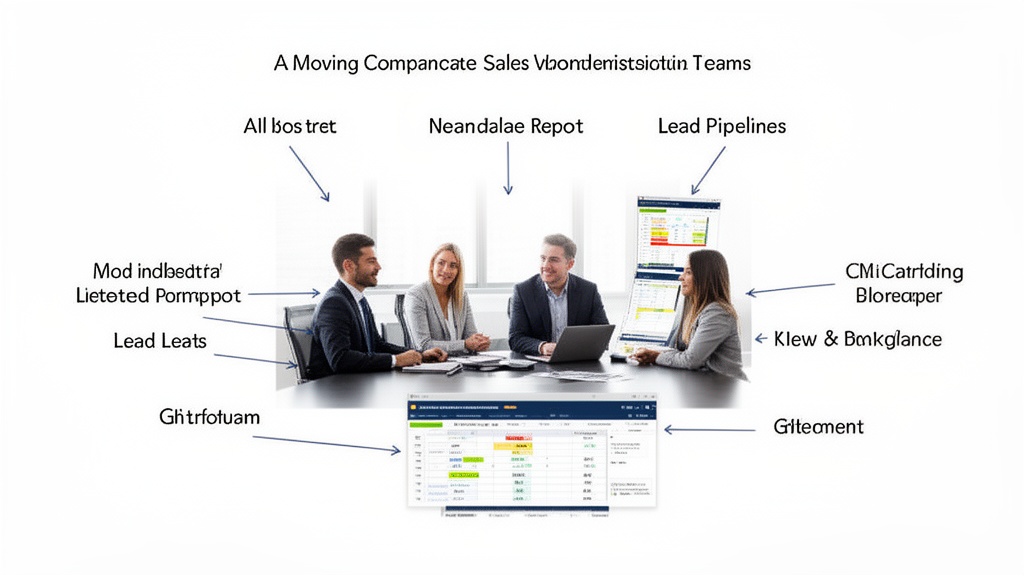
CRM reporting for movers evolved from a reactive monthly review into a daily operating rhythm. The dashboard the team uses today runs on four panels, accessible to both the owner and sales coordinator from any device.
Panel 1 — Pipeline Health: Displays lead count and estimated job value at each pipeline stage, plus median days per stage. Any stage showing a median age over 48 hours highlights automatically, prompting immediate action before leads go cold.
Panel 2 — Source Performance: Compares booking rate, average job value, and lead volume by acquisition channel. Google Ads, referrals, Yelp, and direct website traffic each have dedicated rows with live conversion data updated weekly.
Panel 3 — Revenue Forecast: Projects monthly revenue 30 days forward using booked jobs and historical average job values. This replaced the owner's previous forecasting approach: adding up deposits and estimating the rest.
Panel 4 — Crew Utilization: Plots crew days deployed against revenue generated. When utilization drops below 80%, the system flags available windows for the sales team to prioritize same-week booking outreach.

This is what a mature crm dashboard for movers looks like: not a data repository, but a decision engine. Each panel answers exactly one operational question and connects directly to a concrete action.
Pro Tip: Build your dashboard around decisions, not data. Before adding any panel, ask: "What specific action will I take based on what I see here?" If the answer is unclear, remove it from the primary view and track it separately.
Three Lessons Every Moving Company Can Apply Right Now
Three consistent patterns emerge from crm insights moving industry deployments like this one. These hold regardless of company size or platform.
Lesson 1: Lead response time is the single highest-leverage variable. Nothing in this case study produced faster returns than cutting response time from 6 hours to 22 minutes. No new marketing channel or pricing adjustment matched that single operational change. In a market where prospects contact multiple movers at once, the company that responds first wins the conversation.
Lesson 2: Attribution data changes where money is spent. Without source tracking, every marketing budget decision is guesswork. This operator's CRM data revealed that referrals converted at nearly twice the rate of paid search leads. That finding justified a structured referral incentive program — a modest per-referral reward that produced a strong positive return within 60 days of launch.
Lesson 3: Revenue per crew day is the real growth metric. Total revenue can climb while margins compress. Revenue per crew day exposes that dynamic immediately. When this metric climbed 18%, it reflected better revenue — higher-margin jobs matched to crew capacity, scheduled during productive windows, priced against actual job complexity.
These lessons apply to any deployment of moving company analytics solutions. The platform matters less than the commitment to reviewing data consistently and acting on what it shows.
How Virtual Estimate Powers Moving Company CRM Analytics
The Virtual Estimate CRM platform is purpose-built for moving operators — not adapted from generic enterprise software. The analytics module includes pipeline tracking with moving-specific stage definitions, automated lead response task assignment, source attribution reporting, revenue-per-job tracking, and crew utilization forecasting as native, out-of-the-box features.
For operators evaluating the investment, view CRM pricing for moving companies — plans scale by company size and crew count, making purpose-built analytics accessible whether the operation runs two crews or twenty.

The gap between spreadsheet-based management and CRM-powered growth is not a technology gap. It is a decision gap. The data exists in every moving operation. The question is whether it gets captured, structured, and reviewed consistently enough to change behavior week over week.
The operator in this case study answered that question with 12 months of disciplined moving company crm analytics practice. The result — 40% revenue growth with the same team and the same lead volume — shows what becomes possible when operational data moves from intuition to infrastructure.
See how Virtual Estimate works for your operation →

Related Articles
- Best CRM for Moving Companies: In-Depth Comparison — Compare top CRM platforms built for moving operators, with feature breakdowns and pricing tiers.
- CRM for Moving Companies: Streamline Operations — How CRM software transforms day-to-day operations across dispatch, sales, and customer management.
- Moving Company CRM: Complete Operations Guide — A comprehensive guide to implementing CRM across every function of a moving business.
- Digital Marketing Strategies for Moving Companies — How to attract more qualified leads through search, social, and referral channels.
- Pricing Strategies for Moving Companies: Maximizing Profitability — Data-driven pricing methods that increase revenue per job without losing competitive positioning.
Recommended Resources
- Virtual Estimate CRM Platform — Purpose-built CRM with moving-specific analytics, pipeline tracking, and revenue reporting.
- Pricing — Virtual Estimate — Plans sized for moving companies at every growth stage.
- Solutions — Virtual Estimate — Full suite of moving company operations and analytics tools.
- CRM for Moving Companies: Streamline Operations — How top operators use CRM to reduce admin overhead and increase repeat customer rates.
Ready to see it in action?
Book a free 20-minute demo and explore how Virtual Estimate can help your business.