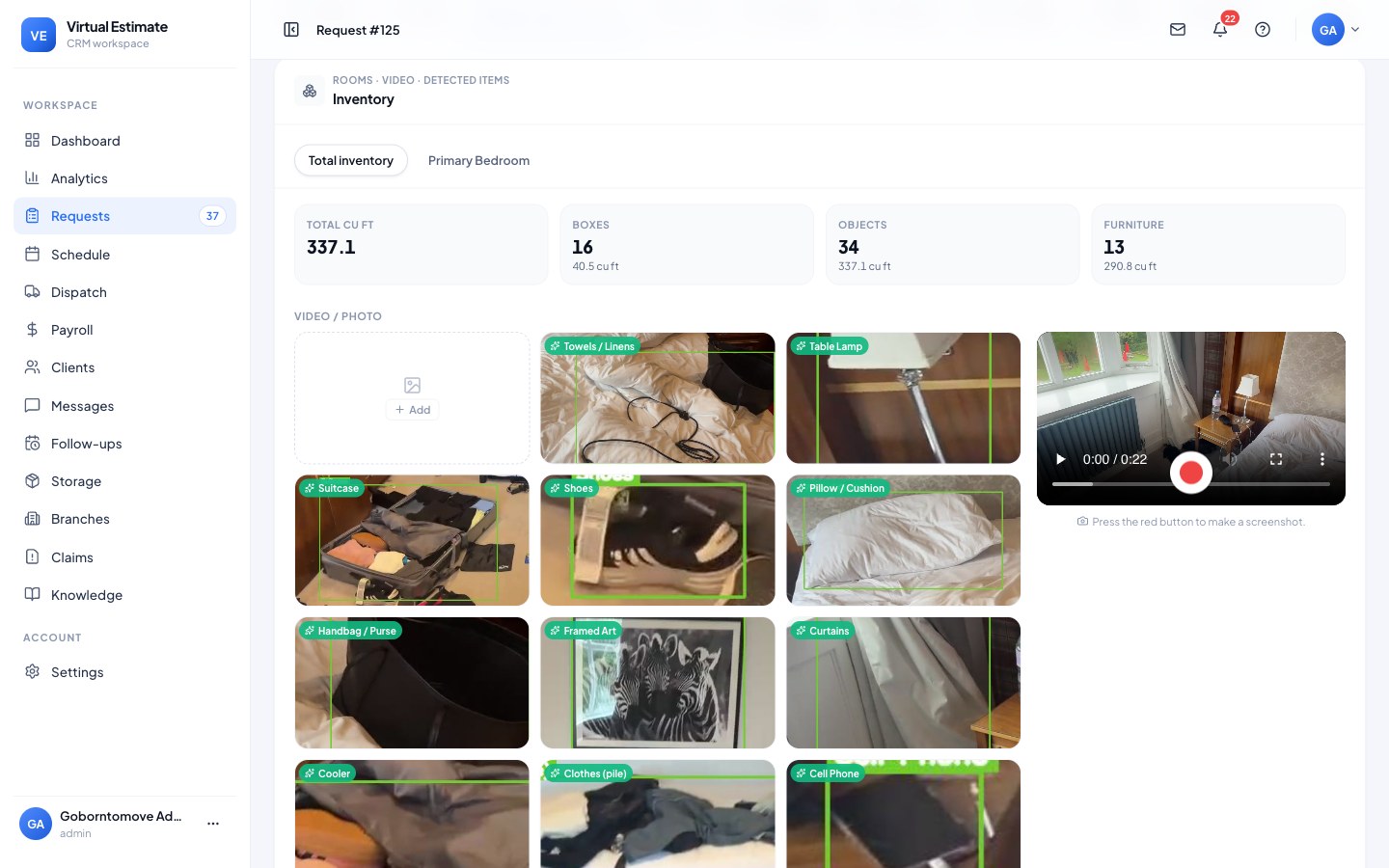
AI Video Estimate
Turn a customer's phone video into a measured, itemized inventory and a priced estimate — the same session, without sending anyone to the house.
AI that measures — not just shows.
Your customer records a short walk-through from a text link. The AI detects every item, measures real cubic feet, and builds a priced inventory — no appointment, no eyeballing, the same quote every time.
A quote from a phone video — no appointment.
Send a link by text. The customer films each room while an on-screen coach keeps the footage steady and well-lit. That's the whole ask — no app to install, no estimator in a truck.
- ✓Guided room-by-room walk-through
- ✓Works on any phone, nothing to install
- ✓Handles partial moves & packing-only jobs
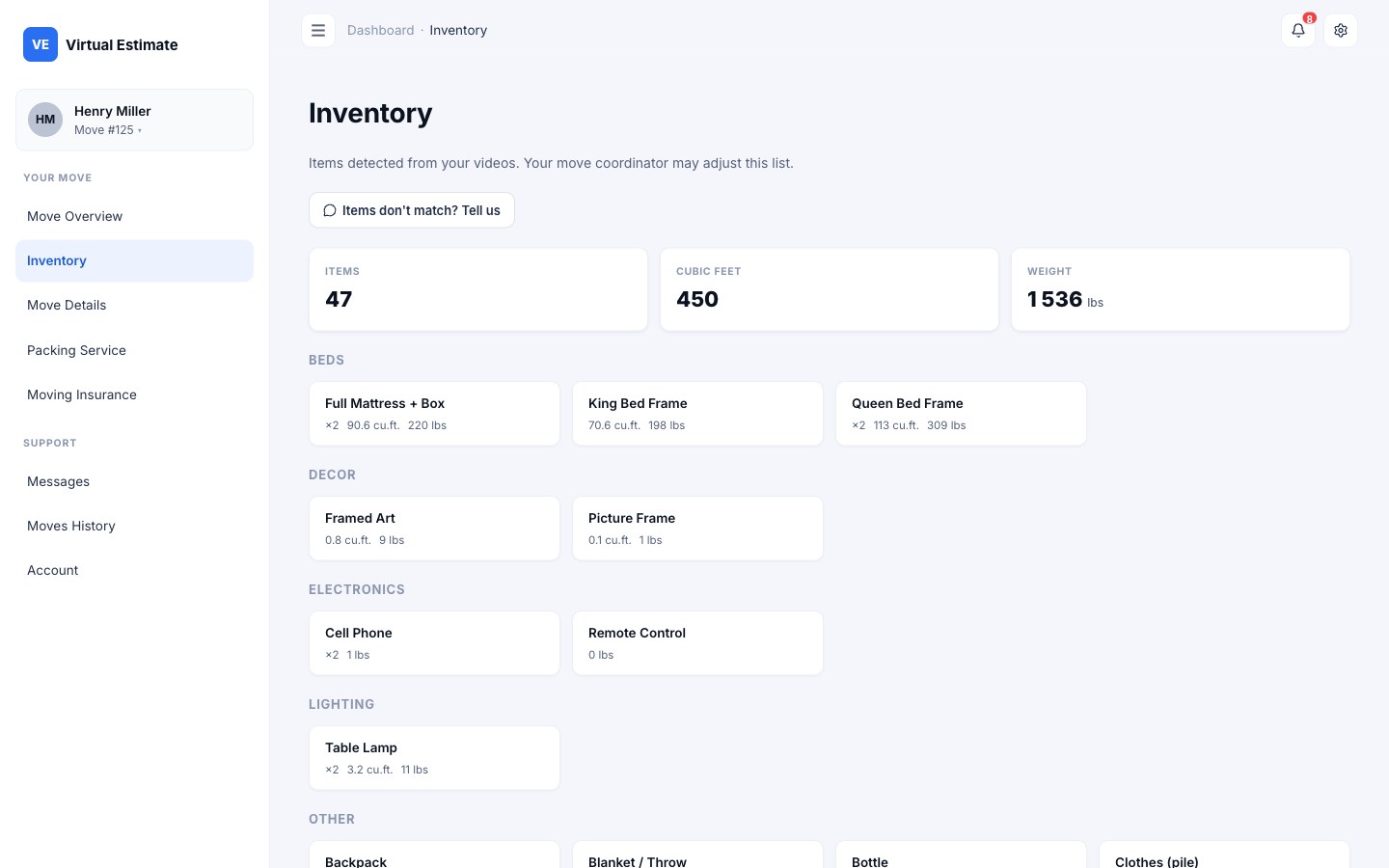
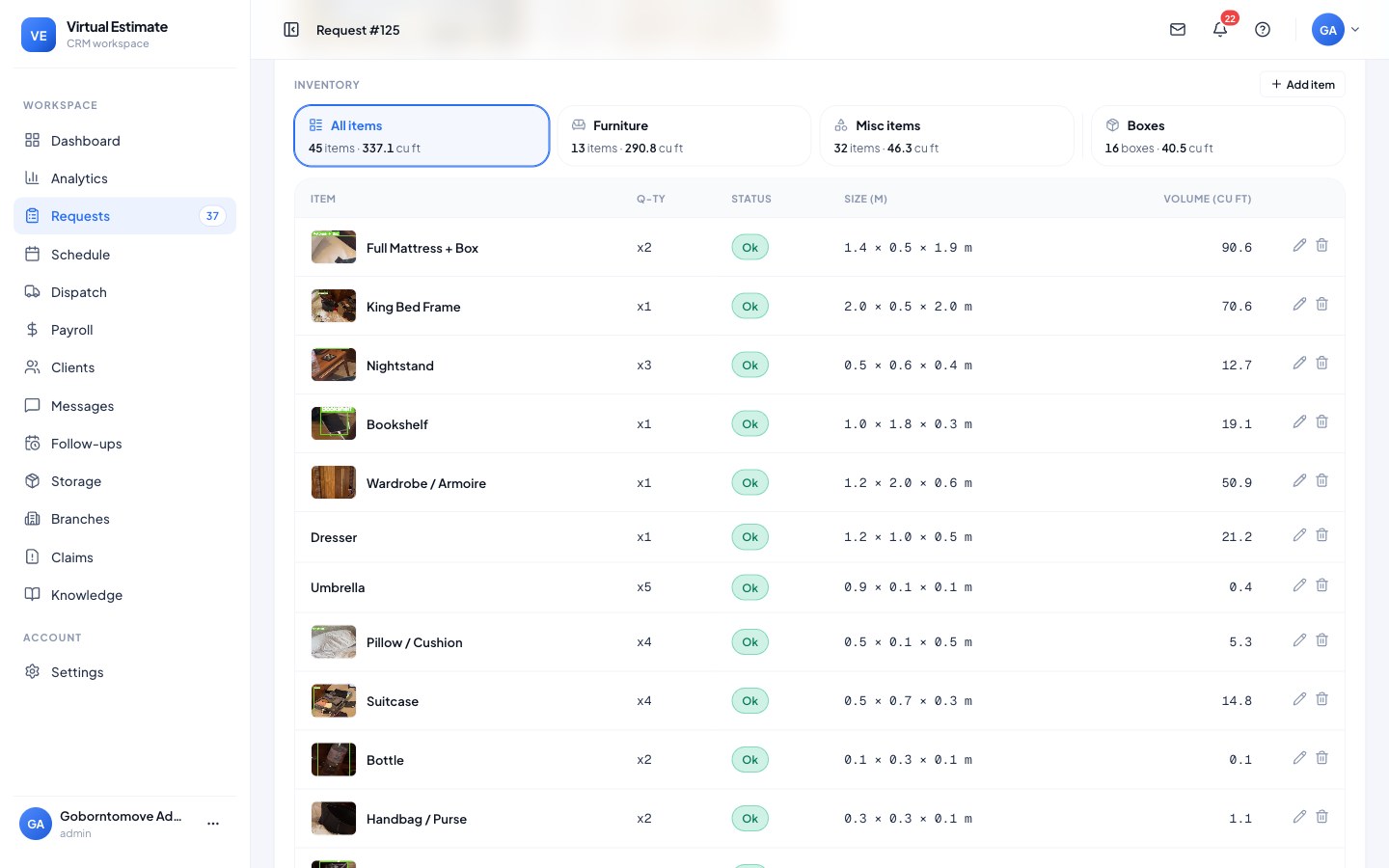
Measured inventory that flows into the contract.
The AI returns an itemized, measured inventory and an auto-calculated quote. It prefills the Bill of Lading, so your estimate and your paperwork are the same data — never re-keyed.
- ✓Itemized cube by room
- ✓Auto-priced against your tariffs
- ✓Inventory prefills the DOT Bill of Lading
From first touch to done — without re-keying a thing.
What AI Video Estimate does for your business.
Turn a lead into a priced quote the same day — no site visit.
The same video yields the same number, every rep, every time.
Real cubic feet instead of a phone guess that under- or over-quotes.
Respond first, while the lead is still warm.
Most "video estimates" still come down to a person watching a call or a clip and typing items into a cube sheet. This is different. The customer films each room from their phone, and the platform detects, measures and prices every item automatically — then hands your manager a reviewable inventory, not a video to sit through.
How it works
The customer opens a link from a text message — no app, no login — and films the rooms. From there the platform runs a multi-model pipeline on the footage:
- Detects the objects in each room and measures their real dimensions using metric depth estimation.
- Self-calibrates against objects of known size in the frame — a doorway, a fridge, an outlet — instead of guessing from a single constant.
- Verifies each item with a vision-language model that confirms the category and reads its color, material and condition.
- De-duplicates the same couch seen across dozens of frames into one item, then matches it to a catalog of 98 reference pieces with real dimensions, cubic volume and weight.
- Prices the move from the measured inventory, packing and complexity — and drops a thumbnail on every item so your manager can confirm the list in seconds.
Every room video has a hard 10-minute analysis budget, so quotes come back the same session — not the next day.
What you get
- A four-model AI pipeline — detection, metric depth, vision-language verification and 3D reconstruction — not a single classifier guessing labels.
- Measured dimensions, not a cube sheet. Volume comes from each specific item's size, not an average for the room.
- A 98-item furniture catalog across 10 categories, each with min/avg/max dimensions, weight and move complexity flags (fragile, needs disassembly, special handling).
- Item attributes read automatically — color, material and condition, the details an estimator normally writes by hand.
- A thumbnail on every item, so a manager reviews the inventory in about 20 seconds instead of re-watching the video.
- Device-aware capture. An iPhone and an Android flagship have different camera geometry — the platform measures against each one correctly rather than assuming one lens.
- Deterministic pricing. The same video produces the same number every time, so you can lock a price before you send it. No "manager A quoted $1,400, manager B quoted $2,100."
- The inventory flows into the contract. The AI item list pre-fills the DOT Bill of Lading — no re-typing between the estimate and the paperwork.
Why it beats a plain "video estimate"
Most video-estimate tools on the market are a video call or a recording that a person still has to eyeball and count. The inventory is built by hand; the volume is an average from a table. Here the objects are detected, measured and priced automatically, the estimate is repeatable, and the same data becomes the Bill of Lading — instead of a manual re-entry between the quote and the truck.
The numbers
- 10-minute hard analysis budget per room video — same-session quotes.
- 12-step, 4-model pipeline on every video.
- 98 reference furniture items across 10 categories, with measured dimensions and weight.
- Compared with a typical on-site estimate — an estimator's round trip plus a day of scheduling — this is a link in a text and an answer the same day.
The AI measures each item's dimensions from the video and converts them to cubic volume with one consistent method, so the estimate is repeatable and consistent between managers — the same video always produces the same number. Every item carries a thumbnail, and your manager confirms or edits the inventory before it goes to the customer.
The inventory is a reviewable list, not a black box. Your manager sees every detected item with a thumbnail and can add, remove or edit before sending, and the customer can fix counts, add a missed item and approve the list from their own account. De-duplication across frames stops the same couch being counted many times.
No. Filming happens in the phone browser from a link in a text message — no install, no password.
Analysis of a room video is capped at 10 minutes and rooms process in parallel, so a manager gets the inventory the same session rather than the next day.
No — the customer films ordinary HD video on any phone. The 3D model of the room is built by AI from the video and a depth map; there's no special hardware to buy.
One platform — every part of the move.
Virtual Survey
Replace the in-home walkthrough. Your customer films their own rooms from a link and answers the logistics an...
Estimate Software
Your rates, your rules — one calculator for local, long-distance and everything in between. The estimate auto-...
Dispatch & Scheduling
One board for every truck, crew and job — with conflict protection, calendar sync, and a foreman app that carr...
Ready to put AI Video Estimate to work?
Turn a customer's phone video into a measured, itemized inventory and a priced estimate — the same session, without sending anyone to the house.