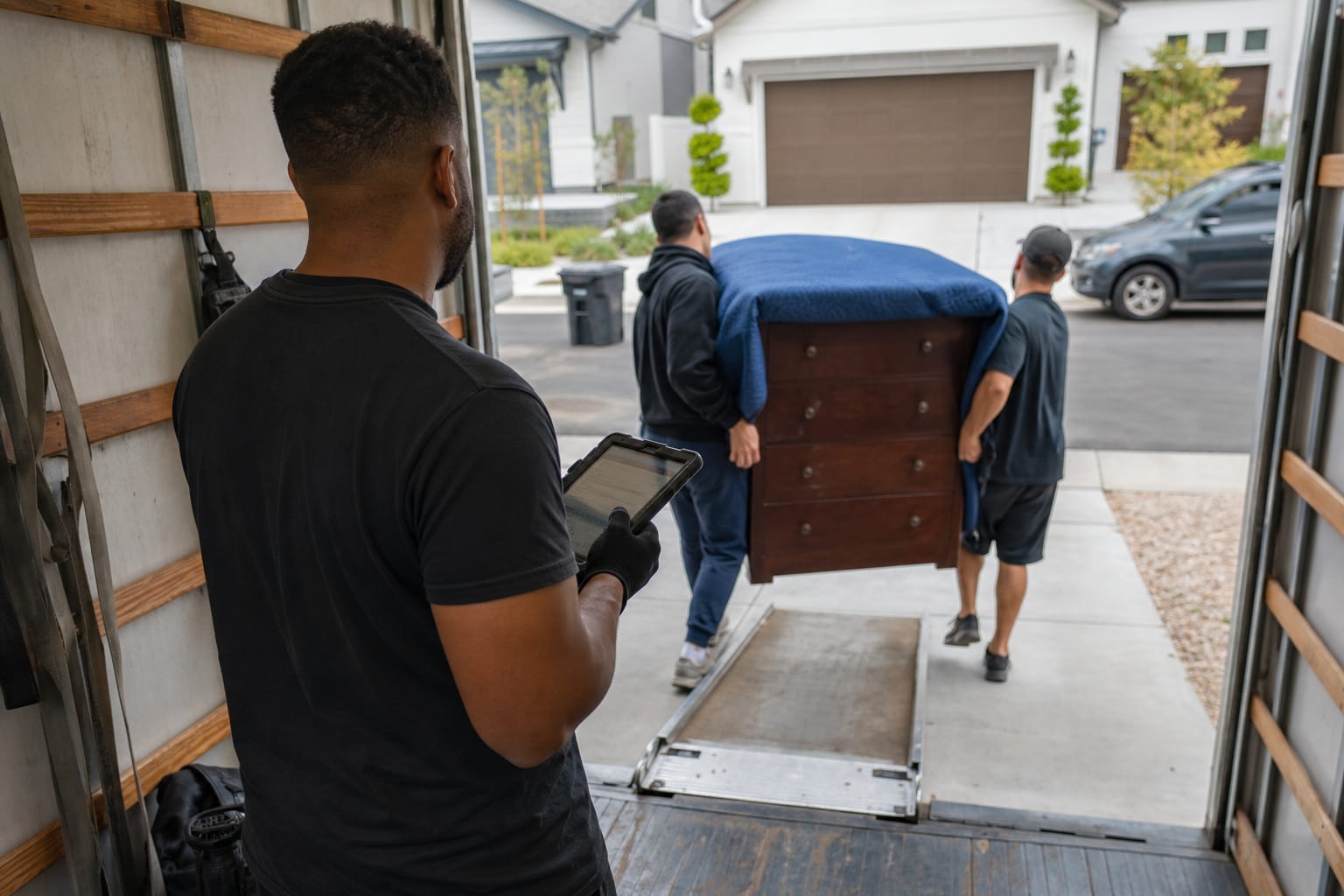

A video-based moving estimate lets a moving company price a job by having the customer film their belongings on a smartphone, then measuring that footage—usually with AI—to build the quote without ever sending an estimator to the home. It replaces the in-home walkthrough and the live video call with a short recording the customer sends on their own schedule. This guide breaks down exactly how the process works, why it produces more consistent quotes, and how it frees up hours each week for local moving companies.
The old model has a cost problem. Every in-home survey means a round-trip drive, a scheduled appointment, and an estimator pulled off other work. A video moving estimate removes all three. Below is the full workflow, step by step.
Key Takeaways
| Point | Details |
|---|---|
| Definition | A video moving estimate prices a job from a customer-recorded walkthrough, replacing the in-home visit and live video call. |
| Universal access | 97% of U.S. adults own a cellphone, so nearly every customer can film a room-by-room video. |
| Consistency | AI converts furniture into a cubic feet moving quote, removing the guesswork of eyeball estimates. |
| Time saved | Estimators can reclaim an estimated 5–10 hours a week otherwise spent driving to walkthroughs. |
| Compliance | The measured inventory feeds directly into the FMCSA-required bill of lading. |
Why in-home and video-call walkthroughs are costing movers jobs

Speed wins moves. Customers request several quotes at once, and the mover who answers first with a firm number usually books the job. In-home surveys and scheduled video calls both introduce delay—and delay loses deals.
Consider the friction of a traditional in-home estimate. The customer takes time off work. The estimator drives across town, often 30 to 60 minutes each way. If the customer reschedules, the whole cycle repeats.
Live video calls fixed the drive but kept the calendar problem. Both parties still have to be free at the same moment, and no-shows are common. A recorded virtual moving survey removes that constraint entirely—the customer films whenever it suits them.
Pro Tip: Track your "lead-to-quote" time as a single metric. Movers who send a firm number within an hour of the request consistently out-book those who take a day to schedule a walkthrough.
What a video-based moving estimate actually is
A video-based moving estimate is a pricing method where the customer records a guided walkthrough of their home, and software—not a human eyeballing furniture—measures the contents to generate the quote. The output is an itemized inventory and a price, not a rough range.
This differs sharply from a phone estimate, which relies on the customer describing their belongings from memory. It also differs from a live video call, which still requires a scheduled appointment. The recorded model is asynchronous and measurable.
Here is how the three methods compare:
| Criteria | In-home survey | Live video call | Video-based estimate |
|---|---|---|---|
| Scheduling | Fixed appointment | Fixed appointment | Anytime, on demand |
| Travel required | Yes (30–60 min each way) | No | No |
| Customer effort | High (host a visitor) | Medium (be on camera live) | Low (record and send) |
| Measurement basis | Estimator's judgment | Estimator's judgment | AI-measured cubic feet |
| Documentation | Manual notes | Manual notes | Auto-generated inventory |
Q: What is the difference between a video moving estimate and a phone estimate?
A: A phone estimate relies on the customer describing items from memory, while a video moving estimate measures an actual recording of the home, producing an itemized, defensible inventory instead of a guess.
Because the recording captures real footage, disputes drop. For a deeper breakdown of quote formats—binding, non-binding, and not-to-exceed—see this guide to types of moving estimates, and for market pricing context, review how much movers cost.
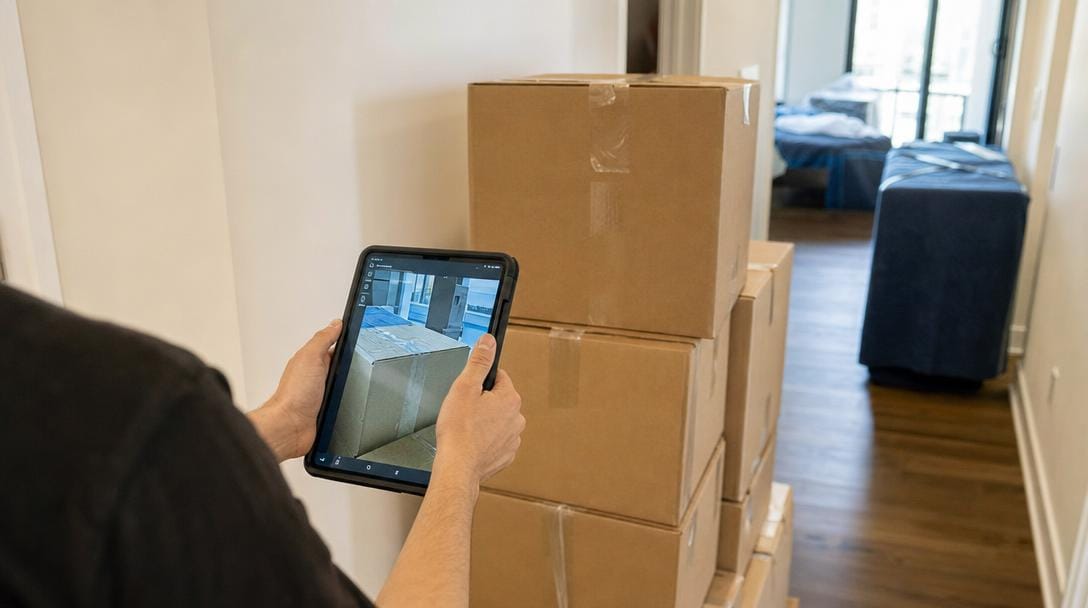
Recording the video: the customer films from a text link, no appointment needed
Step one puts the customer in control. Modern moving estimate software sends a text link that opens a guided camera in the browser—no app store download, no login. The customer taps the link and starts filming.
The interface prompts them room by room: living room, bedrooms, kitchen, garage, closets. On-screen guidance keeps the pace slow enough for the software to capture each item. Most walkthroughs finish in under 15 minutes.
This works because the hardware is already universal. 97% of U.S. adults own a cellphone, and the guided flow means no technical skill is required. A remote moving estimate app that demands a download loses customers at that hurdle—so the best tools run in the browser.
Pro Tip: Send the recording link within two minutes of the inbound lead, while intent is highest. A reply that says "tap this to get your exact quote today" converts far better than "let's schedule a time."
Geographic mobility keeps this demand steady. Tens of millions of Americans relocate every year, according to U.S. Census Bureau migration data, and a growing share expect a fully digital booking experience.
Measuring the inventory: AI calculates cubic feet for defensible quotes
Step two is where the estimate earns its accuracy. Once the video uploads, the AI moving inventory engine identifies each object, labels it, and estimates its dimensions. Sofas, dressers, boxes, and appliances all get catalogued automatically.
The system then converts that inventory into total cubic feet—the industry's standard unit for volume-based pricing. A cubic feet moving quote is inherently more defensible than a weight guess or a memory-based list, because it traces back to visible footage.

Q: How does AI measure furniture from a moving video?
A: The software detects each item, assigns standard dimensions, and sums the volume into cubic feet, producing a consistent AI moving inventory that any estimator can review before the quote goes out.
Consistency is the real payoff. Two different estimators looking at the same living room will produce two different numbers. The AI applies the same logic every time, which stabilizes margins and reduces the underestimates that eat into profit. For more on this, see how AI-powered estimates speed up quotes while tightening accuracy.
Turning inventory into price, contract, crew sheet, and DOT Bill of Lading

Step three is where a measured inventory becomes an operational asset. The same cubic-feet count that sets the price also flows into every downstream document—no re-keying required.
Here is what the single inventory record powers:
- The customer quote — priced from measured volume, hourly rate, and distance.
- The signed contract — the agreed scope, tied to the recorded evidence.
- The crew job sheet — a room-by-room list so movers arrive knowing what to load.
- The bill of lading — the legally required receipt and contract of carriage.
That last item is not optional. Federal regulators require movers to issue a bill of lading; the FMCSA specifies the bill of lading as the mover's contract with the customer. Interstate operators must also carry a USDOT number and comply with FMCSA registration rules. Pulling these documents from one verified inventory reduces compliance errors.
Pro Tip: Store the original walkthrough video alongside the bill of lading. If a customer disputes an item or a claim arises, the recorded footage is your strongest evidence—far stronger than an estimator's handwritten notes.

How video estimates cut the hours movers spend driving to walkthroughs
The biggest operational win is reclaimed time. A dispatcher or estimator who runs in-home surveys can spend an estimated 5–10 hours a week just driving between appointments—time that produces zero moves and zero revenue.
Video estimating collapses that overhead. The table below maps the shift:
| Task | In-home model | Video-based model |
|---|---|---|
| Travel to home | 30–60 min each way | Eliminated |
| Scheduling coordination | Multiple calls | Single text link |
| Building the inventory | Manual, on paper | Automated from video |
| Turning quote around | Hours to a day | Minutes to a few hours |
| Estimator jobs handled per day | A handful | Many more |
Workforce economics reinforce the point. Hand laborers and material movers earn a defined median wage tracked by the Bureau of Labor Statistics, so every non-revenue hour has a real labor cost. Removing the drive time converts that cost back into productive capacity.
Movers looking to formalize these gains often pair estimating tools with a broader moving company technology stack and lean on AI to reduce operating costs across dispatch and follow-up.

Getting started with video estimating at your moving company
Adoption is a workflow change, not a rip-and-replace. Start by choosing one lead source—say, web form inquiries—and route those customers through a recorded walkthrough instead of a scheduled visit. Measure booking rate and quote turnaround against your current baseline.
A practical rollout looks like this:
- Pick a single lead channel to pilot for 30 days.
- Standardize the text-message script that sends the recording link.
- Train one estimator to review AI inventories before quotes go out.
- Compare booking rate, turnaround time, and quote accuracy to the old method.
- Expand to all lead sources once the numbers hold.
Keep your vetting fundamentals intact regardless of tooling: verify licensing, insurance, and reputation. City-specific roundups such as the best moving companies in Phoenix, AZ show how local movers compete on transparency—and a faster, evidence-backed quote is a direct transparency signal. For the hands-on mechanics, this step-by-step virtual pre-move survey guide walks through each stage.
Related Articles
- New York City Moving: The Complete Relocation Guide — a full walkthrough of planning and pricing a move in a dense urban market.
- Video Survey Moving Estimates: How Movers Quote Jobs Without In-Home Visits — a deeper look at remote quoting workflows and tooling.
- Best Moving Companies in NYC: Top Picks & Costs — how top movers compete on price and transparency in a major metro.
- Moving Services in Columbus: Compare Options & Get Quotes — a framework for comparing local movers and reading their estimates.
Recommended Reading
- Estimating Software for Movers — how quoting tools generate itemized inventories.
- AI-Powered Moving Estimates: Complete Guide — the mechanics of AI measurement and speed.
- Virtual Pre-Move Survey: Complete Guide — why recorded surveys outperform live calls.
- Moving Company Technology Stack Guide — the tools that connect estimating, dispatch, and CRM.
- Reduce Moving Costs With AI Technology — where automation trims operating overhead.
Disclaimer: This article is for general informational purposes only and does not constitute legal advice. For guidance on your specific situation, consult a qualified attorney.
Ready to see it in action?
Book a free 20-minute demo and explore how Virtual Estimate can help your business.