
Every moving job starts with an estimate. In a competitive market, the company that delivers the most accurate, professional estimate first typically wins the booking. The AI estimates moving companies are adopting today reshape that dynamic entirely — turning what used to be a 24-48 hour manual process into a sub-minute competitive advantage. This article shows exactly how to use AI estimates for moving operations, from initial lead contact to signed booking, and which implementation steps produce the fastest gains in conversion.
Key Takeaways
| Point | Details |
|---|---|
| Speed wins bookings | Lead response research shows the first hour after inquiry is the most critical conversion window — AI delivers estimates in minutes, not hours |
| Accuracy reduces friction | Automated pricing rules eliminate estimate variance between reps, reducing price objections and disputed invoices |
| Automated follow-up recovers lost leads | AI-powered follow-up sequences convert leads that go quiet — a category most manual processes lose entirely |
| Conversion improves measurably | Moving companies that automate estimate delivery consistently report improved moving estimate conversion rate vs. manual baselines |
| Low barrier to entry | AI estimation solutions built for moving companies are available as SaaS subscriptions — see what AI estimate tools cost before you decide |

Why Slow and Inaccurate Estimates Are Costing You Jobs Right Now
The moving industry loses bookings at the estimate stage more than at any other point in the sales process. When a customer requests quotes from multiple companies — which most do — the first credible estimate received captures a disproportionate share of bookings. Delayed responses allow competitors to engage first, build rapport, and anchor the customer's price expectations before you've even had a conversation.
Manual estimates compound this problem. A sales rep who hand-calculates weight, distance, labor hours, and fuel costs introduces variability with every quote. Two reps quoting the same job often produce estimates that differ by 15-20%, creating negotiation friction and eroding trust before the relationship has started. Accuracy problems also carry real financial risk: underestimates lead to disputed final invoices, and overestimates lose the job entirely.
The lead decay problem is acute. Research published in the Harvard Business Review shows that the window immediately following a lead submission is the most critical period for conversion. Prospects who receive a response within minutes are still in active decision mode. Those who wait a day have typically already committed to a competitor who moved faster.
Pro Tip: Track your average estimate turnaround time this week. If it exceeds two hours during business hours, you're losing jobs to competitors who respond faster — even if your pricing is more competitive. The fix isn't working harder. It's automating the estimate delivery step entirely.
How AI Estimates Work: A Plain-English Explanation for Movers
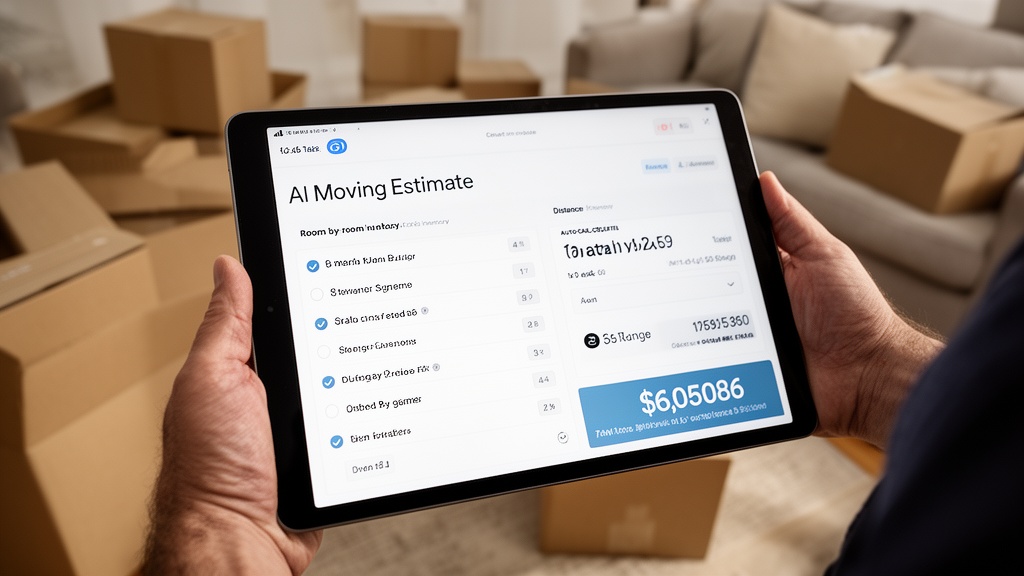
AI moving estimates use guided inventory inputs, machine learning, and real-time pricing data to generate accurate price ranges without manual calculation. The customer or sales rep answers structured questions — room by room, item by item — and the system calculates total cubic footage, estimated weight, required crew size, truck configuration, labor time, and distance-based fuel cost simultaneously.
Automated moving estimates don't guess. They apply pricing models trained on real job data, adjusted for your specific service area, labor costs, and fuel rates. The output is a professional, branded estimate document delivered digitally within minutes of the initial inquiry. Instant moving estimates are especially valuable for after-hours inquiries: a prospect who fills out your web form at 10pm receives a complete, itemized estimate before any competitor's sales team starts work the next morning.
Understanding the different types of moving estimates and when each makes sense helps you decide which jobs to route through full AI automation and which genuinely require a manual walkthrough. For most standard residential moves, AI handles the entire estimate process accurately without human intervention.
Here's what the AI calculates in a single pass:
- Total estimated weight based on item-level inventory
- Required truck size and number of vehicles
- Crew size and projected labor hours
- Fuel cost based on origin-to-destination distance
- Packing material requirements
- Add-on services: piano moving, specialty items, storage
Pro Tip: Configure your AI tool to ask one question that manual estimates often skip: whether the customer has a flexible move date. Flexible-date moves are easier to schedule and more profitable to run. The AI can surface this at the quote stage and flag the lead accordingly for priority follow-up.
Step-by-Step: Integrating AI Estimates into Your Sales Workflow
Knowing how to use AI estimates for moving is less about technology and more about workflow design. The goal is to embed AI at every point where estimate speed or accuracy currently creates friction in your sales process.
Step 1: Connect AI to your inbound lead sources. Every web form, Google Ads landing page, and moving lead provider should trigger an automated estimate flow. The customer answers 8-12 structured inventory questions, and the system generates an estimate in real time — no sales rep involvement required for the first touchpoint.
Step 2: Configure your pricing rules once. Set base rates, fuel surcharges, minimum charges, and seasonal adjustments in the AI system. Every estimate produced reflects your actual pricing, with manual overrides needed only for genuinely non-standard jobs.
Step 3: Enable digital delivery with e-signature. The estimate arrives as a professional, branded web page or PDF. Virtual estimate moving jobs can progress from inquiry to booking in a single session — customers can accept, ask questions, or schedule a call, all tracked automatically in your CRM.
Step 4: Set up automated follow-up sequences. If a customer doesn't respond within 24 hours, the system sends a follow-up automatically. Most converting leads respond on the first or second follow-up. Automating this step removes the single most common failure in moving sales: the forgotten follow-up.
Step 5: Review your estimate data weekly. The system accumulates data on which estimates convert, which lose to competitors, and where pricing friction occurs. This feedback loop continuously improves future estimate accuracy and pricing strategy.
Virtual Estimate can help: Virtual Estimate provides AI estimation solutions built for moving companies — from instant web form quotes to full CRM integration and automated follow-up sequences. Learn more →
Presenting AI-Generated Estimates to Build Immediate Customer Trust
An AI-powered moving quote only converts if the customer trusts it. Presentation quality signals professionalism — and professionalism correlates directly with price credibility. A clean, itemized document implies precision. A handwritten or plain-text emailed price range implies the opposite, regardless of how accurate the underlying number is.
Effective AI-generated estimates follow a consistent structure:
| Estimate Element | Purpose |
|---|---|
| Branded header with company logo | Establishes identity and professionalism immediately |
| Itemized room-by-room inventory | Shows the customer every item is accounted for |
| Weight and volume summary | Justifies the price mathematically |
| Pricing breakdown by service component | Eliminates objections about unclear charges |
| Clear terms and conditions | Reduces post-move disputes and billing surprises |
| Digital signature block | Enables instant booking commitment from the estimate document |
Customers who receive detailed, itemized estimates are less likely to negotiate on price because the breakdown leaves less room for ambiguity. The conversation shifts from "why is this so expensive?" to "when can you start?" For competitive jobs, configure your AI platform to include a brief paragraph covering insurance coverage, service guarantees, and any operational differentiators — content that appears automatically on every estimate without your team writing it fresh each time.
Using AI Estimates to Shorten Your Sales Cycle and Close Faster
Speed and automated follow-up are the two variables that most directly determine whether an estimate converts to a booking. Fast moving estimates AI systems address both simultaneously, eliminating the human latency that kills deals between touchpoints.
The typical manual sales cycle for a moving job spans multiple days: lead arrives → rep reviews → rep calls customer → survey scheduled → estimate drafted → estimate sent → waiting period → follow-up → maybe a booking. An AI-assisted workflow compresses this dramatically: lead arrives → AI sends estimate within minutes → automated follow-up → booking. For standard residential moves, the entire cycle from inquiry to signed contract can complete in under 24 hours.
The moving estimate conversion rate impact is cumulative and compounds over time. To win more moving jobs with AI, the primary lever is removing human delay from each handoff in the sales process. Registered moving carriers reviewed by the FMCSA operate in a market where consumers routinely contact three to five companies before booking. Delivering a complete, professional estimate first — before competitors respond — changes the competitive calculus structurally in your favor.

For leads that go quiet after the initial estimate, AI-powered follow-up sequences recover bookings that manual processes write off as lost. A sequence of three to five touchpoints over seven to ten days — email, SMS, or both — runs without any team involvement. Many moving companies report that a meaningful share of their monthly confirmed jobs come from this automated recovery layer, representing revenue that a manual-only operation would never capture.
Pro Tip: Add a time-limited incentive to your AI estimate delivery — for example, "Book within 48 hours and we waive the fuel surcharge." This creates urgency without discounting your base rate, and the AI applies the incentive logic automatically based on response timing.
Real Results: What Moving Companies Report After Switching to AI Estimates
Moving companies using AI-powered moving estimates consistently report measurable improvements across three dimensions: speed, accuracy, and conversion.
On speed: estimate delivery drops from hours to minutes. This is the most immediate operational change, and its conversion impact is direct. Prospects who receive estimates within minutes are still in active decision mode. Those who wait until the next business day have often already committed to a competitor who moved faster.
On AI estimate accuracy movers report that automated systems significantly reduce estimate variance between team members. When pricing rules are correctly configured, every estimate for a comparable job produces a consistent, defensible output. This eliminates the scenario where two sales reps quote the same customer different prices — a trust-destroying experience that pushes customers toward competitors who appear more organized and reliable.
| Metric | Manual Process | AI-Assisted Process |
|---|---|---|
| Average estimate turnaround | 4–24 hours | Under 5 minutes |
| Estimate consistency (same job, two reps) | High variance | Near-identical output |
| Follow-up completion rate | Varies by rep discipline | Near 100% (automated) |
| Moving estimate conversion rate | Baseline | Consistently higher with automation |
| Sales team time per estimate | 20–45 minutes | 2–5 minutes (review only) |
| After-hours lead capture | Missed until next morning | Immediate automated response |
The American Moving and Storage Association tracks professional standards across the industry — and AI-generated estimates align directly with their guidance on written, itemized disclosures for consumer protection. See what AI estimate tools cost to evaluate whether the conversion improvement justifies the investment for your current lead volume.
What to Look for in an AI Estimation Tool for Your Moving Business
Not all AI estimation tools are built for the moving industry. Generic quoting software lacks the domain-specific logic — item weight databases, crew sizing algorithms, multi-stop pricing structures — that makes moving estimates accurate and defensible. Here's what separates purpose-built moving AI from generic alternatives.
Core capabilities to evaluate:
- Inventory database depth: A 500-item database with standard household weights produces more accurate estimates than a generic 50-item list. Specialty item categories — piano, artwork, pool table — are essential for residential and commercial moves.
- Pricing rule configurability: Zone-based rates, seasonal surcharges, minimum charges, and multi-stop pricing must all be configurable. Rigid pricing structures force manual overrides on every non-standard job, eliminating the time advantage AI provides.
- CRM integration: Estimates that don't feed your CRM create data gaps. Look for native integrations or API access to the platforms your team already uses.
- Digital delivery and e-signature: Web-delivered estimates with inline signing convert faster than PDF attachments requiring separate signing tools or printing.
- Automated follow-up capability: The tool should manage follow-up sequences independently, without your team queuing individual messages for every lead.
- Reporting and analytics: Conversion rates by move type, price point, and lead source surface the data needed to continuously improve estimates and pricing strategy.
For a broader view of how AI estimation connects to your overall operations, the moving company technology stack guide covers how estimate tools integrate with dispatch, CRM, and accounting systems. Understanding this architecture before selecting a tool prevents costly integration problems after implementation.
Related Articles
- AI-Powered Moving Estimates: The Complete Guide for Movers — Deep-dive on how AI estimation technology works and how to evaluate tools for your specific operation.
- AI vs. Manual Estimates: Which Delivers Better Accuracy for Movers? — Side-by-side comparison of AI and human estimation accuracy across different move types and complexity levels.
- Virtual Estimate AI: Features, How It Works, and Who It's For — Overview of the Virtual Estimate platform, core features, and which moving company profiles benefit most from adoption.
- Best Moving Company Software: Complete Buyer's Guide — Comprehensive evaluation of moving software platforms covering estimate tools, CRM, and dispatch systems.
- The Future of Moving Estimates: Trends Shaping the Industry — Analysis of where estimate technology is heading and how forward-looking movers are preparing for the shift.
Ready to see it in action?
Book a free 20-minute demo and explore how Virtual Estimate can help your business.