
Estimation errors quietly drain moving company margins. A quote that comes in too low turns into a customer dispute. A quote that runs too high costs the booking. The difference between profitable operations and problem ones often comes down to improved estimation accuracy — and whether your process reliably delivers it. This article compares AI and manual estimating methods head-to-head, covering accuracy performance, error sources, scalability, and the real business cost of getting quotes wrong, so you can make a confident decision for your company.

| Point | Details |
|---|---|
| Manual estimates introduce variance | Inconsistency between estimators on identical job types is a primary driver of moving estimate errors in growing operations |
| AI applies uniform logic | Automated moving estimates use the same rules every time, regardless of volume or individual estimator performance |
| Errors carry a real price tag | Disputed moves generate refund exposure, admin overhead, and lost referrals — often worth multiples of the original job margin |
| AI generates quotes faster | Most AI estimation tools complete full quotes in 5–15 minutes versus 30–90 minutes for a manual assessment |
| Hybrid models outperform both | High-performing movers use AI estimation tools for moving companies for speed at scale, with human review reserved for complex jobs |
Manual Estimates: When Human Judgment Still Has Value
Manual estimates have one genuine strength: contextual judgment. An experienced estimator can read a home, notice the antique piano that won't appear in a standard intake form, and catch the third-floor walk-up that adds two hours of labor. That situational awareness is hard to replicate.
For complex or high-value moves, direct human assessment remains difficult to fully automate. Specialty items, structural access constraints, and unusual customer requirements benefit from real-time observation. A skilled estimator can ask clarifying questions on the spot and adjust the quote to reflect what they actually see — not just what the customer reported.
The limitation is consistency. A 10-year veteran and a 3-month hire produce materially different quotes for the same job. Manual moving company estimation accuracy depends entirely on individual experience, which means it doesn't scale predictably as the business grows.
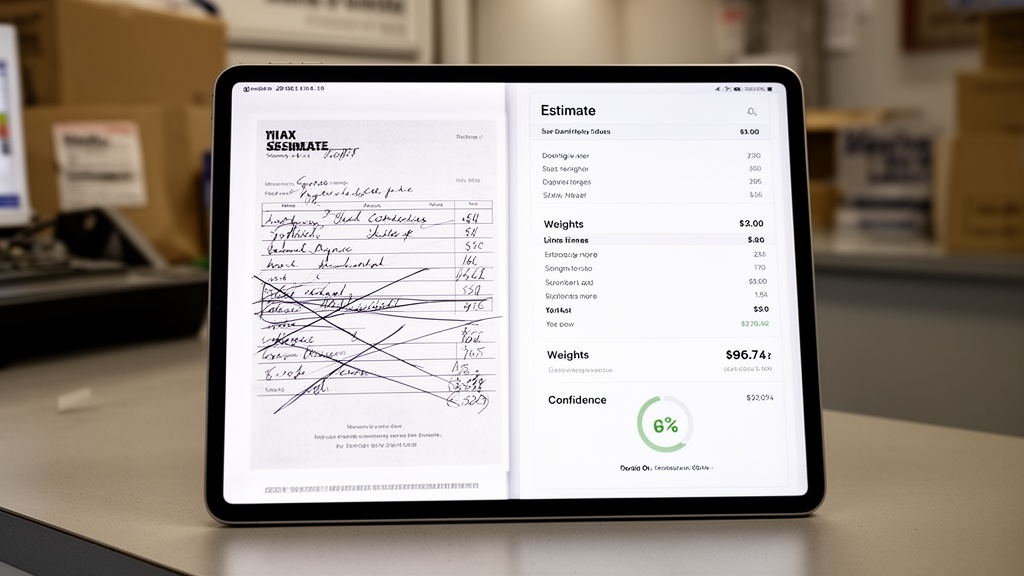
Pro Tip: Even when relying on manual estimates for complex jobs, document every estimator's methodology in a shared checklist. Standardizing the walkthrough process reduces variance across your team and creates a measurable baseline for comparing human versus AI accuracy over time.
How AI Estimates Work — and Why They're Built for Consistency
AI estimation systems analyze customer-provided data — video walkthroughs, room scans, or structured intake forms — and match that information against historical job databases to produce a complete quote. The system applies the same pricing logic, item weights, and labor formulas to every single submission.
This consistency is the defining advantage. Unlike a human estimator, an AI system doesn't have an off day, doesn't skip items when rushed, and doesn't apply informal discounts without documentation. Every quote follows the same decision logic, producing repeatable results across all job types and volumes.
Modern AI tools also improve with use. Each completed job adds data to the underlying model, meaning AI estimation accuracy moving companies experience improves over time as the system learns local patterns — seasonal volume shifts, elevator frequency, typical item profiles by neighborhood type.

The practical result is a system built for accurate moving job quotes at scale. Where manual methods plateau at the individual estimator's skill level, AI systems improve continuously with every completed job.
Accuracy Comparison: AI vs. Manual Across Common Job Types
The accuracy gap between AI vs human estimators moving companies rely on depends heavily on job type. For standard residential moves with predictable inventories, AI holds a measurable consistency advantage. For complex specialty jobs, human judgment still contributes value.

| Job Type | Manual Estimate Performance | AI Estimate Performance |
|---|---|---|
| Standard 2BR apartment | Moderate accuracy; experienced staff know common items | High consistency; strong training data for typical loads |
| Large home (4BR+) | Higher error risk; volume underestimation is common | Consistent; high-volume flags trigger automatic review |
| Specialty items (piano, fine art) | Human judgment advantage; contextual assessment adds value | Variable; quality depends on customer-provided data |
| Long-distance interstate | Complex; many pricing variables affect outcome | Strong; historical route data improves pricing precision |
| High-rise / access-restricted | Experience-dependent; walk-up penalties frequently missed | Rule-based; access surcharges applied automatically every time |
| Last-minute bookings | Time pressure degrades accuracy materially | No performance degradation under time pressure |
| Repeat customers | Inconsistent; relationship pricing introduces variance | Uniform; applies standard logic regardless of customer history |
The pattern is consistent: manual vs AI moving estimates diverge most sharply on volume, time pressure, and repeatability. The issue isn't whether a human estimator knows what to assess — it's whether that knowledge gets applied reliably on every single job.
Virtual Estimate can help: Virtual Estimate's AI-powered platform delivers consistent, data-driven quotes in minutes — reducing estimate errors and protecting your margins on every job. Learn more →
Common Sources of Error in Manual Estimates
Manual estimation fails at predictable, recurring points. Understanding these failure modes is the first step toward addressing them — whether you ultimately switch to AI or improve your existing manual process.
The five most consistent sources of moving estimate errors in manual processes are:
- Item omission — Estimators miss items during walkthroughs, particularly in cluttered garages, storage areas, and secondary bedrooms. Customers also add items after the initial visit, and original quotes rarely get updated to reflect the change.
- Volume underestimation — Humans consistently underestimate cubic footage for irregularly shaped or bulky loads. This is a well-documented pattern in visual estimation research, affecting even experienced professionals making repeated assessments.
- Access factor omission — Stairs, narrow hallways, and extended carries add significant labor time that manual estimators frequently fail to document, especially during remote or phone-based assessments.
- Inconsistent pricing application — Without locked pricing rules, estimators apply personal judgment to discounts. Two customers with identical jobs may receive quotes that differ by 15–20% depending on who handles the call.
- Estimator fatigue — Quote quality declines under high volume. Research on decision fatigue published in the Proceedings of the National Academy of Sciences documents declining professional judgment quality as decision volume increases — an effect that applies directly to estimation tasks.

Pro Tip: Audit your last 50 completed jobs. Compare each original estimate to the final invoice amount. The line-item categories where estimates consistently ran under your actuals are your primary manual error sources — and the highest-value targets for AI automation.
The cumulative effect compounds across a full operating year. Each missed item or underdocumented access factor reduces actual job margin. Across hundreds of jobs, these small gaps become a measurable and solvable revenue leak.
Speed, Volume, and Scalability: Where AI Has a Clear Edge
Speed matters in a competitive moving market. Customers comparing quotes typically make decisions within 24–48 hours. A manual estimate that requires scheduling an in-home visit — or simply waiting for estimator availability — loses bookings to faster competitors who respond within minutes.
Automated moving estimates eliminate this bottleneck entirely. A customer completes a video walkthrough or structured intake form, and the system generates a complete, itemized quote in minutes. No scheduling friction. No estimator availability ceiling. No response time penalty during peak periods.
Scalability follows the same logic. A team of two experienced estimators handles a fixed number of quotes per day. Add a new service area, take on a commercial account, or face a seasonal spike — and manual estimation immediately creates a capacity constraint that limits revenue growth.
| Metric | Manual Estimation | AI-Powered Estimation |
|---|---|---|
| Time to generate quote | 30–90 minutes | 5–15 minutes |
| Daily quote capacity | 8–15 per estimator | Unlimited |
| Consistency across team | Variable by individual | Uniform across all jobs |
| Performance under high volume | Degrades with fatigue | Consistent at all volumes |
| Customer response time | Hours to days | Minutes |
| Cost per quote at scale | Increases with volume | Decreases with volume |
AI scales linearly with demand. The same system that handles 20 quotes on a slow Tuesday processes 200 during peak season without accuracy loss — a structural advantage no manual process can replicate.
Real Cost of Estimation Errors for Moving Companies

This is where the business case becomes concrete. Estimation errors aren't just operational friction — they generate direct financial losses with compounding downstream effects.
An underestimate produces a job that runs over budget. The moving company either absorbs the overage, bills the customer for an amount they didn't agree to, or splits the difference. All three outcomes damage the business: margin compression, billing disputes, or eroded trust that eliminates future referrals.
The Federal Motor Carrier Safety Administration tracks household goods complaints annually, and billing disputes rooted in estimate-to-invoice discrepancies consistently rank among the top consumer complaint categories. This is a systemic industry-wide problem, not an isolated one.
Consider the full cost of a single disputed job:
- Direct refund or applied discount: $200–$800
- Staff time to resolve the dispute: 2–4 hours at full labor cost
- Lost referral value from one dissatisfied customer: $400–$1,200
- Online review impact: difficult to quantify, but material at scale
For moving companies working to reduce moving costs with AI technology, estimate error reduction typically delivers the fastest visible ROI. Fewer disputes mean lower admin overhead, higher net margin per job, and a cleaner referral pipeline that compounds over time.
Pro Tip: Track your dispute rate — the percentage of completed jobs that generate post-move billing complaints. A rate above 5% signals systematic estimation problems. Reducing it below 2% produces visible improvement in online reviews and referral volume within a single operating quarter.
Which Approach Is Right for Your Moving Company Right Now?
The right answer depends on your current volume, job complexity mix, and growth trajectory. Here is a practical decision framework.
Manual-only makes sense when:
- Monthly job volume is under 20 moves
- The majority of jobs involve specialty items requiring in-person assessment
- Your team has experienced estimators with consistently documented accuracy records
AI-first makes sense when:
- You are handling 50+ quote requests per month
- Response time is a competitive differentiator in your market
- You are expanding into new service areas without proportional estimator headcount growth
- You want systematic, measurable data on reduce estimate errors moving efforts over time
Hybrid is right for most:
Most growing moving companies land in a hybrid model. AI handles standard residential moves, generates initial quotes instantly, and flags outlier jobs for human review. Experienced estimators then focus their time on complex, high-value jobs where judgment genuinely adds margin value — rather than routine 2BR apartment quotes.
Understanding the types of moving estimates — binding, non-binding, and binding not-to-exceed — helps moving companies determine which quote types to automate first. Standard non-binding estimates for routine residential jobs are ideal AI candidates. High-value binding quotes for specialty or complex moves benefit from human oversight.

To evaluate the investment directly, see what AI estimation software costs and compare it against your current estimating overhead. For operations handling 30+ jobs per month, the cost-per-accurate-quote math consistently favors AI.
Related Articles
- Types of Moving Estimates: Choosing the Best Option — Understand binding, non-binding, and binding not-to-exceed estimates to choose the right approach for your operation.
- How to Conduct a Virtual Pre-Move Survey: Step-by-Step Guide — Learn how virtual surveys work and how to capture better inventory data before the move date.
- Pricing Strategies for Moving Companies: Maximizing Profitability — Explore proven pricing frameworks that protect margins without sacrificing competitive positioning.
- Customer Experience Excellence in Moving Services — See how accurate estimates connect to broader customer satisfaction outcomes and referral generation.
- How to Reduce Moving Costs With AI Technology — A practical guide to where AI generates the fastest cost savings across moving company operations.
Ready to see it in action?
Book a free 20-minute demo and explore how Virtual Estimate can help your business.