

Moving company websites generate traffic that too often exits without a single estimate request. The gap between visitors and booked jobs is a conversion problem — one that conversion rate optimization services for moving companies are specifically designed to close. The moving industry faces distinct conversion challenges: high-intent searches that expire within minutes, mobile-first audiences, and seasonal demand shifts that compress decision windows. This guide examines which CRO tactics, tools, and service approaches produce measurable results for movers.
Key Takeaways
| Point | Details |
|---|---|
| CRO directly improves booking rates | Moving companies using structured CRM pipelines have raised booking rates from 28% to 41% — from the same monthly lead volume, with no new acquisition spending |
| Lead response time is the highest-leverage variable | Cutting response time from 6 hours to 22 minutes was the single highest-leverage conversion improvement documented across moving industry case studies |
| Software ROI arrives quickly | Mid-size movers processing 40+ jobs/month consistently reach full software payback within 60-120 days of complete adoption |
| CRO requires CRM integration | Without connecting website conversions to booked revenue, optimization targets vanity metrics rather than actual business outcomes |
| DIY vs. agency CRO depends on traffic | Under 1,000 monthly visitors, foundational DIY fixes outperform paid CRO service retainers for most moving operations |
What Is Conversion Rate Optimization for Moving Companies?

Conversion rate optimization for movers is the systematic process of improving a website's ability to turn visitors into actionable leads — estimate requests, phone calls, and quote form completions — and then into booked jobs. Unlike SEO, which grows traffic volume, CRO extracts more revenue from traffic already arriving.
For a moving company, the primary conversion is an estimate request or direct phone call. Secondary conversions include chat initiations, email captures, and callback form completions. CRO for service businesses differs fundamentally from e-commerce CRO: the conversion point is not a purchase but a commitment to be contacted. Reducing friction at that step is the highest-leverage intervention available.
The core CRO methodology follows four stages: measure baseline performance, hypothesize where and why visitors drop off, test changes against the control, and implement winners. The American Moving and Storage Association represents thousands of professional movers competing in one of the most contested local service markets for online lead generation — making conversion infrastructure a competitive necessity, not an optional upgrade.
Why Moving Company Websites Lose Leads Before the Estimate Request
Most moving company website conversion failures trace back to three root causes: slow page load times, buried CTAs, and form designs that demand too much information upfront.
Google's Core Web Vitals guidelines establish that page experience directly impacts how Google ranks and scores a site — and slow pages lose impatient users before they convert. A moving site that takes more than three seconds to load surrenders a meaningful share of high-intent local searchers to competitors.
CTA placement is the second failure mode. Many mover sites bury the "Get a Quote" button below the fold or inside navigation menus. On mobile — where the majority of local moving searches originate — a visitor who cannot immediately see how to request an estimate will not scroll to find it. Moving company website conversion depends entirely on making the next step impossible to miss.
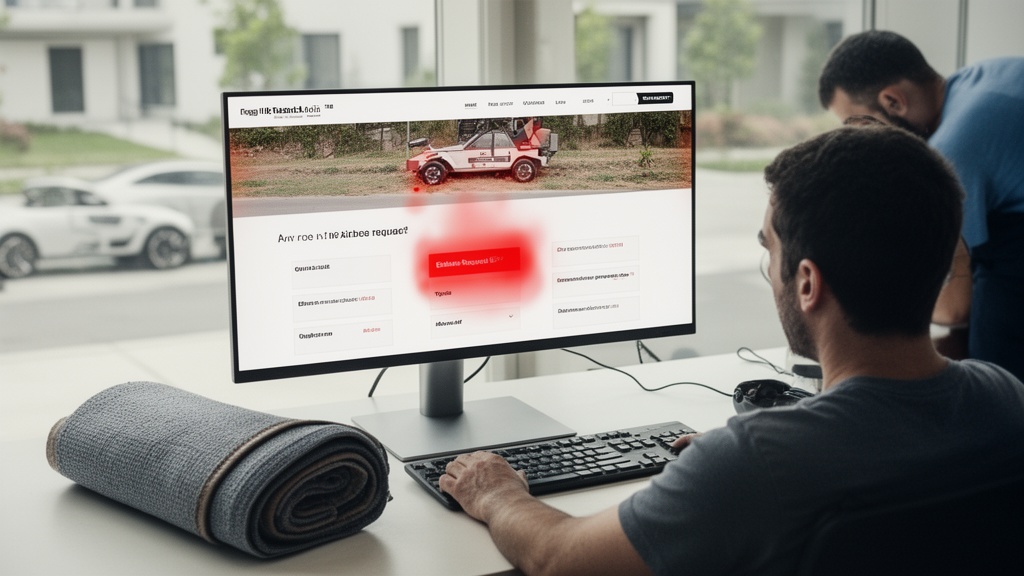
Form friction is the third culprit. Initial quote forms requesting inventory details, move dates, and destination addresses on the first screen repel early-stage leads who are still evaluating options. High-converting mover landing pages request only three fields at first contact: name, phone number, and move date. Additional details come after the lead is captured.
Top CRO Tactics That Actually Work for Movers
Effective moving website CRO concentrates on proven interventions with consistent track records across the service business category.
- Above-the-fold CTA prominence. Place the estimate request button in the hero section using a contrasting color. Add a nearby trust signal: "Licensed & Insured," a Google review count, or years in business.
- Progressive form disclosure. Collect only three fields on step one, then request inventory details on step two. This consistently outperforms long single-page forms with eight or more fields.
- Speed optimization. Compress images, reduce JavaScript payloads, and implement lazy loading. Fast load times directly improve moving company website optimization performance and reduce bounce rates from mobile searches.
- Social proof integration. Google Business Profile star ratings and customer testimonials placed near CTAs increase estimate request rates. Visitors need to trust a company before submitting contact information.
- Mobile-first design. Tap targets must accommodate thumbs, phone numbers must be click-to-call, and forms must render as single-column on small screens.
Pro Tip: Run a five-second test on your homepage: cover the screen, reveal it for five seconds, then determine whether someone can immediately identify what the company does and how to get a quote. If not, redesign the hero section before starting any other CRO work — everything else depends on this foundation.

Virtual Estimate can help: Virtual Estimate combines moving company growth and conversion tools — CRM, automated follow-up, and built-in analytics — in a single platform built specifically for moving companies. Learn more →
Landing Page Optimization: Turning Traffic Into Booked Jobs

Mover landing page optimization is the highest-ROI CRO activity for moving companies running paid search campaigns. A dedicated landing page for each ad group — local moves, long-distance relocations, commercial moves — consistently outperforms routing paid traffic to a generic homepage.
A high-converting mover landing page includes six elements: a headline that mirrors the search query, a single primary CTA, three to five trust signals, a customer testimonial, a progress-indicator form, and a click-to-call phone number anchored in the header.
For organic traffic, on-page CRO matters equally. Blog posts ranking for "how much do movers cost" or "moving checklist" convert better when they include inline CTAs at natural reading break points — not only at the page footer. Testing CTA placement within established organic content is among the fastest wins available.
Testing cadence matters. A/B tests on landing pages require meaningful traffic volumes to produce statistically reliable results. For most local movers, running a test for a minimum of three weeks across at least 500 visitors per variant produces trustworthy data. Shorter tests with lower traffic produce misleading signals.
CRO Tools and Software Built for Moving Company Websites
CRO services moving industry providers deploy a consistent stack of five tool categories. Understanding each helps operators evaluate what a CRO engagement actually delivers versus what they can handle internally.

| Tool Category | Primary Function | Moving Company Application |
|---|---|---|
| Heatmap & Session Recording | Visualize where visitors click and scroll | Identify whether visitors see and click the estimate CTA |
| A/B Testing Platform | Compare two page variants with live traffic | Test short vs. long quote forms and CTA copy variations |
| Analytics Platform | Measure conversion funnels and drop-off rates | Identify which traffic sources convert to booked jobs |
| CRM / Lead Tracking | Connect website conversions to revenue outcomes | Attribute actual bookings to specific marketing channels |
| Page Speed Diagnostic | Identify and fix load-time issues | Improve Core Web Vitals scores for ranking and UX |
Moving company sales software that integrates with the CRM layer is essential for closing the attribution loop. Without connecting website conversions to actual booked jobs, CRO work optimizes for form submissions rather than booked revenue — a critical distinction that changes which interventions get prioritized.
Pro Tip: Before investing in heatmap or A/B testing tools, confirm your analytics platform tracks form completions as conversion events — not just page views. Many mover sites have broken conversion tracking that makes all downstream CRO data unreliable from day one.
Lead Tracking Software and Its Role in Conversion Optimization
Lead tracking software for moving company operations provides the attribution data that makes CRO decisions evidence-based rather than intuitive. This is where website optimization and operational performance converge.
Consider what source attribution data revealed in a documented CRM implementation: referrals converted at nearly twice the rate of paid leads. That single insight — invisible without proper lead tracking — justified reallocating budget toward a structured referral program. Per moving company CRM analytics documentation, referral share of leads grew by 19 percentage points over 12 months as a direct result.
Lead tracking also surfaces the most consequential CRO variable in the moving industry: response time. Cutting average lead response time from 6 hours to 22 minutes was identified as the single highest-leverage operational change in the same case study — outperforming any landing page redesign or ad creative test. No external CRO agency can fix response time; that requires internal process change supported by CRM task automation and mobile notifications.
Moving company lead conversion rates are directly tied to response speed. Research published in Harvard Business Review on online lead response rates confirms that leads contacted within the first hour of inquiry are significantly more likely to convert than those reached hours later.
Pro Tip: Track lead response time alongside booking rate as a primary CRO metric. If average response time exceeds 30 minutes, fixing that internal process delivers faster ROI than any landing page optimization project — and it costs nothing beyond CRM configuration.
For operators evaluating the best moving leads companies, understanding which lead sources convert at the highest rate — not just which deliver the most volume — is the foundational question that lead tracking software answers. Moving company lead conversion starts with knowing where your best customers actually come from.
Agency vs. DIY Optimization: Finding the Right Approach

The right CRO approach depends on three factors: monthly traffic volume, internal technical capacity, and the volume of jobs processed each month. Neither approach universally wins — context determines fit.
| Factor | DIY CRO Works When | CRO Service Works When |
|---|---|---|
| Monthly website visitors | Under 1,000 visitors/month | Over 2,000 visitors/month |
| Internal team capacity | Has a marketing-savvy staff member available | No dedicated marketing or technical staff |
| Budget allocation | Limited to software tools as primary investment | Budget allocated for ongoing service retainer fees |
| Test complexity | Simple CTA and form changes needed | Full funnel redesign or multi-page test sequences |
| Attribution setup | Basic analytics already configured correctly | Needs CRM integration and revenue-level tracking |
For most mid-size moving operations, a hybrid approach delivers the best results: handle foundational fixes internally — page speed, CTA placement, form simplification — then engage a CRO service for structured A/B testing and analytics configuration. See Virtual Estimate AI pricing for conversion-focused features to understand what a purpose-built moving software subscription covers before adding external agency costs.
DIY CRO tooling is accessible. Google Analytics 4, A/B testing platforms, and heatmap tools cover the fundamentals. The real limitation is interpretation: knowing which test to run, how to read statistical significance, and which changes compound over time requires experience that most mover operators are still developing.
Real Benchmarks: What Conversion Rates Should Moving Companies Expect?
Benchmarking is the foundation of any serious CRO program. Without baseline data, improvement targets are arbitrary and progress is unmeasurable.
Based on documented CRM implementation data, operators without structured lead tracking often start with an estimate-to-booking rate near 28%. After implementing a structured five-stage CRM pipeline with automated follow-up, the booking rate climbed from 28% to 41% — a 13-point gain from the same monthly lead volume with no new acquisition spending.
Moving company booking rate improvements of 8-12 percentage points are consistently achievable for operations implementing CRM automation, per moving software ROI case study analysis. The American Moving and Storage Association identifies operational inefficiency as a primary driver of revenue plateaus among mid-size movers — and systematic moving company website optimization directly addresses one core dimension of this problem.
| Conversion Metric | Baseline | Optimized Outcome |
|---|---|---|
| Estimate-to-booking rate | ~28% | 38-41% with CRM + automated follow-up |
| Lead response time | Hours (often 4-6+) | Under 22 minutes with CRM automation |
| Estimate turnaround time | 18-24 hours | Under 2 hours with digital estimating |
| Office admin time recovered | Baseline hours | 13 hours/week saved via dispatch automation |
| Software payback period | — | 60-120 days from complete adoption |
Website-level conversion rates — visitor to estimate request — vary widely by traffic source and page quality. Paid search from high-intent queries converts at higher rates than informational organic traffic. The actionable benchmark is your own measured baseline tracked consistently over 30-day periods, not a generic industry average.
Selecting a CRO Service Provider for Your Moving Company
Evaluating CRO services for moving companies requires asking six specific questions before signing any agreement.
Industry experience. General CRO agencies apply e-commerce frameworks to service businesses. Moving-specific knowledge of seasonal demand, local search behavior, and quote-to-book funnels is essential — not optional.
Success metrics. Providers who report only on form submissions without connecting to booked revenue are measuring the wrong thing. Insist on revenue-attributable reporting from the start.
Testing methodology. Reputable CRO providers document their hypothesis, test design, traffic allocation, and statistical significance threshold before running any test.
CRM integration. CRO without CRM integration produces disconnected data. Website optimization and lead management must share attribution information to be actionable.
Reporting cadence. Monthly reporting with a documented test log is the minimum standard. Bi-weekly check-ins work better for fast-moving seasonal operations.
Moving industry case studies. Generic case studies from retail or SaaS are not comparable evidence for a local service business operating on a quote-to-book conversion model.
For operators building CRO capabilities in-house, moving company growth and conversion tools that combine CRM, automated follow-up, and analytics in a single platform offer a more direct path to measurable conversion gains than assembling multiple disconnected point solutions.
Related Articles
- Lead Tracking Software for Moving Companies: Top Tools Compared — Compare the top lead tracking platforms and learn which features matter most for moving company conversion rates.
- Moving Company SEO: A Step-by-Step Strategy Guide — Build the organic traffic foundation that CRO depends on with this comprehensive SEO framework for movers.
- CRM for Moving Companies: Streamline Operations — Learn how a purpose-built moving CRM connects website leads to booked jobs with minimal manual intervention.
- Digital Marketing Strategies for Moving Companies — A complete framework covering SEO, paid search, social media, and conversion optimization for movers.
- Customer Experience Excellence in Moving Services — Discover how post-booking experience improvements drive referrals and repeat business that reduce long-term acquisition costs.
Recommended Resources
- Moving Company Lead Management: Track, Nurture, Convert — Build a structured lead management process that transforms inquiry volume into booked revenue.
- SEO for Moving Companies: The Complete Strategy Guide — Grow the organic traffic that fuels your CRO efforts with this step-by-step SEO framework.
- Moving Service Marketing: The Complete Guide — A full-funnel marketing guide covering paid, organic, and referral channels for moving companies.
- Virtual Estimate Solutions — Explore the complete conversion and operations platform built specifically for moving companies.
Ready to see it in action?
Book a free 20-minute demo and explore how Virtual Estimate can help your business.