

Moving companies lose thousands annually on inaccurate estimates and operational inefficiencies. AI-powered CRM systems can reduce moving estimate errors by up to 40%, drastically cutting costly disputes and transforming how moving businesses operate. This guide explores specialized CRM solutions designed for the moving industry, covering essential features, AI integration benefits, implementation strategies, and measurable improvements in efficiency and customer satisfaction.
Table of Contents
- Understanding CRM In The Moving Industry
- Core Features Of A Moving Company CRM
- How AI Integration Enhances Estimation And Efficiency
- Common Misconceptions About CRM For Movers
- Comparing Specialized Moving CRMs Vs Generic Solutions
- Implementing The Right CRM For Your Moving Company
- Benefits Realized: Efficiency, Accuracy, And Customer Experience
- Explore Virtual Estimate AI’s CRM Solutions For Moving Companies
- Frequently Asked Questions
Key takeaways
| Point | Details |
|---|---|
| Specialized CRM integration | Moving-focused CRMs combine lead management, AI estimation, dispatch scheduling, and billing in one platform. |
| AI accuracy gains | AI-powered estimation reduces errors by 40% and speeds quote generation by an average of 35 minutes per estimate. |
| Industry-specific advantage | Specialized CRMs outperform generic solutions with tailored volume estimation, crew dispatch, and customer portal features. |
| Implementation approach | Successful adoption requires assessing pain points, evaluating AI capabilities, and training staff with phased rollouts. |
| Measurable benefits | Companies achieve 35% efficiency gains, 25% better lead conversion, and significantly improved customer satisfaction. |
Understanding CRM in the moving industry
A CRM platform tailored for moving companies integrates customer relationship management with industry-specific functions like volume estimation, crew scheduling, inventory tracking, and billing. Unlike generic CRMs designed for broad business use, moving-focused systems address unique operational challenges that plague the industry.
Moving companies face fragmented workflows where estimates, scheduling, and billing exist in separate systems. Manual measurements lead to volume miscalculations. Lead follow-ups fall through cracks. Dispatch coordination becomes chaotic during peak seasons. These inefficiencies cost time, money, and customer trust.
Generic CRMs lack critical moving-specific features:
- No automated volume or cubic footage calculation tools
- Missing crew dispatch and resource allocation functions
- Limited integration with moving-specific billing requirements
- No customer portals for shipment tracking and inventory review
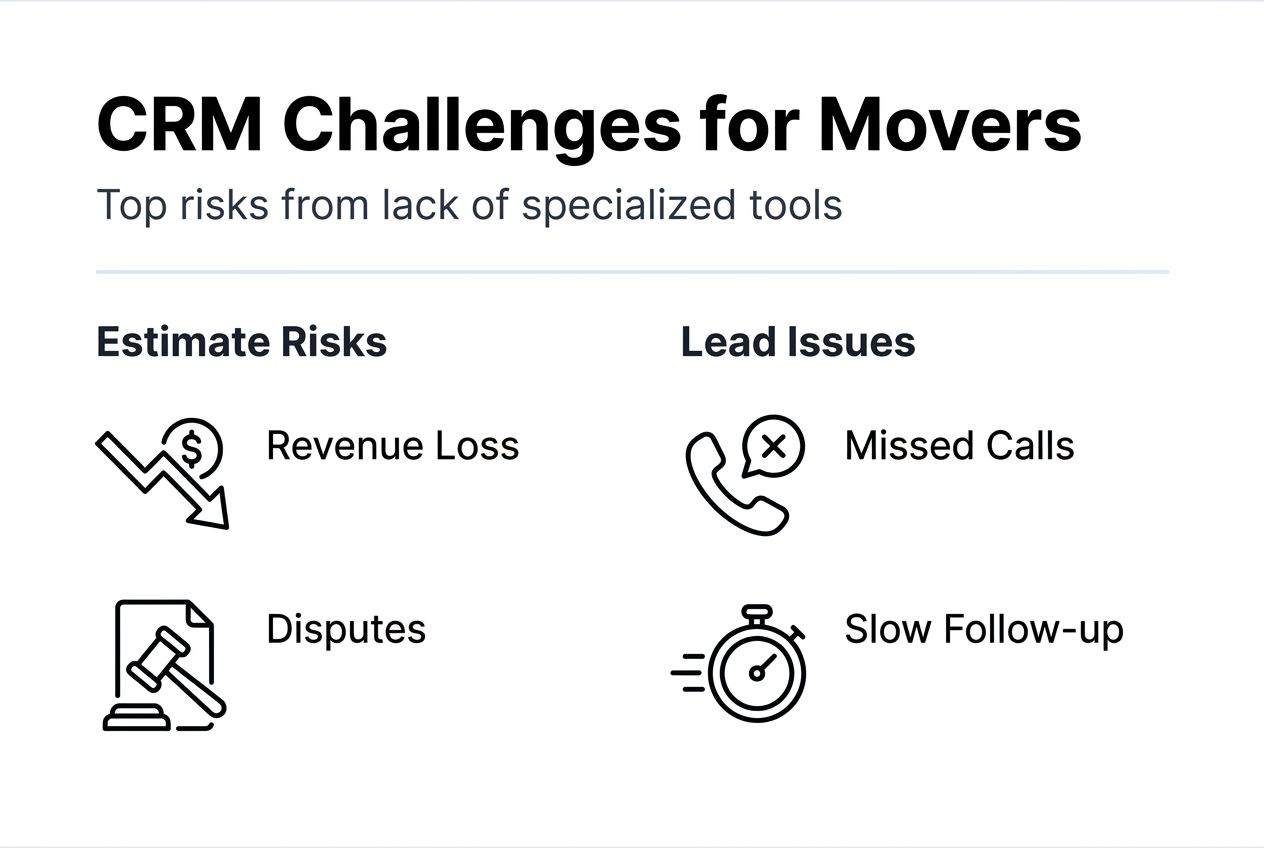
Operational challenges multiply without specialized tools. Inaccurate estimates cause revenue loss and disputes. Poor lead management means missed conversion opportunities. Scheduling complexity results in crew downtime or overwork. Financial errors delay invoicing and payment collection.
Moving companies need systems that speak their language. Digital marketing strategies and pricing strategies work best when supported by operational infrastructure designed for moving industry realities.
Core features of a moving company CRM
Effective moving CRMs deliver five essential capabilities that address industry-specific operational needs. Integrated CRM platforms help moving companies track leads, schedule crews, and invoice customers within a single system, reducing interdepartmental miscommunication by over 40%.
Lead management captures prospect information from multiple sources and automates follow-up sequences. You track inquiry origin, estimate status, and conversion probability. Automated reminders ensure no potential customer falls through gaps. This systematic approach turns more inquiries into booked jobs.
AI-powered volume estimation revolutionizes quote accuracy. Customers record video walk-throughs of their space. The system analyzes room dimensions and inventory automatically. Volume calculations appear within minutes instead of requiring in-person visits. This speed and precision reduce both estimate errors and sales cycle length.

Dispatch and crew scheduling optimize resource allocation across multiple jobs. You assign crews based on job requirements, skill levels, and geographic proximity. Real-time updates adjust schedules as conditions change. Efficient scheduling maximizes crew utilization while minimizing downtime and overtime costs.
Customer portals enhance transparency throughout the moving process. Clients access their inventory lists, volume estimates, and job schedules online. They track shipment status and communicate directly through the platform. This visibility reduces anxiety and support call volume.
Integrated billing and invoicing streamline financial operations. The moving company CRM connects estimates directly to invoices. Integration with QuickBooks and Stripe automates payment processing. You eliminate manual data entry errors and accelerate cash collection. Financial reporting provides clear visibility into revenue, outstanding balances, and profitability by job.
These features work together as an AI-powered moving CRM ecosystem rather than disconnected tools. Data flows seamlessly from lead capture through job completion and payment. Your team spends less time on administrative tasks and more time delivering excellent service.
How AI integration enhances estimation and efficiency
AI transforms moving company operations by automating time-consuming processes and improving accuracy. Traditional manual measurements require scheduling in-person visits, traveling to customer locations, and spending 45-60 minutes measuring rooms and cataloging items. This approach introduces human error and delays quote delivery.
AI room scanning replaces manual measurements with computer vision technology. Customers use smartphones to record video tours of their homes. The AI analyzes video footage to identify rooms, measure dimensions, and catalog visible items. Volume calculations account for furniture density and packing requirements. The entire process completes in minutes rather than hours.
AI-powered CRM systems can reduce moving estimate errors by up to 40% compared to manual methods. Machine learning algorithms improve over time by comparing estimated volumes to actual move weights and cubic footage. The system learns from thousands of jobs, refining predictions for different home types, furniture arrangements, and customer categories.
Faster digital processes save an average of 35 minutes per estimate. You eliminate travel time, reduce scheduling coordination, and accelerate quote turnaround. This speed advantage helps you respond to inquiries faster than competitors still using traditional methods. Quick responses increase conversion rates significantly.
Automation frees staff for higher-value activities. Estimators focus on complex or high-value jobs requiring personal attention. Sales teams spend more time building relationships and closing deals. Administrative staff handle exceptions rather than routine data entry. This productivity shift directly impacts profitability.
AI-driven CRM solutions also improve workflow consistency. Every estimate follows the same process, reducing variability between different staff members. Standardization makes training easier and quality control more effective. Your company delivers predictable service quality regardless of which team member handles the job.
Pro Tip: Balance AI automation with human oversight. While AI handles volume calculations efficiently, experienced estimators should review estimates for unusual situations, high-value items, or complex logistics. This combination delivers both speed and accuracy while maintaining the employee retention benefit of keeping skilled staff engaged in meaningful work.
Common misconceptions about CRM for movers
Several myths prevent moving companies from fully embracing CRM technology. Understanding these misconceptions helps you make informed decisions about platform selection and implementation.
Generic CRMs appear less expensive initially but cost more long-term. You pay for features you don’t need while lacking moving-specific capabilities. Customization requires expensive development work. Integration with estimation and dispatch tools demands additional software purchases. The CRM platform designed for movers includes industry-specific features at competitive pricing.
Modern moving CRMs prioritize user experience, not complexity. Vendors design interfaces for field crews and office staff with varying technical skills. Mobile apps simplify on-site updates. Dashboard layouts present information clearly without overwhelming users. Most platforms offer guided onboarding and ongoing support to ensure smooth adoption.
Key misconceptions include:
- AI replaces human judgment entirely in estimating
- CRM benefits apply only to sales and marketing functions
- Implementation requires massive IT infrastructure investment
- Small moving companies cannot justify CRM costs
AI enhances but does not eliminate human expertise. The technology excels at volume calculations and pattern recognition. Experienced estimators still assess access challenges, identify special handling requirements, and evaluate factors AI cannot see. The best results come from combining AI speed with human insight.
CRM benefits extend far beyond sales management. Dispatch coordination, crew scheduling, inventory tracking, billing accuracy, and customer communication all improve significantly. Operational efficiency gains often exceed sales productivity improvements. The platform touches every department and job phase.
Cloud-based CRMs require minimal IT infrastructure. You access the system through web browsers and mobile apps. The vendor manages servers, security, and updates. Small moving companies benefit proportionally more than large firms because the technology levels the competitive playing field against bigger rivals with more resources.
Pro Tip: Calculate total cost of ownership, not just subscription fees. Factor in time saved on estimates, reduced errors, improved conversion rates, and better resource utilization. Most moving companies achieve positive ROI within six months of implementation.
Comparing specialized moving CRMs vs generic solutions
Specialized and generic CRMs serve different purposes with measurably different outcomes for moving companies.
| Feature | Specialized Moving CRM | Generic CRM |
|---|---|---|
| Volume estimation | AI-powered automated calculation from video | Manual entry or external tools required |
| Crew dispatch | Integrated scheduling with skill and location matching | Basic calendar or separate scheduling software |
| Customer portal | Moving-specific tracking, inventory, and communication | Generic client portal with limited customization |
| Billing integration | Direct connection between estimates and invoices | Manual transfer or custom development needed |
| Industry workflows | Pre-configured for moving operations | Requires extensive customization |
| User adoption rate | Higher due to intuitive moving-focused design | Lower, requires significant training |
Specialized CRMs deliver tailored volume estimation that accounts for packing density, furniture types, and space utilization patterns specific to residential and commercial moves. Generic systems treat estimation as simple data entry without industry context. This difference directly impacts quote accuracy and profitability.
Integrated billing in moving CRMs connects estimates, job changes, and final invoices automatically. When scope changes occur, adjustments flow through to billing without manual updates. Generic CRMs require exporting data to separate accounting systems, introducing errors and delays.
Customer portals in specialized platforms show moving-specific information like inventory lists, volume breakdowns, and shipment tracking. Clients understand exactly what they’re paying for and when service will occur. Generic portals display basic contact information and documents without context relevant to customer experience in moving.
User adoption rates matter significantly. When software matches daily workflows naturally, staff embrace the system quickly. Interfaces designed for moving operations reduce training time and increase usage consistency. Generic CRMs require workarounds that frustrate users and lead to incomplete data entry.
Overall operational efficiency measurably improves with industry-focused platforms. Moving companies using specialized CRMs report 35% faster quote turnaround, 40% fewer estimate errors, and 25% higher lead conversion compared to generic solutions or manual processes. Customer satisfaction scores increase due to better communication and fewer surprises.
Implementing the right CRM for your moving company
Successful CRM implementation requires strategic planning and systematic execution across four key phases.
Assess your company’s specific pain points before evaluating solutions. Document current challenges in detail:
- Estimate accuracy issues and associated dispute costs
- Lead management gaps and conversion rate weaknesses
- Scheduling inefficiencies and crew utilization problems
- Billing errors and cash flow delays
- Customer communication breakdowns and support call volume
Prioritize problems by financial impact and operational disruption. This assessment guides feature evaluation and helps you measure success after implementation.
Evaluate CRM options systematically. Request demos focused on your priority pain points. Test AI estimation accuracy with sample jobs. Review integration capabilities with existing tools like QuickBooks and Stripe. Assess mobile functionality for field crews. Compare pricing models including implementation costs, training, and ongoing support.
Create a phased implementation plan that minimizes disruption. Start with lead management and estimation in month one. Add dispatch and scheduling in month two. Integrate billing and customer portals in month three. This gradual approach allows staff to adapt while maintaining service quality.
Plan comprehensive staff training:
- Executive overview covering strategic benefits and ROI expectations
- Administrative team training on full platform capabilities and workflows
- Sales staff focus on lead management and AI estimation features
- Dispatch and operations training on scheduling and crew coordination
- Field crew orientation on mobile apps and job updates
Communicate benefits clearly to encourage adoption. Explain how the CRM platform makes individual jobs easier, not just company metrics better. Share specific examples of time saved, errors prevented, and customer satisfaction improved. Address concerns transparently and provide ongoing support as users adapt.
Pro Tip: Designate internal champions in each department who become power users first. These advocates help colleagues troubleshoot issues, share best practices, and maintain momentum through the learning curve. Their peer support proves more effective than top-down mandates.
Monitor key performance indicators weekly during the first three months. Track estimate accuracy, conversion rates, scheduling efficiency, and customer satisfaction scores. Adjust workflows based on feedback and results. Most moving companies achieve measurable improvements within 30 days of go-live.
Benefits realized: efficiency, accuracy, and customer experience
Moving companies implementing specialized CRMs achieve quantifiable improvements across all operational areas. Integrated CRMs reduce interdepartmental miscommunication by over 40% while delivering additional measurable benefits.
| Metric | Improvement | Impact |
|---|---|---|
| Operational efficiency | 35% increase | 35 minutes saved per estimate, reduced administrative time |
| Estimate accuracy | 40% error reduction | Fewer disputes, improved profitability per job |
| Lead conversion | 25% increase | Faster response times, better follow-up consistency |
| Customer satisfaction | 30 point NPS gain | Improved communication, transparent processes |
Operational efficiency improves dramatically through workflow automation. Staff complete estimates in 15 minutes instead of 50. Dispatch coordination that previously required multiple phone calls happens through automated crew notifications. Billing cycles shrink from weeks to days. These time savings compound across hundreds of jobs annually.
Estimate errors decrease significantly with AI-powered volume calculation. Accurate quotes reduce costly disputes over final charges. Better predictions improve truck and crew allocation, minimizing wasted capacity or last-minute scrambles for additional resources. Profitability per job increases when estimates match actual requirements.
Lead conversion rates jump when response speed and follow-up consistency improve. You contact inquiries within minutes instead of hours. Automated sequences ensure no prospect gets forgotten. Professional estimates delivered quickly position your company as more capable than competitors still using manual processes.
Customer satisfaction rises with improved transparency and communication. Clients appreciate accurate estimates that match final bills. Real-time tracking reduces anxiety during moves. Easy access to inventory and volume details builds trust. Positive reviews and referrals increase as customer experience improves systematically.
Revenue growth follows naturally from these operational improvements. Higher conversion rates bring more jobs. Better estimates improve margins. Efficient operations allow handling more volume without proportional staff increases. Companies typically see 20-30% revenue growth within the first year of CRM implementation.
Explore Virtual Estimate AI’s CRM solutions for moving companies
Transforming your moving company’s operations starts with the right technology partner. Virtual Estimate AI delivers an AI-powered moving estimates platform built specifically for the challenges you face daily.
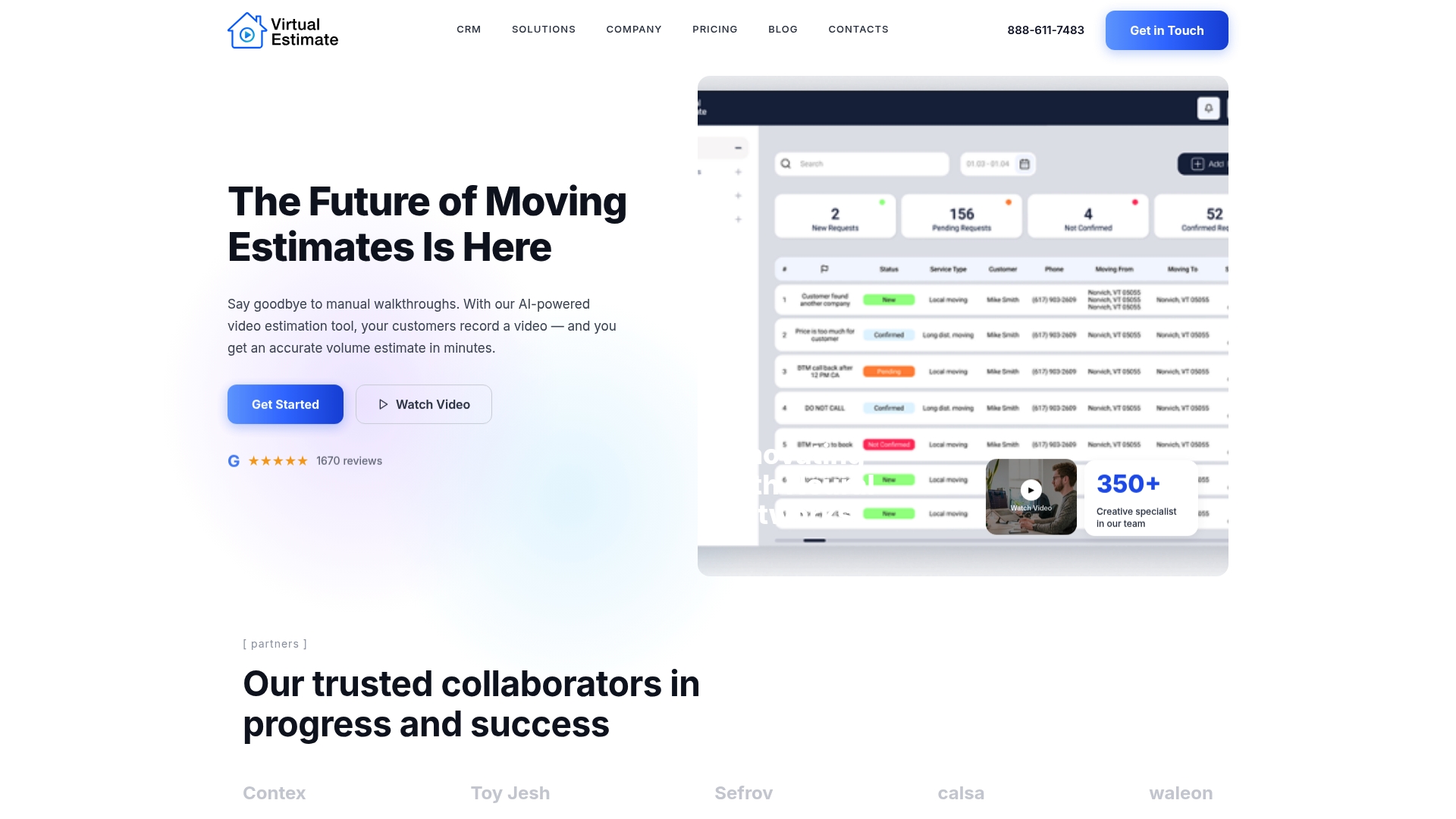
Our CRM platform integrates lead management, AI room scanning, dispatch scheduling, customer portals, and billing into one intuitive system. You eliminate fragmented workflows, reduce estimate errors by 40%, and accelerate quote delivery by 35 minutes per job. Moving companies using Virtual Estimate AI report measurable improvements in conversion rates, operational efficiency, and customer satisfaction within weeks of implementation.
Explore our complete solutions designed to streamline every aspect of your moving business. From initial customer inquiry through final payment, Virtual Estimate AI powers efficient operations that delight customers and improve profitability. Schedule a demo to see how AI-powered estimation and integrated CRM capabilities can transform your moving company in 2026.
Ready to see it in action?
Book a free 20-minute demo and explore how Virtual Estimate can help your business.