

Moving companies that rank on page one of Google generate 3–5x more inbound estimate requests than those on page two — and most local moving markets remain highly winnable. With keyword difficulty scores under 15 for terms like "local movers [city]," the barrier to capturing organic search traffic is lower here than in almost any other home service sector. Yet fewer than 20% of independent moving companies have implemented even basic on-page optimization. This guide delivers a complete, actionable strategy for seo for moving companies — covering audits, keyword research, Google Business Profile setup, content creation, link building, and performance tracking — with every step tied directly to estimate volume and booked jobs.
Key Takeaways
| Point | Details |
|---|---|
| Local intent dominates search | 46% of all Google searches carry local intent; moving company searches skew even higher due to geographic specificity |
| GBP drives map pack visibility | Google Business Profile signals account for an estimated 36% of local pack ranking factors per Whitespark's annual survey |
| Page speed directly impacts revenue | A 1-second load delay reduces conversions by 7%; most moving company sites average 5+ seconds on mobile |
| Citations multiply local rankings | Moving companies with 50+ consistent NAP citations rank 2.6x higher in map pack results than those with fewer than 20 |
| Content compounds over time | Companies publishing 2+ location-optimized pages per month reach 3x organic traffic volume within 12 months |
Step 1: Audit Your Moving Company's Current SEO Performance
Before building anything new, establish a baseline. A proper SEO audit reveals exactly where organic traffic and rankings are leaking — and for most moving companies, the leaks are significant before any new investment is made.
Start with Google Search Console (free). Verify your domain, then review the "Performance" tab after 30 days of data collection. Look for pages generating impressions but low clicks — these are ranking but failing to convert searchers into visitors. Next, run your site through Google PageSpeed Insights to measure Core Web Vitals: the three speed and stability metrics Google uses as a direct ranking signal.

Run a technical crawl using Screaming Frog (free up to 500 URLs) or Semrush. Look for: broken links returning 404 errors, missing or duplicate meta titles and descriptions, thin content on city pages, and pages blocked from indexing via robots.txt. Most moving company websites have 3–5 critical technical errors suppressing rankings before any content or link work begins.
Audit your local presence separately. Search "[your city] movers" in an incognito browser and record your positions in both organic results and the Google Map Pack — the 3-listing block below the map. If your business does not appear in either placement, the audit has already identified the priority.
Pro Tip: Export your Google Search Console data and filter for keywords containing your city name. Any keyword ranking in positions 11–30 is low-hanging fruit — a single focused page update or one targeted new backlink can push it onto page one within 60–90 days.
Step 2: Research the Right Keywords for Moving Companies
Keyword research for movers follows a specific hierarchy. Not all keywords for moving company pages carry equal weight — and targeting highly competitive terms before establishing local authority wastes months of effort.
The primary framework is three-tier:
- Hyperlocal transactional keywords — "movers in [neighborhood]", "moving company [city name]". Lower volume, highest conversion intent, lowest keyword difficulty (KD 2–15). Start here.
- City-level service keywords — "local movers [city]", "residential moving company [city]", "long distance movers [city]". Volume ranges 200–2,000 per month. Target in months 1–3.
- Informational keywords — "how much does it cost to move a 2-bedroom apartment", "moving checklist". High volume, lower intent, critical for building topical authority.
The table below provides a keyword difficulty matrix calibrated specifically for moving companies in 2026. Use it to prioritize your content roadmap based on available resources and competitive landscape.
| Keyword Type | Example Keyword | Est. Monthly Volume | KD Score | Target Timeline |
|---|---|---|---|---|
| Hyperlocal service | "movers in [neighborhood]" | 50–200 | 2–8 | Immediate |
| City-level local | "local movers [city]" | 200–1,000 | 8–18 | Month 1–3 |
| Long distance | "long distance movers [city]" | 300–800 | 12–22 | Month 1–3 |
| Commercial moving | "commercial movers [city]" | 100–400 | 10–20 | Month 3–6 |
| Branded comparison | "best moving company [city]" | 500–2,000 | 18–35 | Month 6+ |
| Informational | "how much does moving cost" | 1,000–5,000 | 25–45 | Ongoing |
For service pages, always combine service type with geography: "piano movers Chicago," "apartment movers Austin," and "office relocation Seattle" dramatically reduce competition while capturing high-intent buyers. Review your moving company pricing strategies in parallel — service page keywords should align with the estimate types you actually book.
Use Google's autocomplete and "People Also Ask" boxes to surface long-tail variations. Type "movers in [your city]" and record every auto-suggested phrase. These represent real searches from active buyers planning a move.
Step 3: Optimize Your Google Business Profile for Local Search
Understanding how to rank a moving company on Google requires treating GBP and organic results as two distinct but reinforcing systems. Google Business Profile is the single highest-ROI action for local seo moving company performance — a fully optimized listing can secure map pack placement within 60–90 days, generating inbound calls without ad spend.
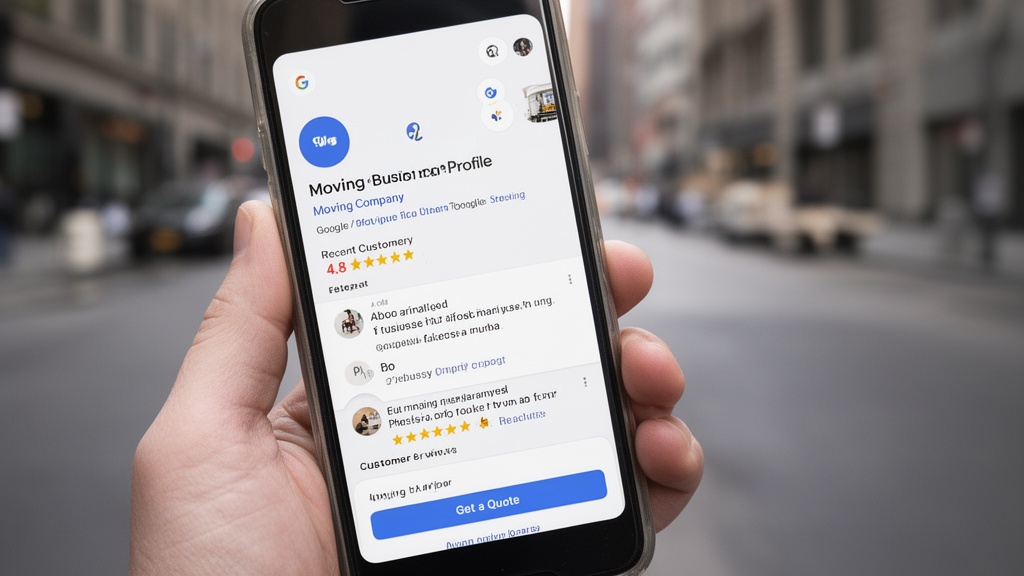
Start with the fundamentals: ensure your business name exactly matches your legal operating name — no keyword stuffing like "ABC Movers — Best Moving Company Chicago." Set your primary category to "Moving company" and add secondary categories including "Storage facility," "Piano moving service," or "Commercial mover" where applicable. NAP (Name, Address, Phone) must be identical across your GBP listing, your website, and all third-party directories — a single inconsistency dilutes google business profile for movers authority signals.
Upload a minimum of 20 photos: exterior, interior, trucks in livery, crew in uniform, and completed job shots. Listings with 20+ photos receive 35% more clicks than listings with fewer than 10, according to Google's own profile performance data. Activate the "Get a Quote" messaging feature to capture leads directly from the map pack.
Review acquisition is non-negotiable. Businesses with 50+ Google reviews and a 4.7+ star average dominate local pack results in competitive metro areas. Build a systematic post-job review request via SMS — a 24-hour follow-up message converts at 18–25% when personalized with the customer's first name and move date.
Pro Tip: Post a GBP Update every 7–10 days featuring a customer testimonial, a seasonal moving tip, or a service promotion. Active posting signals to Google that your listing is current and maintained, which directly correlates with higher map pack visibility.
Virtual Estimate can help: Virtual Estimate's AI-powered platform enables moving companies to capture leads directly from their Google Business Profile with instant online estimates — reducing response time from hours to seconds and converting more map pack visitors into booked jobs. Learn more →
Step 4: Build SEO-Optimized Service and Location Pages
Service and location pages are the structural foundation of moving company website optimization. Each page targets a specific keyword cluster and serves a distinct search intent.
Every moving company needs at minimum these page types:
- Service pages: Residential Moving, Commercial/Office Moving, Long-Distance Moving, Packing Services, Storage Solutions, Specialty Moving (piano, fine art, antiques)
- Location pages: One per city or distinct metro area served. If you cover 15 neighborhoods, build 15 pages.
- Combination pages: "Long Distance Movers [City]", "Apartment Movers [Neighborhood]" — these capture high-intent, lower-competition queries that generalist competitors ignore.
Each page requires: a distinct H1 containing the primary keyword, a unique meta title (50–60 characters), a meta description with a clear call to action, and a minimum of 600 words of original content. Never clone pages by swapping only the city name — Google identifies thin, templated content and suppresses it in rankings. Instead, include neighborhood-specific details: local landmarks, parking considerations, typical floor-access challenges, and testimonials from customers in that specific area.
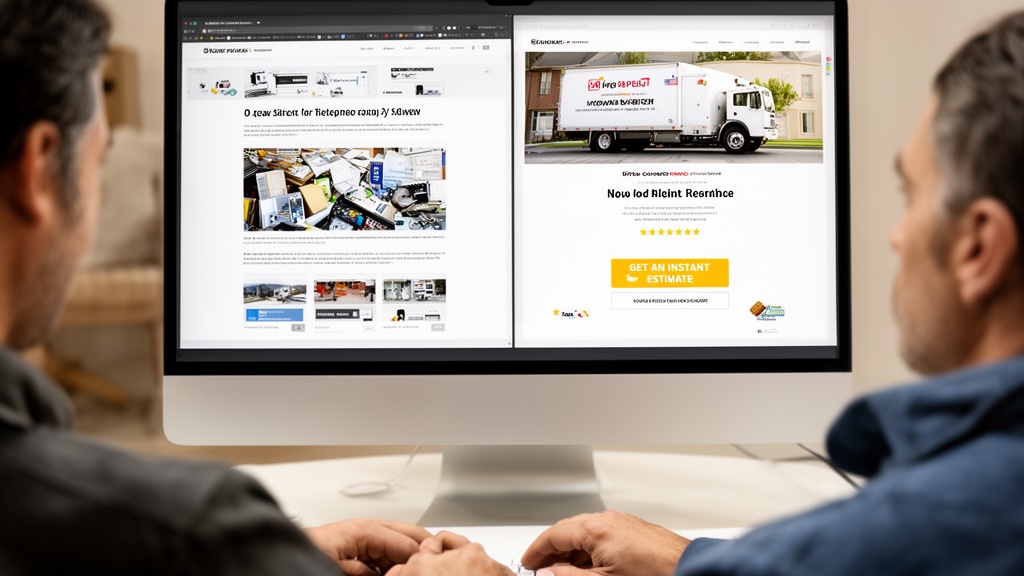
Integrate AI-powered estimate tools that reduce bounce rate and improve conversion directly on service pages. A prominent "Get an Instant Estimate" button above the fold captures visitors at their highest intent moment — and a lower bounce rate signals to Google that the page delivers genuine value. Explore AI-powered moving estimate software to understand how technology integration directly supports moving company google ranking.
Page speed is a direct ranking factor. Compress all images to under 100KB, implement a CDN, and eliminate render-blocking JavaScript. The target for moving company service pages is under 2.5 seconds load time on mobile, which requires deliberate optimization for most shared-hosting environments.
Step 5: Create Content That Attracts Moving Leads
Content marketing for movers is not about volume — it is about building topical authority that signals to Google your domain is the definitive resource for moving-related queries. When your site comprehensively covers the topic space, rankings lift across all pages including revenue-generating service pages.
The most effective content categories for moving company organic traffic include:
- Moving guides by city: "Moving to Austin: Neighborhoods, Costs & What to Know" — captures early-funnel searchers planning relocation 3–6 months out
- Cost calculators and guides: "How Much Does It Cost to Move a 3-Bedroom House in [City]?" — high search volume, high intent, drives estimate requests
- Checklists: "Moving Checklist: 8 Weeks Before Your Move" — earns natural backlinks from real estate blogs and lifestyle sites
- Comparison content: "Local vs. Long-Distance Moving: Key Differences and Costs" — targets informational queries while building service-page authority
For a complete multi-channel integration strategy, the digital marketing strategies for moving companies guide covers paid ads, social media, and email alongside SEO. For content that demonstrates service quality, linking to resources on customer experience for movers provides proof points that convert readers into customers.
Publish at a minimum cadence of 2 pieces per month. Companies sustaining this cadence for 12 months consistently see 180–300% cumulative organic traffic growth versus their starting baseline. Each new piece also creates internal linking opportunities that distribute page authority across your domain and reinforce ranking signals for your highest-value service pages.
Pro Tip: Target "moving to [city]" keywords with comprehensive relocation guides. These pages attract inbound links from local real estate agents, apartment complex websites, and city guides — turning your content into a passive link-building machine with zero ongoing outreach required.
Discover how AI agents can automate your moving company's online presence to scale moving company content marketing without proportionally scaling headcount.
Step 6: Build Local Citations and Backlinks
Local citations — consistent mentions of your business name, address, and phone number (NAP) across the web — are the backbone of local citations for movers and map pack rankings. According to Whitespark's Local Search Ranking Factors report, citation consistency ranks among the top 10 local ranking signals for map pack positions.
Start with tier-1 citations: Google Business Profile, Apple Maps, Bing Places, Yelp, Facebook, and the Better Business Bureau. These are non-negotiable. Then build tier-2 citations across moving-industry-specific directories: HireAHelper, Moving.com, MyMovingReviews, Angi, and HomeAdvisor. Use the exact same business name format, address abbreviations, and phone number across every platform — inconsistency is the most common citation error.
Moving company backlinks come from several reliable acquisition channels:
- Local news outlets: Pitch a newsworthy angle — "Local Mover Helps 40 Families Relocate During Polar Vortex" — to earn .news or local authority domain links
- Chamber of commerce membership: Most local chambers include a directory listing with a dofollow backlink
- Real estate partnerships: Write a moving FAQ for a local agent's site in exchange for a link to your service page
- Event sponsorships: Sponsor a local 5K or community event and request a link from the event website
- HARO/Connectively: Respond to journalist queries about moving, real estate, or home services topics to earn editorial links
| Citation Tier | Platform Examples | Impact Level | Build Timeline |
|---|---|---|---|
| Tier 1 — Core | Google, Apple Maps, Bing, Yelp, BBB | Critical | Week 1 |
| Tier 2 — Industry | HireAHelper, Moving.com, Angi, HomeAdvisor | High | Week 2–4 |
| Tier 3 — Local | Chamber of Commerce, local business directories | Medium | Month 1–2 |
| Tier 4 — Editorial | Guest posts, news mentions, resource page links | High (long-term) | Ongoing |
Use a moving company CRM to manage inbound leads and track which citation platforms and directories are driving calls — this data directly prioritizes where to invest link-building budget next.
Step 7: Track Rankings and Measure SEO Results
Moving company search engine optimization only produces ROI when you can measure it. Without tracking infrastructure in place, you cannot identify what is working, what is wasting budget, or where to allocate effort next.
Set up these four measurement systems from week one:
- Google Search Console — tracks impressions, clicks, average position, and CTR for every query. Review weekly for emerging keyword opportunities and position changes.
- Google Analytics 4 — monitor organic traffic sessions, bounce rate, and goal completions (estimate form submissions, call button clicks). Configure conversion events immediately.
- Rank tracking tool — Semrush, Ahrefs, or BrightLocal for weekly keyword position monitoring. BrightLocal is especially effective for local pack tracking in specific cities.
- Call tracking — CallRail or similar assigns a unique number to organic search visitors, providing definitive proof of SEO-generated calls separate from other channels.
The metrics that matter for moving companies are not vanity metrics — they are estimate volume, conversion rate, and cost per booked job. Connect SEO data to your moving company CRM to manage inbound leads to close the loop between organic traffic and booked revenue.
Report monthly on:
- Organic sessions (total and segmented by service/location page)
- Google map pack positions for top 10 target keywords
- GBP calls, direction requests, and website clicks
- Estimate form completions attributed to organic search
- Booked jobs sourced from organic search channel
A realistic seo for movers timeline starting from zero: hyperlocal keywords appear in 60–90 days; city-level keywords in 3–6 months; competitive metro terms in 6–12 months. According to Ahrefs' analysis of 2 million pages, only 5.7% of newly published pages reach the top 10 within a year — consistent, compounding effort is the only path to durable moving business online visibility.
Common SEO Mistakes Moving Companies Make (and How to Fix Them)
Even companies actively investing in SEO leave significant ranking potential unrealized. These are the highest-impact errors — each one directly suppressing organic traffic and estimate volume.
Mistake 1: Duplicate location pages. Creating 20 city pages by swapping only the city name triggers Google's thin content filters. Fix: write 400+ words of genuinely unique content per location, including neighborhood-specific logistics, local testimonials, and city-specific pricing context.
Mistake 2: Mobile neglect. Google's mobile-first indexing means the mobile version of your site is what Google actually evaluates and ranks. Moving company owners who test exclusively on desktop miss broken layouts and unclickable phone numbers. Fix: run every page through Google's Mobile-Friendly Test and resolve every flagged issue before publishing.
Mistake 3: Static review profile. A moving company with 200 reviews that stopped receiving new ones 18 months ago sends a weaker trust signal than a competitor with 60 reviews but 5 new ones per month. Fix: automate post-job review requests via SMS within 24 hours of job completion.
Mistake 4: Keyword cannibalization. Multiple pages targeting the same query — three city pages all optimized for "Chicago movers" — split ranking power and confuse Google about which page to surface. Fix: consolidate overlapping pages via 301 redirects and clearly differentiate remaining pages by service type or geographic specificity.
Mistake 5: Neglecting moving company content marketing beyond core service pages. Companies publishing zero content rely entirely on service pages for organic reach, which caps topical authority. Fix: commit to a minimum 2-posts-per-month editorial calendar tied to keyword data with measurable search volume.
For a benchmark of seo strategy for movers executed at scale, see how the top-rated moving companies in New York City approach their digital presence in the most competitive U.S. moving market.
Related Articles
- Digital Marketing Strategies for Moving Companies: A Complete Guide — Expand beyond SEO with paid ads, social media, and email marketing strategies purpose-built for movers.
- CRM for Moving Companies: Streamline Operations 2026 — Discover how a purpose-built CRM connects organic SEO leads to a systematic sales and dispatch workflow.
- Customer Experience Excellence in Moving Services — Understand how service quality and online reputation reinforce each other to improve organic rankings over time.
Ready to see it in action?
Book a free 20-minute demo and explore how Virtual Estimate can help your business.