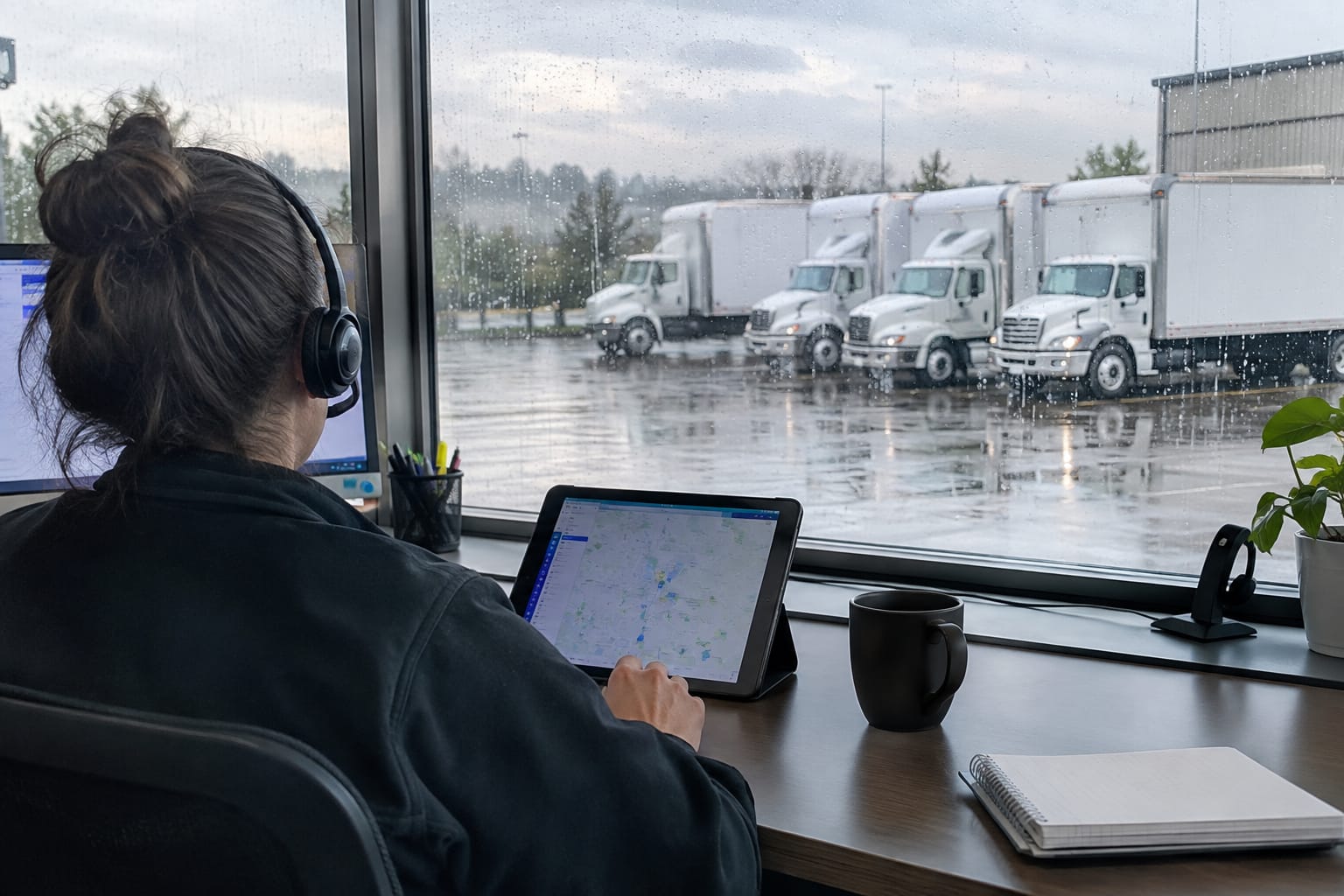

Moving logistics is the coordination of inventory, crews, trucks, storage, and paperwork that turns a booked move into a completed, paid job. This guide is for owners, general managers, and dispatchers of US moving companies, typically running a few trucks and a growing crew, who want fewer surprises on move day and more margin per job.
Most content on the topic targets households planning their own move or freight supply chains. This article covers the operator's side instead. It breaks moving logistics into working stages, shows where each stage leaks time and money, and explains how to measure whether the operation is improving.

Key Takeaways
- Inventory drives every logistics decision. Cubic feet, crew size, truck assignment, and hours all derive from the survey inventory, so an incomplete inventory breaks the whole day's plan.
- Remove re-entry between stages. The largest efficiency gains come from one job record flowing from estimate to Bill of Lading, dispatch, payroll, and invoice without retyping.
- Interstate rules shape estimates and storage.
- Field data must work offline. Basements, elevators, and rural routes drop signal, so the foreman's paperwork, photos, and times need to sync later rather than fail.
- Estimated vs actual is the core metric. Tracking variance by estimator, survey method, and crew reveals whether problems come from surveys, pricing, sizing, or execution.
What Moving Logistics Means for an Operating Company
For a mover, logistics is every decision between the first phone call and the final payment. It covers how much the customer owns, which crew and truck handle the job, when they arrive, where the goods sit if delivery is delayed, and what the job actually cost.
The moving supply chain differs from freight in three ways. Every shipment is unique. The customer is present and emotionally invested.
Q: What is the difference between moving logistics and freight logistics?
A: Freight logistics moves standardized, palletized goods between businesses, while moving logistics handles one household's unique inventory.
That distinction shapes everything downstream. A freight planner optimizes lanes and pallets. A moving logistics company optimizes crews, survey accuracy, and the customer's trust in the number they were quoted.
Terminology varies between companies and regions. A shared moving and storage glossary helps sales, dispatch, and crews use the same words for the same things, which reduces handoff errors.
The Logistics Lifecycle: Lead to Final Invoice
Every move passes through the same core stages, whether the company runs two trucks or fifteen. Each stage produces data the next one depends on. When that data is wrong or retyped, errors compound.
| Stage | What happens | Data it produces | What breaks when it is wrong |
|---|---|---|---|
| 1. Intake and survey | Lead captured, inventory collected | Room-by-room inventory, access notes | Every later estimate and plan |
| 2. Estimate | Inventory priced with company rates | Cubic feet, hours, crew size, price | Margin, customer trust |
| 3. Booking and contract | Customer signs, deposit taken | Confirmed date, terms | Disputes, cancellations |
| 4. Dispatch and scheduling | Crew and truck assigned | Daily board, arrival windows | Double-booking, overtime |
| 5. Capacity planning | Truck sized to the load | Truck assignment, loading plan | Second trips, idle space |
| 6. Field execution | Load, transport, unload | Signed Bill of Lading, photos, times | Claims, payroll errors |
| 7. Storage-in-transit | Goods held between pickup and delivery | Vault location, billing schedule | Lost items, unbilled storage |
| 8. Invoice and payment | Final charges collected | Paid invoice | Cash flow |
| 9. Review | Estimated vs actual compared | Variance by job and estimator | Repeat mistakes |
The biggest efficiency gains rarely come from working faster inside one stage. They come from removing re-entry between stages. The end-to-end moving company CRM operations guide walks through how a single job record carries data across this lifecycle.
Accurate Inventory and Estimates as the Logistics Foundation
The inventory is the input for every logistics decision. Cubic feet determines the truck. Item count and access conditions determine crew size and hours. Fragile or oversized items determine materials and special handling.
An inaccurate inventory does not just produce a wrong price. It sends the wrong truck, the wrong crew size, and an arrival window the crew cannot meet. One missed garage or storage unit can wreck an entire day's schedule.
Interstate movers also face formal estimate rules.
Q: What is the 110% rule for interstate moving estimates?
A: Confirm the current rules on collecting payment against a non-binding estimate with the relevant federal authority before relying on any limit.
Survey methods have shifted. In-home walkthroughs cost estimator drive time, and live video calls depend on the customer showing up. Customer-recorded video with AI inventory detection lets the customer capture the home on their own schedule. The comparison of how AI video scanning replaces the in-home moving survey covers the tradeoffs in detail.
Whatever the survey method, the estimate should come from structured inventory, not from memory. Estimate software that prices local, long-distance, and flat-rate moves from the inventory keeps rates and surcharges consistent across estimators. For a deeper look at the category, see this overview of estimating software for movers.
Pro Tip: Require the same inventory record to flow from the estimate into the Bill of Lading. If anyone retypes the inventory, that step is where most disputes begin.
Dispatch, Routing, and Crew Scheduling
Dispatch matches three scarce resources to each job: a qualified crew, a suitable truck, and a realistic time window. Good dispatch and routing keeps all three busy without overcommitting any of them.
The constraints stack up quickly. A dispatcher must account for:
- Crew availability and roles: each job needs a foreman, and long-haul jobs need a qualified driver.
- Truck assignment: the right size, available for the full job duration including return.
- Access conditions: stairs, elevators with reserved windows, long carries, and parking permits.
- Job sequencing: a morning job that runs long can collapse an afternoon booking.
Whiteboards and spreadsheets handle these constraints until volume rises. Then double-booked trucks, crews sent to the wrong address, and late schedule changes become weekly events. A dispatch and scheduling board built for movers addresses this with conflict protection, calendar sync, and automatic crew sizing based on the job.
Crew scheduling also carries a retention dimension. Predictable schedules and fair job distribution matter to crews, as covered in this guide on employee retention strategies for moving companies.
Peak season exposes every weakness in dispatch. Locking crew availability, truck maintenance, and buffer days ahead of summer is the core of moving company peak season preparation.
Truck and Capacity Planning by Cubic Feet
Truck capacity planning answers one question: will the load fit, with room to pack it safely? Cubic feet is the working unit. The inventory converts to a total cubic volume, which then maps to a truck size or a combination of trucks.
Raw volume is only the starting point. Real loads take more space than the sum of the items because of furniture pads, disassembled pieces, awkward shapes, and items that cannot be stacked. Experienced foremen plan for that gap rather than loading to the theoretical maximum.

Cubic feet truck sizing errors are expensive in both directions. An undersized truck means a second trip, overtime, and an unhappy customer. An oversized truck wastes fuel and ties up equipment another crew needed that day.
A cubic feet calculator for truck sizing turns an item list into total volume and a suggested truck size. Running every estimate through the same calculator keeps sizing consistent across estimators and dispatchers.
Pro Tip: When volume falls close to a truck's limit, flag the job on the dispatch board before move day. Deciding between a larger truck and a second vehicle the night before leaves no good options.
Field Execution: Crews, Paperwork, and Offline Job Data
Move day is where planning meets reality. The foreman needs the job details, inventory, customer contact, and access notes on hand. The office needs times, photos, signatures, and any changes captured accurately.
The Bill of Lading anchors field paperwork. Paper forms invite missing fields, illegible handwriting, and lost copies.
An electronic Bill of Lading with on-screen signatures pulls inventory straight from the estimate. It records each party's signature with a timestamp and location.
Connectivity is the practical obstacle. Basements, high-rise freight elevators, and rural highways regularly drop signal. A crew app that works offline lets the foreman complete the Bill of Lading and capture photos without signal, then syncs when the connection returns.
Before-and-after photos matter beyond paperwork. Photos tied to the job record, alongside the signed Bill of Lading and inventory, turn a damage claim into a documented file rather than an argument.
Accurate start, stop, and break times also feed payroll directly. When crew hours come from the job record instead of handwritten timesheets, payroll disputes drop and the estimated vs actual comparison becomes trustworthy.
Storage-in-Transit and Warehouse Logistics
Many moves do not go straight from origin to destination. A closing date slips, a renovation runs long, or a long-distance customer needs time before delivery. For movers with their own warehouse, storage in transit becomes a logistics stage of its own.
Q: What is storage-in-transit in a moving company?
A: Confirm the current regulatory definition of storage-in-transit with the relevant authority.

Warehouse logistics depends on traceability. Each vault or unit needs a clear tag, a recorded location, and a link back to the job's inventory. When a delivery date arrives, the crew should pull the right vaults without searching the aisles.
Billing is the second failure point. Storage that is not tied to the move record tends to go unbilled, billed late, or billed at the wrong rate. Recurring billing with past-due handling keeps storage revenue from leaking.
The regulatory side matters too.
Managing storage-in-transit agreements tied to the move keeps the vault, the billing schedule, and the delivery job connected in one record.
Measuring Logistics Performance: Estimated vs Actual
The single most useful logistics metric is estimated vs actual: how closely each completed job matched its estimate. Every planning error shows up as a variance, whether it came from the survey, the pricing, the crew size, or the truck.
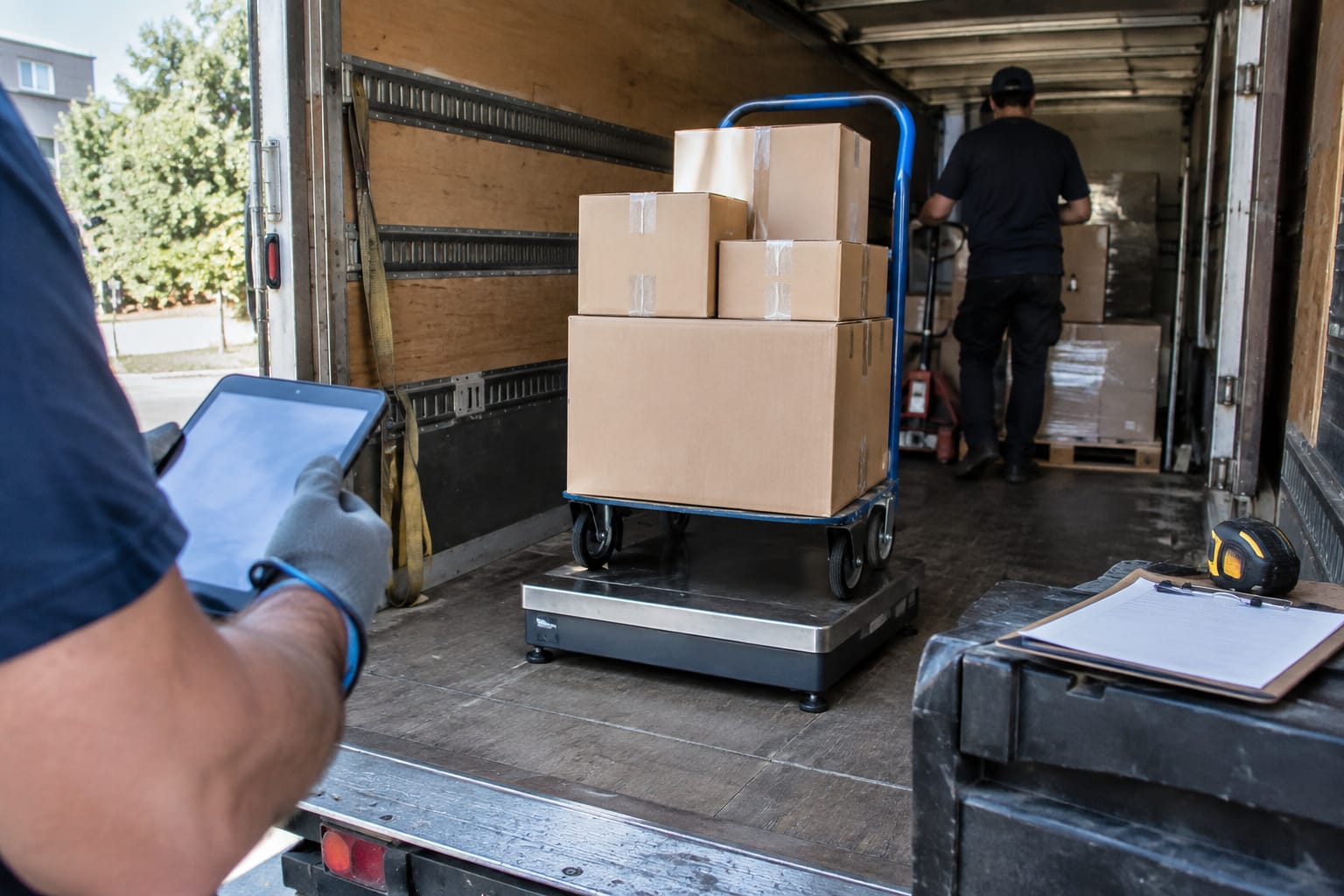
Track these metrics per job, then roll them up by estimator, survey method, job type, and crew:
| Metric | What it reveals | Where the data comes from |
|---|---|---|
| Estimated vs actual hours | Survey accuracy, crew efficiency | Estimate and crew time records |
| Estimated vs actual volume | Inventory completeness | Estimate and Bill of Lading |
| Planned vs actual crew size | Dispatch sizing logic | Dispatch board and payroll |
| Revenue per truck day | Fleet utilization | Invoices and dispatch board |
| On-time arrival | Scheduling realism | Crew app timestamps |
| Claims per job | Handling and documentation quality | Claims records |
| Revenue by lead source | Marketing return | CRM lead records |
The value comes from patterns rather than single jobs. If one estimator consistently underestimates hours on walk-up apartments, the fix is training or a rate adjustment, not working the crews harder. The same data informs pricing strategies for moving companies.
This analysis only works when estimates, payroll, and invoices live in the same system. A moving company CRM with built-in estimated vs actual reporting ties each job's estimate to its payroll and revenue, with a P&L view company-wide or per branch.
Pro Tip: Review variances weekly during peak season, not monthly. A pricing or sizing error repeated across thirty summer jobs costs far more than catching it after the first five.
Software That Ties the Logistics Chain Together
Logistics software for movers earns its cost by eliminating handoffs. The goal is one job record that starts at the lead and ends at the paid invoice, with every stage reading from and writing to it.
When evaluating tools, check whether each capability connects to the others:
- Inventory to estimate: does the survey inventory price the job automatically with company rates?
- Estimate to Bill of Lading: does the inventory carry into the contract without retyping?
- Estimate to dispatch: does crew size and truck selection follow from the estimated volume and hours?
- Field to office: does the crew app capture signatures, photos, and times offline?
- Job to storage: are storage-in-transit vaults and billing linked to the move?
- Job to payroll: do crew pay and commissions calculate from completed jobs?
- Job to reporting: can managers see estimated vs actual on every job?
A stack of disconnected apps can cover each stage individually and still fail this test. The overview of apps for moving companies and the checklist on what to look for in a CRM for moving companies help frame those evaluations.
A practical first step needs no software at all. Map the current lifecycle on one page, mark every point where someone retypes data or makes a phone call to confirm details, and rank those points by how often they cause a problem on move day. That list becomes the requirements document for any tool under consideration.
Related Articles
- CRM for Moving Companies: Streamline Operations — how a moving CRM connects sales, dispatch, and billing into one workflow.
- Faster Quote Turnaround: How Moving Companies Book More Jobs — why estimate speed affects booking rates and how to shorten the quote cycle.
- Automated Moving Surveys to Collect Client Information — how self-guided surveys capture inventory and job details before the estimate.
- Customer Experience Excellence in Moving Services — the operational habits that shape how customers judge a move.
Useful Links
- Moving Dispatch Software & Scheduling
- Moving Company Reporting & Analytics Software
- Moving Cubic Feet Calculator
- Storage-in-Transit and Storage Billing for Movers
- Moving and Storage Glossary
Need help with this? Moving Estimate Software for Movers · Get started · Call (888) 611-7483
Ready to see it in action?
Book a free 20-minute demo and explore how Virtual Estimate can help your business.