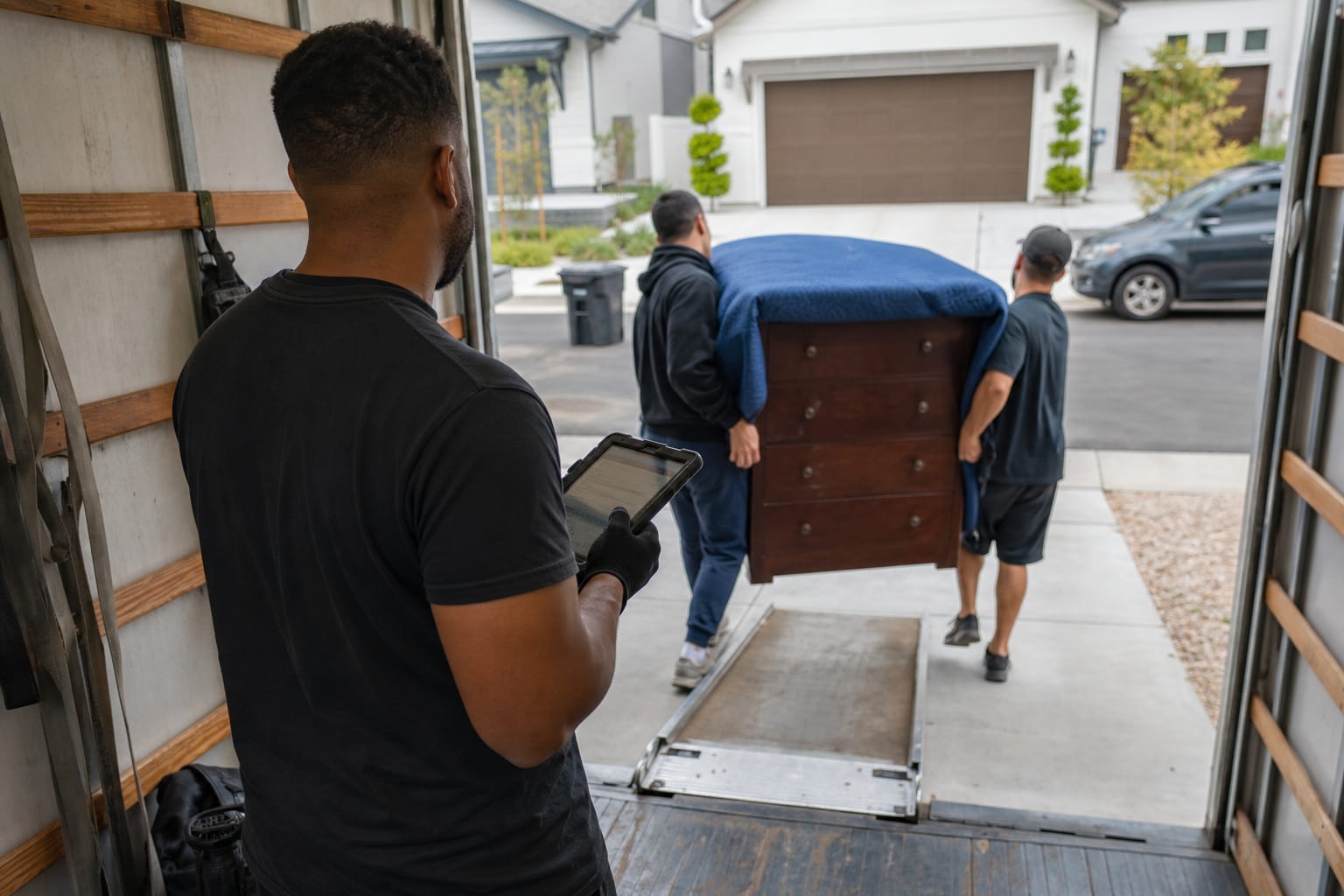

For owners, GMs, sales managers, and dispatchers of US moving companies, the moving company sales process is the repeatable set of stages a mover uses to turn a raw inquiry into a booked, deposited job: capture, first response, qualification, survey, quote, follow-up, and booking. Run consistently, it removes guesswork and stops jobs from leaking between the phone call and the truck.
Price isn't the only way small movers lose jobs. Slow replies, no-show estimates, and quotes nobody ever chased lose them too. This guide breaks the process into seven named stages — who touches the deal, what triggers the next step, and where the work usually falls apart.

What a Moving Company Sales Process Actually Is
A sales process is a written sequence of steps that moves a lead from "just asking" to "deposit paid." It is not a personality trait or a pep talk. It is a checklist with owners and exit criteria.
Here's the difference that matters for a 2–15 truck operation. A funnel describes how leads narrow from many to few. A pipeline is the operational version of that funnel inside your software, with each deal sitting in a named stage until something moves it forward.
The payoff is predictability. When every inquiry runs the same track, you can see how many jobs sit at each stage, spot the leak, and coach one step instead of blaming the whole month.
The Seven Stages, End to End (Quick Map)
Most booked moving jobs pass through the same seven stages. Each one has a single exit criterion — the thing that must be true before the deal advances.
- Capture — every inquiry lands in one system. Exit: contact and move details recorded, no lead lost to voicemail.
- First response — someone replies fast. Exit: two-way contact made (call, text, or reply).
- Qualify — confirm it's a real, servable job. Exit: move date, origin, destination, and rough scope known.
- Survey — inventory the home. Exit: room-by-room inventory captured.
- Quote — present a clear, itemized price. Exit: customer has seen and understood the estimate.
- Follow-up — chase a decision. Exit: a yes, a no, or a firm next date.
- Book — collect a deposit and hand off. Exit: deposit paid, job scheduled, dispatch notified.
| Stage | Owner | Trigger | Exit criteria |
|---|---|---|---|
| 1. Capture | Whoever answers first (or the CRM) | Inbound call, web form, or ad lead | Lead logged with contact + move basics |
| 2. First response | Sales coordinator / owner | New lead appears in the pipeline | Two-way contact made |
| 3. Qualify | Sales coordinator | Contact established | Date, addresses, scope, budget fit confirmed |
| 4. Survey | Estimator (or customer, on video) | Lead qualified | Full inventory captured |
| 5. Quote | Estimator / owner | Survey complete | Priced estimate delivered and explained |
| 6. Follow-up | Sales coordinator | Quote sent, no decision | Yes, no, or scheduled next step |
| 7. Book | Sales coordinator / office | Verbal yes | Deposit paid, job on the dispatch board |
Hand that table to a new hire and they know exactly what "done" looks like at every step.
Stage 1: Capture Every Inquiry in One Place
You cannot sell a job you never recorded. The first stage is simply making sure every call, form, text, and ad lead lands somewhere you can act on it — not scattered across a cell phone, a shared inbox, and a sticky note.
The leak here is invisible because it looks like nothing happened. An after-hours call goes to voicemail, the caller books the mover who answered, and the missed lead never appears in any report. Auto-importing web and ad-form leads straight into a moving company CRM pipeline closes that gap by timestamping every inquiry the moment it arrives.

Pro Tip: Route missed and after-hours calls to an instant text-back. A lead who gets "Thanks for calling — what's your move date?" within a minute stays warm until a human can call. A systematic approach to how you track, nurture and convert leads starts with never dropping one at the door.
Stage 2: First Response — The Window That Decides the Job
Q: How fast should a mover respond to a new moving lead?
A: Within five minutes for online and ad-form leads.
Speed wins moving jobs because customers shop several companies at once and often book the first credible mover who calls back. The reality is blunt: lead response time decides which movers win jobs, and the gap between a five-minute reply and a five-hour reply is the gap between booked and gone.
The exit criterion is two-way contact — not "I left a voicemail." A voicemail is a hope, not a response. If a call doesn't connect, a text and an email should fire immediately so the conversation actually starts.
Stage 3: Qualify Before You Spend an Estimator's Day
Qualification confirms three things: the move is real, it's on a date you can service, and the scope fits what you do. Skip it and you'll send an estimator across town for a job you were never going to run.
Q: Should every moving lead get a full estimate?
A: No. Estimate only leads that clear basic qualification — confirmed move date, origin, destination, and a scope you actually service. In-home surveys cost hours of a paid estimator's day; screen first, survey second.
Keep the qualifying questions short and consistent: When are you moving? Where from and to? House, apartment, or storage? Any long carries, stairs, or elevators? A one-page qualification script keeps every coordinator asking the same things, which makes your pipeline data comparable across reps.
Qualification also sets pricing expectations early. If the customer's budget and the job's real cost are miles apart, it's cheaper to learn that now than after a two-hour survey.
Stage 4: Run the Survey — In-Home, Live Video, or AI Video Walkthrough
The survey turns "a three-bedroom house" into a room-by-room inventory you can price. You have three practical formats, and they trade accuracy against speed and cost.
In-home surveys are the traditional gold standard for accuracy but eat hours in drive time — and they no-show. Live video calls save the drive but still require both sides to be free at the same moment. The types of moving estimates each carry different accuracy and liability, so match the format to the job size.

The format that removes the scheduling problem is a self-recorded AI video estimation walkthrough. The customer gets a magic link by text or email — no app to install — and films their rooms whenever it's convenient. Most people finish the walkthrough in about five to eight minutes, and a priced, room-by-room estimate lands back in the system ready to review. This approach to AI video scanning that replaces the in-home survey attacks the single biggest survey leak: the estimate no-show.
Pro Tip: For any survey format, capture stairs, long carries, and bulky specialty items explicitly. Those are the details that blow up a quote after the truck arrives — and destroy trust.
Stage 5: Present the Quote So It Survives Price Shopping
A quote that's just a number invites the customer to compare you on that number alone. A quote that shows the inventory, the crew size, the truck, and what's included survives the price-shopping call because it explains why it costs what it costs.
How you build the number matters as much as how you present it. Getting clear on how movers price jobs across common pricing models — hourly, weight, or flat — keeps your estimates consistent and defensible when a customer pushes back.
Speed still counts here. A post on faster quote turnaround so movers book more jobs points to the same pattern as first response: the quote that arrives while the customer is still deciding beats the one that arrives tomorrow. Send the itemized estimate the same day the survey completes, and confirm the customer opened it.
Stage 6: Follow Up Until You Get a Yes or a No
Follow-up is not nagging — it's finishing the conversation you started.
Q: How many times should you follow up on a moving quote?
A: Plan for five to seven touches across roughly two weeks, mixing call, text, and email, until you get a yes, a firm no, or a scheduled decision date. Stop only when the customer gives you one of those three answers.

Consistency beats volume. A simple cadence — same-day, day two, day four, day seven, day ten — catches customers at different decision moments without becoming annoying. Building automated follow-up sequences means the day-four text fires whether or not anyone remembered.
The exit criterion is a decision, not silence. A "no" is a valid outcome; it frees your estimator and cleans your pipeline. What kills a sales operation is deals that sit in "quoted" forever because nobody closed the loop.
Stage 7: Deposit, Booking and a Clean Handoff to Dispatch
A verbal yes is not a booked job. The job is booked when the deposit is paid and the date is locked — everything before that is intention.
A deposit does two things: it secures the date and it filters out tire-kickers who were never going to commit. The smoothest way to collect one is to let customers e-sign and pay their deposit themselves through a portal where they view the quote, sign, pay, and upload IDs — no phone tag, no chasing a signature.
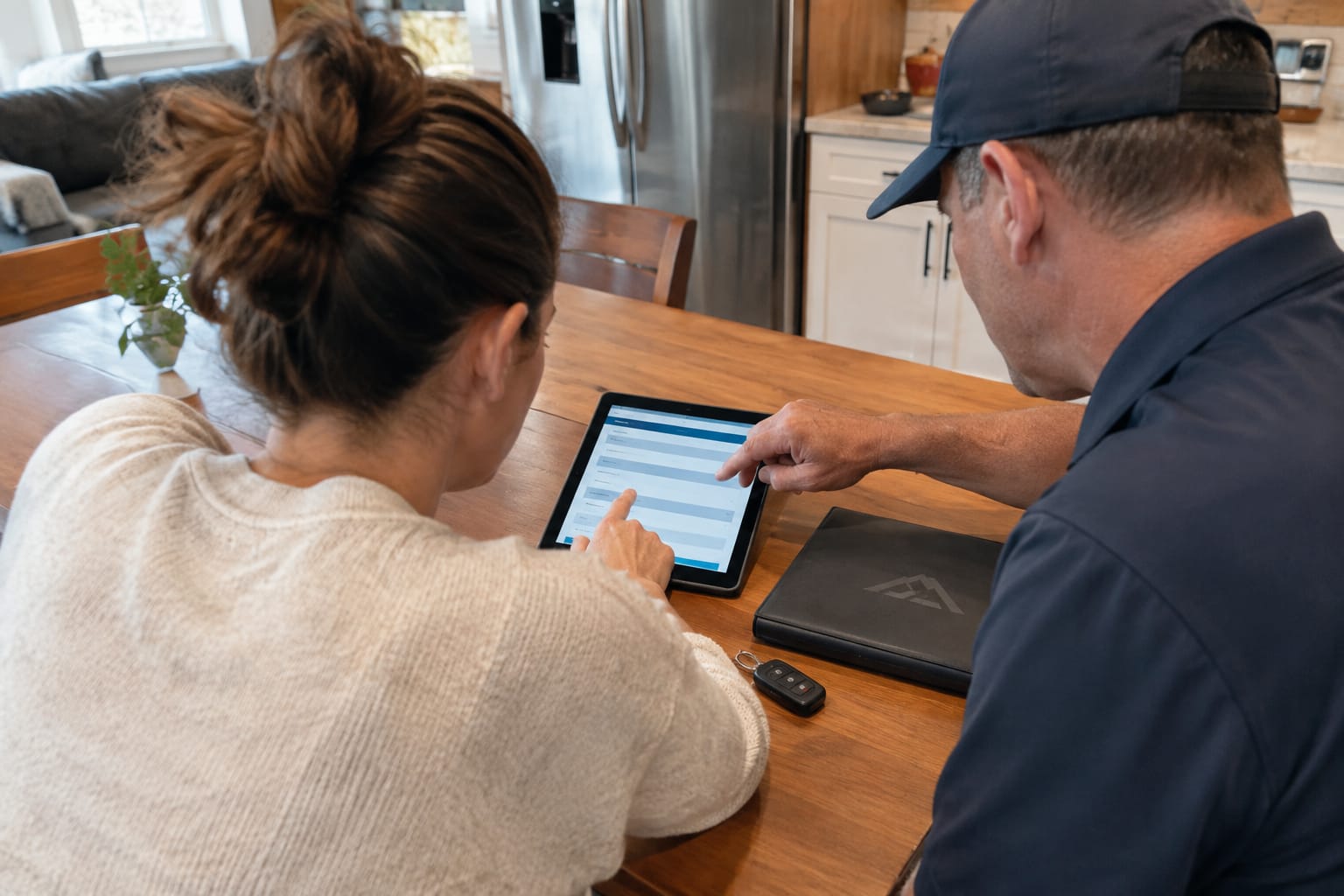
Collecting deposits on your own merchant accounts, rather than a locked-in processor, keeps that money and the customer relationship yours. Once paid, the deal exits sales and enters operations: the booked job hits the dispatch board, the crew is scheduled, and the bill of lading and paperwork are prepped. A clean handoff here is what makes the customer's move day feel professional instead of chaotic.
Building These Stages Into Your CRM Pipeline
A pipeline is just your seven stages rendered as columns you can see and move deals across. A documented flow — Lead → Inventory → Quote → Booked → Closed — with color flags and per-deal call-back reminders turns the abstract process into a board your whole team reads the same way.
The operational value is visibility. When every deal carries a timestamp and a stage, you stop guessing where jobs stall. If you're evaluating tools, this CRM for moving companies overview walks through what pipeline stages, automation, and reporting should actually do for a small operator.
Q: What are the stages of a moving company sales pipeline in a CRM?
A: A practical setup is five to seven columns — Lead, Qualified, Survey, Quoted, Follow-up, Booked, Closed — each with an owner and an exit rule, so any coordinator can see what a deal needs next at a glance.
Where the Process Usually Breaks (and How to Spot It)
Moving deals leak at four predictable points. Knowing them turns "we had a slow month" into "we lost jobs at first response."
- The after-hours call nobody answered and nobody logged. Fixed by capture + instant text-back.
- The estimate no-show that wasted a survey slot. Fixed by self-recorded video walkthroughs that don't need an appointment.
- The quote sent into silence with zero follow-up. Fixed by an automated cadence.
- The verbal yes that never turned into a deposit. Fixed by portal e-sign and pay.
The reason slow response tops that list is well documented: slow lead response time directly reduces booked jobs for moving companies. Diagnose the leak by counting how many deals die at each stage, not by counting your total leads.
Reviewing the Process: Which Numbers Tell You It's Working
Three numbers tell you whether the process is healthy: average first-response time, estimate-to-booking conversion, and overall booking rate. Track them by stage and you'll know exactly which step to fix.
Consider a composite analytics example — illustrative figures, not a single named customer. The point isn't the exact numbers; it's that you can't improve a response time you never measured.
For context on targets, your booking rate helps you judge whether your conversion is healthy or leaking. Pulling these numbers into a single reporting and analytics view means you review the process weekly instead of guessing at month-end.
Pro Tip: Review one stage per week, not the whole funnel at once. Fixing first-response time in isolation is coachable; "improve sales" is not.
Key Takeaways
- The moving sales process runs in seven stages — capture, first response, qualify, survey, quote, follow-up, book — each with a single owner and exit criterion.
- Speed of first response is the highest-leverage step.
- Self-recorded AI video walkthroughs (most finish in five to eight minutes) remove the estimate no-show, the most expensive survey leak.
- A job is booked only when the deposit is paid and the date is locked — not on a verbal yes.
- Measure first-response time, estimate-to-booking conversion, and booking rate by stage to find exactly where deals leak.
Related Articles
- Moving Company Lead Management: Track, Nurture, Convert — how to organize and work leads so none slip between capture and booking.
- Faster Quote Turnaround: How Movers Book More Jobs — why same-day quotes convert better and how to hit that speed.
- How Moving Companies Price Jobs: Pricing Models Explained — hourly, weight, and flat-rate models compared for accurate estimates.
- CRM for Moving Companies: Streamline Operations — what a moving CRM should do across the full operations lifecycle.
- AI Video Scanning Replaces the In-Home Moving Survey — how self-recorded walkthroughs kill the estimate no-show.
Useful Links
- Moving Company CRM Software
- AI Estimating Software for Movers
- Moving Company Automation & Follow-up Software
- Customer Portal for Deposits & E-Sign
- Reporting & Analytics for Movers
Need help with this? Moving Company Payment & Invoicing Software · Get started · Call (888) 611-7483
Ready to see it in action?
Book a free 20-minute demo and explore how Virtual Estimate can help your business.