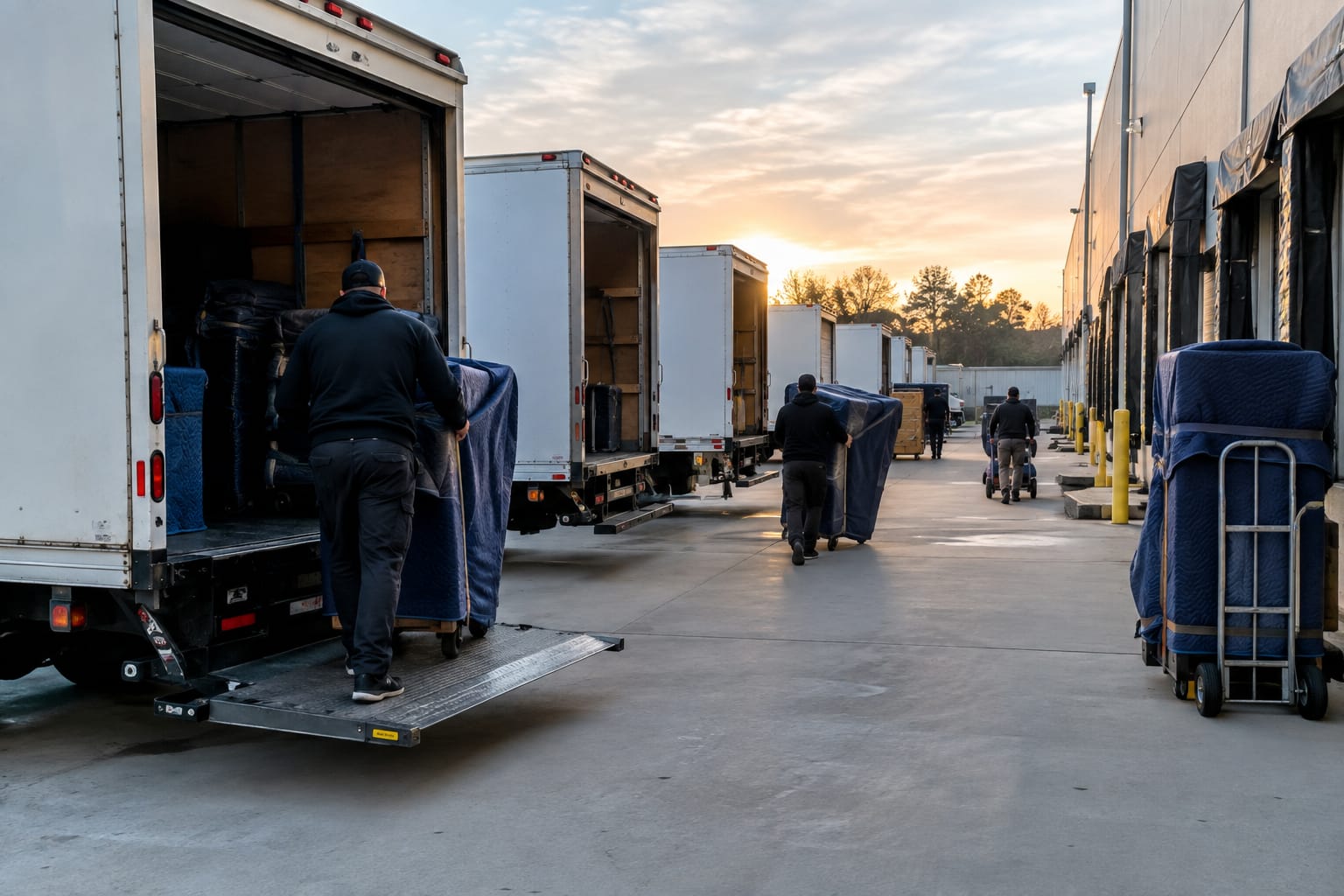

A moving customer who requests a quote is rarely shopping with one company. They have three or four estimates open and a moving date bearing down. An automated quote follow up removals system keeps your estimate in front of that customer while competitors stay silent. The problem is timing: most movers send one quote, go quiet, and lose the job to whoever re-engaged first. This guide shows how to build a follow-up sequence—SMS, email, timing, and CRM workflows—that books more moves without adding manual work.

Key Takeaways
| Point | Details |
|---|---|
| Speed wins jobs | Leads contacted within five minutes are 21x more likely to qualify than slower responders, per research in Harvard Business Review. |
| SMS out-opens email | SMS open rates reach roughly a significant share versus about a significant share for email, per Klaviyo's channel benchmarks. |
| Short decision window | Moving customers usually book within 48–72 hours, so a 5–7 touch sequence over a week captures the decision. |
| Automate the channel mix | Combine SMS for urgency and email for detail; trigger both from your CRM, not by hand. |
| Measure conversion | Track quote-to-book rate and speed to first contact—see moving company lead management for the full workflow. |
Why Moving Companies Lose Leads After Sending Quotes

Most lost moving jobs are not lost on price. They are lost on silence. The moving decision window is short—customers typically book within 48 to 72 hours of requesting estimates—so a quote that sits without a follow-up goes cold fast.
Speed is the hidden variable. Leads contacted within five minutes are 21 times more likely to qualify than those reached later, according to research published in Harvard Business Review. Yet most quotes never receive a second message.
Quote abandonment follows. A large share of moving estimates go unanswered when no follow-up exists, because the customer simply books the first mover who re-engages. Tightening your follow-up is the single cheapest way to lift a moving lead conversion rate. Strong moving company lead management closes that gap by treating the period after the quote as the most important stage of the moving sales funnel.
Pro Tip: Audit your last 50 quotes. Count how many got a second contact within 60 minutes. Most movers discover under a third did—and that single number explains most of their lost revenue.
What Automated Quote Follow-Up Looks Like in Practice
Automated quote follow-up is a set of pre-written messages your software sends on a schedule after a quote goes out—no manual effort per lead. The moment a quote is delivered, the system starts a timed series of texts and emails until the customer books, replies, or the sequence ends.
This is automated follow up moving company work at its most practical: the rep builds the templates once, and every new lead enters the same disciplined cadence. Customers are cautious because moving carries real risk—federal regulators urge consumers to vet movers carefully—so consistent, professional touches build the trust that converts.
Q: What does automated quote follow-up actually automate?
A: It automates the timing and delivery of follow-up SMS and email after a quote—triggered by the quote event—so every lead gets a 5-minute-fast first touch, the response speed Harvard Business Review tied to a 21x lift in qualification.

The groundwork starts upstream. If quotes go out late or inconsistently, automation only speeds up a broken process, so start by automating the quoting process itself before layering follow-up on top.
The Ideal Follow-Up Sequence: Timing, Channels, and Cadence
The winning pattern for movers is front-loaded: hit hard in the first 48 hours, then taper. Because nearly all U.S. adults carry a phone—Pew Research documents near-universal cellphone ownership—SMS is your fastest opening move, with email carrying the detail.
Here is a proven moving quote response sequence built around the industry's short decision window:
- Touch 1 — within 60 minutes: SMS + email confirming the quote arrived and inviting a reply.
- Touch 2 — same evening: SMS check-in offering to answer questions.
- Touch 3 — Day 2: email restating value and handling common objections.
- Touch 4 — Day 4: a phone task plus a short text for a personal touch.
- Touch 5 — Day 7: a final email before the lead is marked lost.
| Touch | Timing | Channel | Purpose |
|---|---|---|---|
| 1 | Within 60 min | SMS + Email | Confirm receipt, open the door |
| 2 | Day 1 evening | SMS | Quick, low-pressure check-in |
| 3 | Day 2 | Address objections, restate value | |
| 4 | Day 4 | Phone + SMS | Human, personal nudge |
| 5 | Day 7 | Final offer or close out |
Q: How many follow-up touches convert the most moving leads?
A: Five to seven touches across roughly seven days, front-loaded into the first 48–72 hours, matches the moving decision window when most customers book.
This cadence is the backbone of any moving sales automation sequence. Build it once, and lead nurturing for a moving company runs the same way for every estimate—weekday or weekend.
Configuring SMS Follow-Up Automation in Your Moving CRM

Start with SMS because it gets seen. SMS open rates reach roughly a significant share versus about a significant share for email, per Klaviyo's channel benchmarks—an enormous gap for time-sensitive moving decisions.
To set up automated sms follow up movers can rely on, configure four things inside your CRM:
- A trigger: the "quote sent" event starts the sequence automatically.
- Opt-in capture: collect SMS consent on the quote request form to stay compliant.
- Templates with merge fields: insert the customer name, move date, and quote total.
- Quiet hours: restrict sends to daytime so texts never land at 11 p.m.
A capable Virtual Estimate CRM ties the text directly to the quote record, so a reply lands in the same lead thread the rep already sees. That keeps SMS automation from becoming a disconnected blast.
Pro Tip: Keep follow-up texts under 160 characters and always end with one clear question. "Want me to lock in your June 14 date?" earns far more replies than a paragraph of features.

Building Email Follow-Up Sequences for Moving Leads
Email carries the weight SMS cannot—the full estimate, the itemized inventory, and the proof points that ease a nervous customer. A strong quote follow up email movers send re-attaches the PDF and answers the question the customer is actually asking: why you over the other three quotes.
An effective email drip sequence runs in parallel with SMS, not as a duplicate. Each email should carry one job: confirmation, objection handling, social proof, or a final deadline.
| Day | Focus | Goal | |
|---|---|---|---|
| 1 | Day 1 | Quote recap + next steps | Make replying effortless |
| 2 | Day 2 | Objection handling (price, dates) | Remove hesitation |
| 3 | Day 4 | Reviews and licensing proof | Build trust |
| 4 | Day 7 | Calendar urgency | Prompt a decision |
Moving lead follow up automation works best when the email and text reference the same move details, so the customer feels one coordinated conversation rather than two systems pinging them. Setting up crm follow up for moving leads this way also means a booking instantly stops every remaining message in the sequence.

Writing Follow-Up Messages That Convert Without Feeling Pushy
The difference between persistent and annoying is value. Every touch should give the customer a reason to engage—a clarified detail, a flexible date, a removed worry—not just "checking in again."
Use the channels for what they do best:
| Criteria | SMS | |
|---|---|---|
| Visibility | Very high | Moderate |
| Best for | Urgent nudges, scheduling | Detailed quote, proof |
| Ideal length | Under 160 characters | Longer, structured |
| Response speed | Minutes | Hours |
| Compliance need | Opt-in required | Unsubscribe required |
Moving customers have predictable objections—price, availability, and trust. Write a short scripted answer for each, then drop them into the right touch. "Worried about the estimate? It's a fixed price, not an hourly guess" handles the most common one in a single line.
Pro Tip: Personalize on the move, not the person. Referencing "your 3-bedroom move to Denver on the 14th" outperforms generic "Hi [First Name]" greetings because it proves a human read the file.
Connecting Follow-Up Automation to Your Quoting and Dispatch Tools

Follow-up automation only pays off when it is wired into the rest of the operation. The quote tool should fire the trigger, the CRM should run the cadence, and dispatch should see the booking the moment it lands—no re-keying.
Q: Does follow-up automation need a separate tool from your CRM?
A: No. Most modern moving CRMs include built-in SMS and email sequences, so a single platform handles quoting, follow-up, and the lead record without bolting on extra software.
For a broader view of what to look for, this guide to moving company automation software breaks down how quoting, CRM automation, and dispatch fit together. When the stack is connected, a booked job updates the calendar and silences the sequence in one step—you can see how Virtual Estimate handles follow-up automation end to end as one example of that integration.
The payoff is compounding. Each booking flows into dispatch with the quote details intact, which means fewer errors on move day and a cleaner record for the next round of lead nurturing.
Measuring Whether Your Follow-Up Automation Works
A sequence you do not measure is a guess. Track a small set of numbers weekly and let them drive changes to timing and copy. The U.S. moving market is large—U.S. Census Bureau migration data shows tens of millions of Americans relocate each year—so even a small lift in conversion moves real revenue.
| Metric | How to calculate | Why it matters |
|---|---|---|
| Quote-to-book rate | Booked jobs ÷ quotes sent | Core conversion signal |
| Speed to first contact | Time from inquiry to first message | Tied to qualification odds |
| Follow-up reply rate | Replies ÷ messages sent | Tests message quality |
| Sequence completion rate | Leads finishing the full series | Confirms automation health |
| Cost per booked job | Marketing spend ÷ bookings | Shows true ROI |
Movers that adopt a disciplined 3-to-5 touch automated follow up removals process commonly report a meaningful rise in their quote-to-book rate, because they capture decisions competitors miss by going silent. Watch speed to first contact most closely—it is the metric most directly tied to the 21x qualification lift documented by Harvard Business Review.
Pro Tip: Segment your metrics by lead source. Paid leads and referral leads behave differently; a referral may convert on touch two, while a paid lead may need all five. Tune the cadence per source instead of using one average.
Related Articles
- Moving Company Automation Software: The Complete Buyer's Guide — how quoting, CRM, and dispatch tools fit into one automated stack.
- How to Automate Removals Quoting for Your Business — build fast, consistent quotes before layering follow-up on top.
- CRM Automation for Moving Companies: Workflows That Convert Leads — design the automated workflows that turn quotes into booked jobs.
- Email Automation for Moving Companies: A Step-by-Step Guide — set up email drip sequences that nurture moving leads.
- CRM for Moving Companies: Streamline Operations — connect lead nurturing to the rest of your operation.
Recommended Reading
- CRM Platform — Virtual Estimate
- Moving Company Lead Management: Track, Nurture, Convert
- Moving Company Automation: Tools That Save Time and Cut Costs
- Virtual Estimate Solutions — Automation for Moving Companies
- Advanced CRM and Estimation Software Solutions for Movers
Ready to see it in action?
Book a free 20-minute demo and explore how Virtual Estimate can help your business.