

Moving companies that break the $1M annual revenue threshold share one operational trait: they have replaced disconnected tools with advanced CRM estimation software solutions that link every lead to a booked job without manual intervention. Nucleus Research shows CRM adoption delivers an average $8.71 return for every dollar invested — yet most movers still run estimates in one spreadsheet and track contacts in another. The friction between those two systems kills revenue through slow follow-up, missed callbacks, and inaccurate pipeline forecasting. This article defines what genuinely advanced functionality looks like for the moving industry and how to evaluate platforms that eliminate the gap between quoting and closing.
Key Takeaways
| Point | Details |
|---|---|
| CRM delivers measurable ROI | Nucleus Research confirms CRM returns $8.71 per $1 invested on average across industries. |
| Integration drives conversion gains | Companies with fully integrated sales tech stacks close 36% more deals than those using fragmented, disconnected tools. |
| Purpose-built platforms deploy faster | Moving-specific CRM platforms implement in 2–6 weeks versus 3–6 months for generic CRM customization projects. |
| Automation targets critical moments | Stage-triggered sequences — not mass email blasts — drive the largest lift in lead-to-book conversion rates. |
| Evaluate the right way | Explore moving company software solutions based on automation depth, not raw feature count. |
Why Moving Companies Outgrow Basic CRM Tools
Basic CRM tools handle contact storage and manual note-taking — functions that any $20/month SaaS subscription provides. The problem surfaces when a moving company processes more than 50 leads per week: sales reps spend more time updating records than actually selling.
Salesforce research on sales productivity shows that representatives dedicate only 28% of their working week to active selling. The remainder goes to administrative tasks — data entry, status updates, scheduling follow-ups — all of which a properly configured moving company pipeline management system automates without human intervention.
The compounding cost is significant. A mover handling 200 leads per month at a 40% close rate who improves that rate to 48% through automation adds approximately 16 additional jobs monthly. At an average job value of $1,500, that translates to $24,000 in incremental monthly revenue from a single workflow improvement.
Signs a basic CRM has become a growth ceiling:
- Estimate status requires manual updates in both the quoting tool and the CRM
- Follow-up reminders are set per lead by hand, not triggered by pipeline stage changes
- No visibility into which sales rep holds the highest volume of uncontacted quotes
- Revenue forecasting requires exporting pipeline data to a separate spreadsheet
- No way to link estimate acceptance to an automatic deposit request or dispatch entry
What Makes CRM 'Advanced' for the Moving Industry
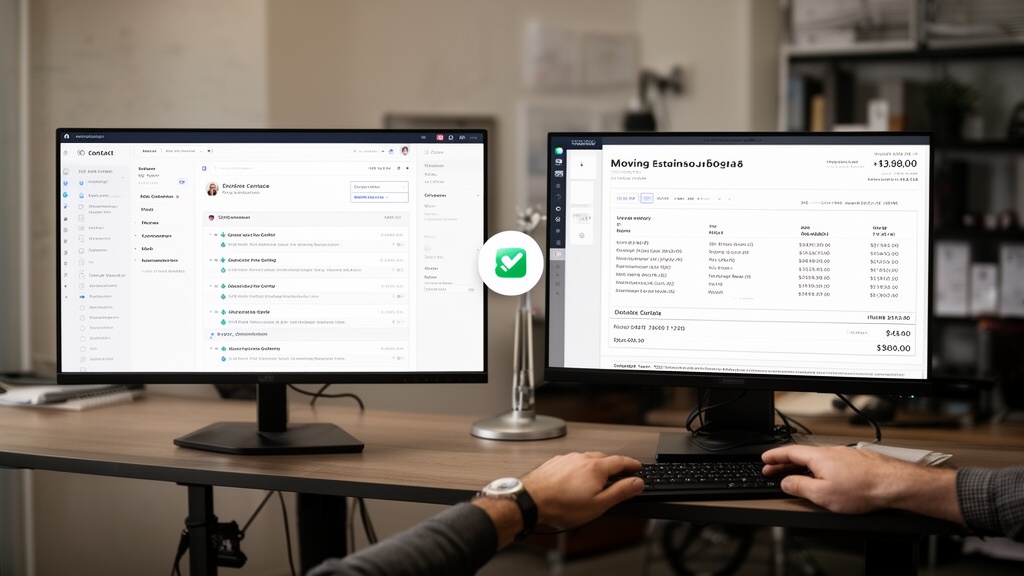
Advanced CRM for movers is defined by automation depth, industry-specific data models, and native integration with estimation workflows. A generic CRM stores contact fields; an advanced moving company CRM stores move date, origin and destination zip codes, estimated cubic footage, and crew requirements — then uses those fields to trigger relevant automation sequences.
The four capabilities that distinguish advanced crm estimation software solutions:
- Stage-triggered communication: When an estimate status changes from "Sent" to "Viewed," the system queues a follow-up SMS within 15 minutes — no rep action required.
- Job-board integration: Dispatchers see confirmed jobs auto-populate on a scheduling board the moment a contract is signed in the platform.
- Weighted revenue forecasting: The dashboard calculates pipeline value based on historical close rates by lead source — not just raw estimate totals that inflate the number.
- Multi-channel sequences: Email, SMS, and call reminders fire in sequence based on days elapsed since estimate delivery, stopping automatically when the customer books.
The distinction between basic and advanced moving company sales software is not about having more features. It is about having the right data model. An advanced platform understands what a move is at the schema level — treating it as a complex event with origin, destination, inventory, and crew requirements — not merely a generic deal in a contact record.
Pro Tip: Map your current sales process in a flowchart before evaluating any CRM. A platform qualifies as "advanced" only if it automates the specific pipeline handoffs where your team currently drops leads — not just the stages every vendor demos in a polished product walkthrough.
How Estimation Software Integrates with CRM Platforms
The core challenge with disconnected estimation and CRM tools is bidirectional data drift. A rep updates the estimated job value in the quoting tool, but the CRM still shows the original figure — producing inaccurate pipeline reports and mis-prioritized follow-up queues.
Native integrated CRM moving estimates eliminate this problem entirely. When both functions live in the same platform, updating a line item in the estimate instantly recalculates deal value in the pipeline view. Communication history, estimate revisions, and signed contracts all live on a single contact record with a unified timeline.

For movers using separate tools, integration typically happens via API or automation middleware. This approach introduces a 5–15 minute sync delay and requires ongoing maintenance each time either platform updates its API structure. HubSpot sales and marketing data indicates that companies with fully integrated sales tech stacks close 36% more deals than those operating with fragmented systems.
The automated estimates moving CRM workflow in a native platform follows this sequence:
- Lead submits inquiry via web form → CRM creates contact record automatically
- Virtual survey is scheduled and completed → estimate generates within the CRM record
- Estimate is sent → CRM logs delivery timestamp and begins follow-up sequence
- Customer accepts → pipeline stage advances, deposit invoice triggers, job populates dispatcher board
This end-to-end sequence, with zero manual steps between inquiry and dispatch entry, is what separates a true mover all-in-one software platform from a collection of disconnected apps requiring constant human maintenance.
Virtual Estimate can help: Virtual Estimate combines virtual survey technology, automated estimation, and CRM pipeline management in a single platform — eliminating the sync errors and manual handoffs that cost movers booked jobs every week. Learn more →
Key Features to Prioritize in a Combined CRM and Estimation Solution
When evaluating moving company software solutions, feature count matters significantly less than how features connect. A platform with 50 capabilities requiring manual handoffs between them is operationally inferior to one with 20 capabilities that automate every critical transition.
Essential features for advanced moving company CRM software:
| Feature | Why It Matters | Automation Level |
|---|---|---|
| Stage-triggered SMS/email sequences | Eliminates manual follow-up gaps at every pipeline stage | Fully automated |
| Virtual survey + estimate builder | Cuts quote turnaround from days to under 2 hours | Partially automated |
| Dispatcher job board | Converts confirmed deals to scheduled jobs instantly | Fully automated |
| Lead source attribution | Identifies highest-ROI acquisition channels for budget allocation | Automated reporting |
| Weighted revenue forecasting | Projects monthly revenue from historically weighted pipeline | Automated calculation |
| E-signature + deposit collection | Closes the booking loop without leaving the platform | Automated on acceptance |
| Two-way SMS inbox | Enables real-time customer communication at volume | Rep-managed |
| Mobile-optimized interface | Gives field reps and foremen full access from any device | Full access |
Pro Tip: Require a live demo using your own data — not vendor sample data. Import 20 real leads from the past 90 days and ask the vendor to walk through how each automation would have fired. This exposes gaps between marketing claims and actual workflow behavior faster than reviewing any feature checklist.
Prioritize automation depth above all else. Evaluate the CRM platform built for moving companies on whether pipeline handoffs fire automatically at each stage. If any critical handoff — estimate to follow-up, acceptance to deposit, deposit to dispatch — requires manual action, that gap is where leads will continue to fall through.
Top Advanced CRM and Estimation Platforms for Movers Compared
The moving industry has seen significant software consolidation since 2022. The best CRM for moving estimates today falls into three distinct categories: purpose-built mover platforms with native estimation, generic CRMs requiring custom integration, and hybrid platforms combining advanced CRM with virtual survey capabilities.

| Platform | Native Estimation | Pipeline Automation | Virtual Survey | Dispatcher Board | Approx. Starting Price |
|---|---|---|---|
|---|---|
| Virtual Estimate | Yes | Advanced | Yes | Yes | Custom pricing |
| Supermove | Yes | Basic–Moderate | No | Yes | ~$200/month |
| SmartMoving | Yes | Moderate | No | Yes | ~$150/month |
| HubSpot + middleware | No (via Zapier) | Advanced | No | No | $90+/month |
| Salesforce + developer | No (via custom dev) | Advanced | No | No | $165+/month |
Generic platforms like HubSpot and Salesforce offer powerful automation engines but require 3–6 months of customization to handle moving-industry data models correctly. Implementation consulting for a mid-size mover typically costs between $8,000 and $25,000 in developer time — compared to 2–6 weeks for purpose-built platforms with pre-built moving workflows.
For companies processing more than 100 moves monthly, the advanced moving company CRM features in purpose-built tools — particularly automated dispatch integration and inventory-aware estimation — justify the trade-off in configurability. Before choosing a platform, compare plans and see what advanced CRM tools cost across tiers to evaluate total cost of ownership, not just monthly subscription price.
Implementation Roadmap: Rolling Out New Software Without Disrupting Operations
McKinsey research on digital transformation establishes that 70% of technology implementations fail to meet their stated objectives — primarily due to inadequate change management, not technical failure. For moving companies, implementation risk peaks during peak season (May through August), making a phased rollout non-negotiable.
A proven four-phase implementation approach:
Phase 1 — Data migration and configuration (Weeks 1–2)
Import all existing contacts, tag historical lead sources, and configure pipeline stages to match the current sales process exactly. Defer automation setup entirely until the team is familiar with the new interface.
Phase 2 — Estimation workflow activation (Weeks 3–4)
Train estimators on the new quote-building workflow. Run parallel processes — old tools and new platform simultaneously — for two weeks to surface data gaps before the full transition.
Phase 3 — CRM automation activation (Weeks 5–6)
Enable automated follow-up sequences for new incoming leads only. Monitor response rates and adjust sequence timing before applying the same logic to the full existing pipeline.
Phase 4 — Full integration and optimization (Week 7+)
Activate dispatcher board integration, revenue forecasting dashboards, and lead source reporting. Retire legacy tools and fully consolidate operations onto the single platform.
Pro Tip: Assign one internal "CRM champion" — typically a sales manager or operations lead — who owns the implementation timeline and post-launch optimization. Vendors offering dedicated onboarding account managers consistently deliver 2× faster time-to-value than self-serve implementations, based on patterns observed across software adoption research.
Measuring ROI After Adopting Advanced CRM and Estimation Tools
ROI from advanced CRM estimation software solutions manifests across three categories: revenue gained through higher conversion rates, costs avoided through reduced manual labor, and time recovered for high-value selling activities. Tracking all three provides a complete picture within 90 days of full platform adoption.
Primary ROI metrics for moving company CRM adoption:
| Metric | Measurement Period | Expected Improvement |
|---|---|---|
| Lead-to-book conversion rate | 60 days pre-launch vs. 90 days post | +8–15 percentage points |
| Average quote turnaround time | Hours from inquiry to estimate sent | Reduce by 50–70% |
| Follow-up attempts per booked job | Manual contacts before close | Reduce by 40–60% |
| Revenue per estimator (monthly) | Booked revenue per sales FTE | Increase 20–35% |
| Job cancellation rate post-deposit | % confirmed jobs that cancel | Reduce by 15–25% |
The single highest-impact metric is lead-to-book conversion rate. Moving companies implementing automated follow-up sequences routinely improve conversion well above industry averages tracked by AMSA within 90 days of deployment — a gain that compounds monthly across every active lead source.
Revenue forecasting accuracy improves substantially as well. When pipeline stages carry historical close-rate weights derived from actual booking data, the moving company pipeline management dashboard produces forecasts accurate to within 10–15% of actual monthly revenue — compared to the ±40% variance typical of manual spreadsheet forecasting that most growing movers still rely on.
Related Articles
- CRM for Moving Companies: Streamline Operations — A comprehensive guide to implementing CRM tools that reduce manual work and improve booking rates across your full moving operation.
- Moving Company CRM: Complete Operations Guide — Step-by-step breakdown of how moving companies structure CRM workflows from first contact through completed job and review collection.
- Types of Moving Estimates: Choosing the Best Option — Understand binding, non-binding, and not-to-exceed estimates and how each type integrates with CRM billing and follow-up workflows.
- Pricing Strategies for Moving Companies: Maximizing Profitability — Data-driven approaches to setting estimate values that close more jobs at stronger margins without underpricing services.
- Customer Experience Excellence in Moving Services — How communication automation inside CRM platforms directly improves customer satisfaction scores and generates more referrals.
Recommended Resources
Ready to see it in action?
Book a free 20-minute demo and explore how Virtual Estimate can help your business.