

A moving company CRM is industry-specific software that centralizes leads, estimates, scheduling, billing, and customer communication in one platform built for movers. It replaces spreadsheets, sticky notes, and disconnected apps, letting a moving business respond to inquiries faster, book more jobs, and coordinate crews from a single dashboard.
Most moving companies lose revenue not on the truck, but in the office. Leads go cold. Estimates never get sent. Follow-ups slip through the cracks. This guide explains what a moving company CRM does, the features that actually matter, and how the right system lifts booking rates while shortening response times.

Key Takeaways
| Point | Details |
|---|---|
| What it is | A moving company CRM unifies leads, estimates, crew scheduling, and payments in one industry-specific platform. |
| Speed wins deals | Firms that contact web leads within an hour are nearly 7x more likely to qualify them, per Harvard Business Review. |
| A large lead pool | About 25.6 million people moved in 2022, according to the U.S. Census Bureau. |
| Automation cuts busywork | Automated follow-ups and reminders reduce manual office tasks and lower no-show rates. |
| Go deeper | See this operations-focused guide on CRMs for movers. |
Why Moving Companies Need Purpose-Built Software

A generic CRM tracks contacts and deals. A moving operation needs much more. It needs cubic-foot inventories, crew assignments, truck capacity, binding estimates, and survey footage. Generic tools force clumsy workarounds. Purpose-built CRM for moving companies models the job the way movers actually run it.
The demand is real and recurring. About 25.6 million people moved in 2022, according to the Census Bureau — millions of potential jobs flowing through inboxes and phone lines every year. Without a central system, a share of those leads simply vanishes.
The labor side is just as demanding. Hand laborers and material movers number in the millions across the U.S. workforce, per the Bureau of Labor Statistics. Matching that fluctuating crew supply to a shifting booking calendar is exactly the problem a dedicated platform solves.
Q: How is a moving company CRM different from a generic CRM?
A: A moving company CRM includes industry-specific tools — cubic-foot estimating, crew and truck scheduling, virtual surveys, and binding-estimate templates — that generic platforms like a standard sales CRM do not offer out of the box.
Pro Tip: Before evaluating any platform, list your five most repeated manual office tasks. If a tool can't automate at least three of them on day one, it isn't purpose-built — it's a generic CRM with a moving-industry label.
Capturing and Tracking Leads in One Pipeline
Every inquiry — web form, phone call, referral, or paid lead — should land in the same place. A unified lead pipeline for movers shows each prospect's stage at a glance: new, estimated, booked, or lost. Visibility alone prevents the most common failure, which is forgetting a lead exists.
Leads arrive from many channels, and each carries a cost. Tracking source-by-source performance tells you which channels deserve more budget. For movers buying leads, this matters even more — pairing a CRM with the right strategy for buying moving leads turns raw volume into measurable booked revenue.
A structured pipeline also surfaces bottlenecks. If most prospects stall between "estimated" and "booked," the problem is follow-up, not lead volume. The data points to the fix.
- Centralized intake — every channel feeds one queue
- Stage tracking — instant view of where each deal sits
- Source attribution — know which channels convert
- Assignment rules — route hot leads to the right rep automatically
Automated Follow-Ups That Close the Timing Gap
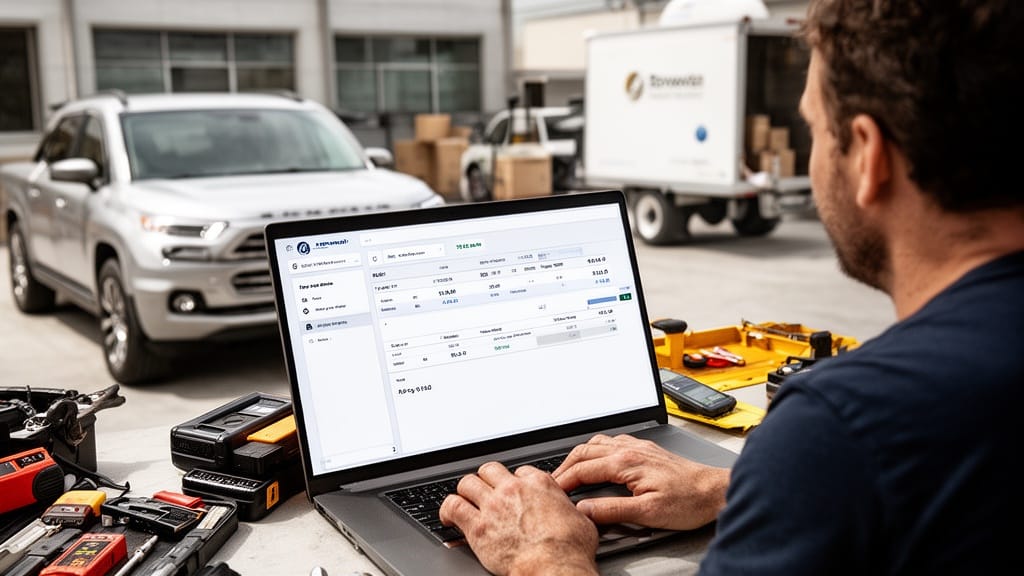
Speed is the single biggest lever in lead conversion. Companies that respond to an online lead within an hour are nearly seven times more likely to qualify that lead than those that wait even 60 minutes longer, according to Harvard Business Review research. Manual processes rarely hit that window. Automation does.
Good moving company software sends an instant confirmation the moment a lead arrives, then triggers a sequence: a reminder to send the estimate, a check-in if the quote goes unanswered, and a pre-move confirmation before the job. These automated follow-ups moving prospects toward booking run without anyone touching a keyboard.
Automation also protects revenue after booking. Appointment reminders and survey-upload nudges reduce no-shows and last-minute reschedules — two quiet profit killers in moving operations.
Q: How fast should a moving company respond to a new lead?
A: Aim to make first contact within five minutes. The HBR study found odds of qualifying a lead drop sharply after the first hour, so automated instant responses give movers a decisive edge.
Pro Tip: Build one automated sequence specifically for "estimate sent, no response after 48 hours." This single workflow recovers more stalled deals than any other, because it targets prospects who already showed buying intent.
Scheduling Crews and Planning Routes Visually
A booking is only profitable if the right crew and truck show up at the right address on time. Dedicated crew scheduling software inside a moving CRM replaces the whiteboard with a drag-and-drop calendar that flags double-bookings and capacity conflicts before they happen.

Visual route planning adds another layer of efficiency. Mapping jobs by location reduces deadhead miles and fuel waste, and it lets dispatchers fit more moves into a single day. For a deeper operational view, this moving company technology stack guide shows how scheduling fits alongside other tools.
Scheduling data also feeds smarter staffing. When the calendar shows demand patterns by week and season, managers hire and assign labor against real numbers instead of guesswork.
| Module | What it does | Office benefit |
|---|---|---|
| Crew calendar | Assigns movers and trucks to jobs | No double-bookings |
| Route planning | Maps daily stops geographically | Less deadhead mileage |
| Capacity view | Shows truck/load availability | Confident overbooking limits |
| Mobile crew app | Pushes schedules to the field | Fewer dispatch calls |
Capturing Estimates and Virtual Surveys Accurately

Accurate estimates are the foundation of a profitable move and a satisfied customer. A CRM that supports video walkthroughs and virtual surveys lets prospects upload footage of their home, so estimators quote without a costly in-person visit. The result is faster, more precise quotes.
Virtual surveys also scale. One estimator can review far more homes per day on video than in person, which compresses the time between inquiry and a sent estimate. That speed ties directly back to conversion. For a full walkthrough, see this guide to the virtual pre-move survey.
Estimate accuracy protects margins, too. When inventory and cubic footage are captured digitally and stored on the customer record, disputes drop and binding estimates hold up.
Invoicing, Online Payments, and Financial Visibility
Cash flow is where many small movers struggle, and slow billing is often the cause. The SBA stresses that disciplined cash-flow management is critical to small-business survival. A CRM that generates invoices automatically and accepts online payments shortens the gap between job completion and money in the bank.
Trust and compliance matter as well. Movers operate under consumer-protection rules — the FMCSA outlines required disclosures and estimate practices for household-goods moves. Storing signed documents and binding estimates inside the CRM keeps a company audit-ready and transparent with customers.
Financial dashboards turn raw transactions into decisions. Revenue by month, average job value, and outstanding balances become visible at a glance instead of buried in a separate accounting file.
- Automated invoicing the moment a job closes
- Online payments customers complete from a portal
- E-signed documents stored on the customer record
- Revenue dashboards for at-a-glance financial health
How the Right System Lifts Booking Rates

Every feature above ladders up to two metrics: response time and booking rate. Faster responses win more deals, and a complete CRM compresses response time from hours to minutes. The global CRM market exceeded $70 billion in 2023, per Grand View Research — adoption is rising precisely because the link between organized data and revenue is so direct.
Booking rate is the truer scoreboard. When pipeline, automation, and estimating work together, fewer leads leak out between stages. To benchmark your own numbers, this overview of a good booking rate for contractor services provides useful context.
Pro Tip: Track two numbers weekly — median time-to-first-contact and lead-to-booking percentage. If automation is working, the first number falls and the second rises within 30 days. If neither moves, your sequences need fixing, not your sales team.
Getting Started With Your First CRM
Adopting a moving company CRM is less about features and more about fit. Start by mapping your current workflow from inquiry to final payment, then look for a platform that mirrors those steps without forcing workarounds. The closer the match, the faster your team adopts it.
Migrate in stages. Move lead capture and follow-up automation first, since they deliver the quickest payback, then layer in scheduling, estimating, and billing. A phased rollout avoids overwhelming crews and office staff at once.
| Decision factor | Why it matters | What to ask |
|---|---|---|
| Industry fit | Generic tools miss moving workflows | Does it handle cubic-foot estimates? |
| Automation depth | Drives response speed | Can it auto-send and follow up? |
| Crew scheduling | Coordinates labor and trucks | Is there a drag-and-drop calendar? |
| Customer portal | Reduces phone tag | Can clients self-serve estimates? |
| Reporting | Reveals what converts | Does it track lead source ROI? |
Finally, weigh the customer experience. A branded self-service portal — where clients view estimates, track their move, upload walkthrough video, e-sign, and pay — removes friction for both sides. For a broader build, compare options in this roundup of the best CRM for moving companies.
Related Articles
- CRM for Moving Companies: Streamline Operations — A deeper look at how a CRM tightens day-to-day moving operations.
- Virtual Pre-Move Survey: Complete Guide — How video walkthroughs speed up and sharpen estimates.
- Customer Experience Excellence in Moving Services — Practical ways to win and keep moving customers.
- Pricing Strategies for Moving Companies — Approaches to pricing that protect margins.
- Employee Retention Strategies for Moving Companies — Keeping reliable crews on the calendar.
Recommended Reading
- Moving Company Technology Stack Guide — The full set of tools a modern mover runs.
- Best CRM for Moving Companies — A comparison-style overview of CRM options.
- Buy Moving Leads: Best Providers — Where leads come from and how to convert them.
- Moving Company Operational Efficiency Playbook — Tactics for running a leaner operation.
Ready to see it in action?
Book a free 20-minute demo and explore how Virtual Estimate can help your business.