
A household goods bill of lading is the receipt and contract an interstate mover issues for every shipment it carries. Confirm the current required contents with the relevant federal authority. This guide is for US moving company owners, office managers and dispatchers who prepare interstate paperwork and want a document that holds up in a dispute.
Here's the thing: a weak bill of lading rarely causes trouble on move day. The trouble arrives weeks later, in a damage claim or a payment dispute, when the bill of lading is the one record everyone reads. This article covers the required fields and where each one comes from in your workflow. It also covers the documents that must come first, how estimates and valuation appear on the form, and what an electronic version needs to stand up.

Key Takeaways
- Most fields come from earlier documents. The estimate, order for service, valuation election and dispatch record feed nearly every line.
- Avoid mismatches. Dates, prices and valuation that differ from the estimate or order for service weaken your position in a claim.
- Electronic is workable with discipline. The ESIGN Act gives e-signatures legal effect, but consumer consent, copy delivery and record retention still have to be handled correctly.
- This is general guidance, not legal advice. Confirm details against the current eCFR text and, for intrastate work, your state regulator.
What the Household Goods Bill of Lading Does for Your Company
The bill of lading does two jobs at once. That makes it the legal anchor for the whole move.
This is not the same document freight carriers use. A freight bill of lading follows commercial shipping conventions. A household goods bill of lading follows the consumer-protection rules in 49 CFR Part 375, which exist because individual shippers rarely negotiate contracts for a living.
Q: Is a bill of lading mandatory for interstate moves?
A: Yes.
For your business, the bill of lading is also an operational record. It ties the price, the dates, the valuation and the crew's work to one signed page. When a customer disputes a charge, that page either backs you up or it doesn't.
Required Contents Under 49 CFR 375.505: A Field-by-Field Checklist
The regulation lists specific elements the bill of lading must contain. The table below closely paraphrases those elements and maps each one to the point in your workflow where the data should originate. Regulations change, so compare it against the current text of 49 CFR 375.505 on eCFR before you finalize a form.
| Required content (paraphrased from 375.505) | Where it comes from in your workflow |
|---|---|
| Your company name and address, or the issuing carrier's | Company profile / settings |
| Names and addresses of other carriers participating, when known | Dispatch (interline or partner carrier assignment) |
| Name, address and phone of the office the shipper contacts about the shipment | Company profile / branch record |
| Form of payment you will accept at delivery, matching what you agreed at the estimate | Estimate |
| Shipper's name, address and contact details, including where they can be reached in transit on collect-on-delivery shipments | Lead record and order for service |
| Agreed pickup and delivery dates or date ranges | Order for service |
| Actual pickup date | Foreman entry on move day |
| Identification number(s) of the vehicle(s) carrying the shipment | Dispatch board |
| Terms and conditions for payment of total charges, including any minimum charges | Your tariff |
| Valuation election and declared value, signed by the shipper | Valuation election |
| The estimate and order for service details tied to the shipment | Estimate and order for service |
Notice the pattern. Almost nothing on this list should be typed fresh on move day. If your crew writes it in by hand at the curb, the data already existed somewhere else and now exists twice, possibly with differences.
The payment-terms and minimum-charge lines depend on your published rates. If those are unclear, start with setting up your moving tariff before you redesign the form. For unfamiliar terms like accessorial services or released value, keep a moving industry glossary handy for new office staff.

Pro Tip: Print your USDOT number in the header of every bill of lading, estimate and order for service. It costs nothing to include.
Documents That Must Come Before the Bill of Lading
The bill of lading is the last document in a chain, not the first. Part 375 sets the order, and skipping a step undermines everything after it.
- Consumer publications. Confirm the current requirement with FMCSA.
- Written estimate. Confirm the current requirements for binding and non-binding estimates with FMCSA.
- Order for service. It confirms dates, services and the estimate.
- Inventory at pickup. The crew records items and condition as goods are loaded.
- Bill of lading. Issued at origin, signed by the shipper, with a copy left in their hands.
- Delivery signatures. At destination, the shipper signs to acknowledge delivery and notes exceptions on the inventory.
Retention matters too. Many operators keep records longer because claims and chargebacks can surface late.

That filing drawer is where paper systems break down. A missing order for service makes a bill of lading look unsupported, even when the move went perfectly.
How Estimate Type and Valuation Choice Appear on the Bill of Lading
Two decisions made at the sales stage shape the bill of lading more than any others: the estimate type and the valuation election.
Binding vs non-binding estimates
A binding estimate fixes the price for the services listed. A non-binding estimate is a good-faith approximation, and the final charge depends on actual weight and services. The bill of lading has to reflect which one the customer received.
The difference shows up at delivery. Your bill of lading should state the maximum amount due at delivery so the crew and the customer see the same number.
The cleanest way to avoid conflicts is an estimate that carries into the Bill of Lading automatically. When the office re-keys prices, the bill of lading and estimate drift apart, and the drift becomes the customer's argument.
Valuation on the bill of lading
Valuation is the carrier's level of liability, not insurance. Federal law at [49 U.S.C.
Interstate vs Intrastate Moves: When State Rules Take Over
Part 375 applies to interstate household goods moves. For moves that start and end in the same state, confirm the current requirements with the relevant state agency.
State requirements vary widely. Before reusing an interstate form for local work, confirm who regulates moving companies in each state you operate in and request that agency's current requirements.
Companies running both interstate and local jobs often keep two templates. The interstate version follows 375.505; the intrastate version follows the state tariff. Mixing them creates gaps an investigator or a customer's attorney will notice.
Common Bill of Lading Mistakes That Weaken You in a Claim
Most bill of lading problems are consistency problems. The document disagrees with the estimate, the order for service or the inventory.
- Price mismatch. The estimate says one amount, the bill of lading says another, and nobody documented the reason.
- Blank valuation section. No signed election leaves the liability level open to dispute.
- Missing actual pickup date. The agreed window appears, but the real date doesn't.
- No vehicle identification. Dispatch knows which truck carried the load; the bill of lading doesn't say.
- Handwritten additions without initials. Added services appear on the form with no customer acknowledgment.
- No copy delivered. The shipper never received their copy, or you can't prove they did.

A quick weekly audit catches most of this. Pull a handful of completed jobs and compare the estimate, order for service and bill of lading line by line. Patterns show up fast, usually traced to one step where someone re-types data.
Going Paperless: What an Electronic Bill of Lading Needs to Hold Up
An electronic bill of lading can carry the same legal weight as paper, but only if the process around it is sound. The foundation is the federal ESIGN Act.
Q: Can a household goods bill of lading be signed electronically?
A: Generally yes. The ESIGN Act, [15 U.S.C. Check current Part 375 provisions and any state rules before switching.
The ESIGN Act also sets conditions that matter for movers.
In practical terms, an electronic bill of lading process should cover five things:
- Consent. The shipper agrees to electronic documents before signing, and that consent is recorded.
- Copy delivery. The shipper receives a copy they can keep, by email, link or download.
- Signature integrity. The record shows who signed, when and in what order, for every party.
- Tamper evidence. Any change after signing is visible, not silent.
- Retention. Signed documents stay retrievable for at least the regulatory retention period.
Evaluate tools against those five points yourself. As one example of how vendors describe this category, an electronic Bill of Lading software product page lists e-signing on any screen, inventory pulled from the estimate with no re-entry, and multi-party signatures with geolocation and timestamps.
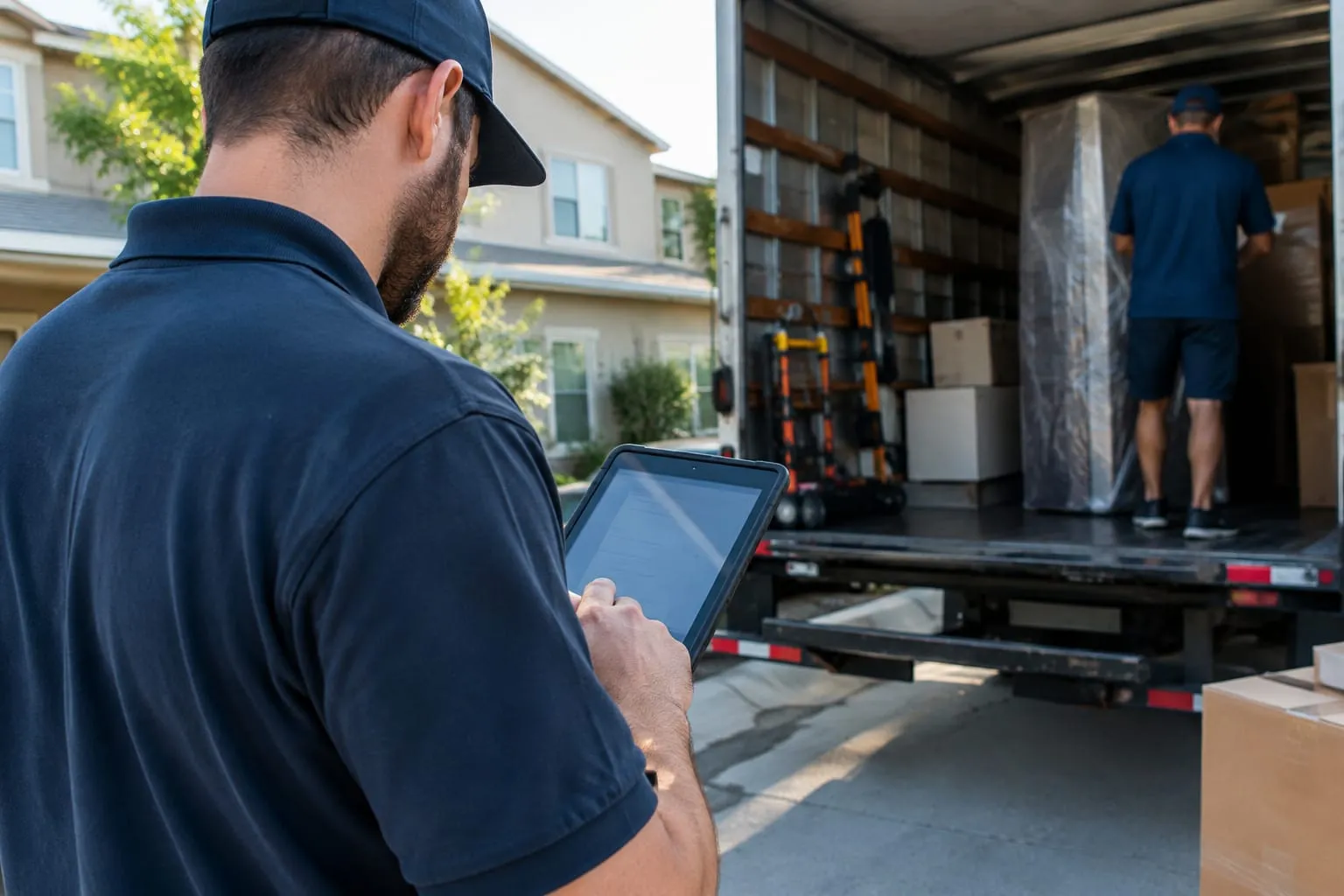
Field conditions matter too. Basements, rural routes and loading docks often lack signal. A crew should be able to complete the Bill of Lading on-site from the foreman app even offline, with the record syncing once the phone reconnects.
This section is general guidance, not legal advice. Have an attorney familiar with household goods regulation review your consent language and templates.
Setting Up an Estimate-to-BOL Workflow in Your Moving CRM
The goal is simple: every field on the bill of lading should be entered once, at the step where it originates. Here is a practical sequence.
- Build the template from 375.505. List each required element and assign it to a source: company profile, estimate, order for service, valuation election or dispatch.
- Load your tariff and payment terms. Minimum charges, accessorial rates and accepted payment forms should live in settings, not in someone's memory.
- Capture estimate type and valuation at sale. Record binding or non-binding, the maximum due at delivery and the signed valuation election before the job is booked.
- Base the order for service on the estimate. Dates, services and price should match.
- Attach dispatch data. Vehicle IDs and any participating carriers come from the dispatch board.
- Finish on-site. The foreman records the actual pickup date, inventory and signatures, then sends the shipper their copy.
- Audit and retain. Compare estimated versus actual on completed jobs and confirm signed records are stored and retrievable.
The bigger benefit is trust: the customer sees the same numbers at every step.
Related Articles
- Automated Survey Removals: A Guide to Pre-Move Intake — how structured intake data reduces re-keying later in the job.
- CRM for Moving Companies: Streamlining Operations — how a moving CRM connects sales, dispatch and paperwork.
- Customer Experience Excellence in Moving Services — why clear documentation shapes how customers judge a move.
Useful Links
- Electronic Bill of Lading Software for Movers
- Moving Claims Software
- Moving Estimate Software for Movers
- Crew & Foreman App
- Dispatch & Scheduling
Need help with this? Electronic Bill of Lading Software for Movers · Get started · Call (888) 611-7483
Ready to see it in action?
Book a free 60-minute demo and explore how Virtual Estimate can help your business.