

Moving companies that store goods face a problem most software ignores: a move ends, but a storage relationship lasts months or years. Choosing the best cloud-based moving company software inventory storage tracking platform means evaluating tools on item-level tracking, vault and unit management, and recurring billing — not just dispatch and quotes. Generic comparison guides bundle every mover together and skip storage entirely. This guide does the opposite. It evaluates named platforms on the features that matter when goods leave the truck and go into a warehouse.

Key Takeaways
| Point | Details |
|---|---|
| Storage changes the buying criteria | Storage-enabled movers need item-level inventory, vault/unit management, and recurring billing — features generic moving tools skip. |
| Cloud is the operating standard | Cloud platforms sync the warehouse, field crews, and office in real time, eliminating the paper-log gaps that cause claims. |
| Digital inventory cuts disputes | Barcode scanning and photo-logged condition reports give every item an auditable trail, reducing claim ambiguity. |
| ROI arrives in one quarter | Mid-size movers reach full ROI in 60–120 days and recover 10–15 weekly admin hours after adoption. |
| Built-for-movers beats generic | Platforms designed around moving workflows — like Virtual Estimate's cloud-based moving solutions — handle storage natively instead of as a bolt-on. |
Why Cloud-Based Software Is Now the Standard for Storage-Enabled Moving Companies

Cloud-based moving software is the operating standard for storage-enabled movers because storage data must stay live across the warehouse, the truck, and the front office at the same time. A desktop tool running on one office PC cannot do that. The moment goods sit in a vault for months, every stakeholder needs the same current record.
Desktop and paper systems break down the instant a customer calls asking what is in their unit. Cloud moving company software answers that question in seconds from any device. That reliability is why cloud-based moving management system adoption has become table stakes rather than a competitive edge.
Q: Is cloud-based moving software better than desktop for storage operations?
A: Yes. Cloud platforms sync inventory, unit assignments, and billing across warehouse, field, and office in real time, while desktop tools trap data on a single machine and require manual reconciliation.
The shift mirrors broader business software trends. The U.S. Census Bureau documents rising cloud and digital-tool adoption across service businesses, and field-service movers are no exception. For storage operators specifically, the always-on record is the whole point.
Pro Tip: Before migrating, export your current unit roster and recurring-billing schedule to a spreadsheet first. Clean data in equals clean data out — a messy import is the single most common reason storage migrations stall past week one.
What to Look for in Moving Software With Inventory and Storage Features
The best moving software cloud-based platform for a storage operation must do four things generic tools do not. Evaluate every candidate against this short list before booking a demo.
- Item-level inventory — each piece logged, tagged, and photographed, not just a box count.
- Storage unit and vault management — assign goods to a physical location and see occupancy at a glance.
- Recurring storage billing — automatic monthly invoices tied to each unit, not one-time job invoices.
- Real-time field sync — crews update inventory from a phone and the office sees it instantly.
- Accounting integration — recurring revenue flows into QuickBooks without manual re-entry.
Moving software with inventory tracking that lacks recurring billing forces your team back into spreadsheets the day a unit goes long-term. That defeats the purpose. Treat recurring billing as a non-negotiable, not a nice-to-have.

Look closely at how each platform models storage. Some treat a unit as a simple text field; true moving company storage management software treats it as a structured object with occupancy status, billing rate, and an item manifest attached. That structural difference determines whether the software scales with you. For a full feature framework, the best moving company software complete buyer's guide walks through every category.
Pro Tip: Ask each vendor to demo a long-term storage customer scenario end to end — intake, monthly billing, partial release, and final out-move. Most demos showcase a simple A-to-B move and quietly avoid the storage workflow where weaker products fall apart.
Top Cloud-Based Moving Software Platforms Compared
Four platforms dominate conversations among storage-enabled movers: Virtual Estimate, SmartMoving, Supermove, and MoveitPro. Each offers cloud access and core moving features; they diverge sharply on how natively they handle storage units, vaults, and recurring billing.
The table below compares storage-relevant capabilities. Feature availability varies by plan and changes over time, so confirm specifics in a current demo before deciding.
| Feature | Virtual Estimate | SmartMoving | Supermove | MoveitPro |
|---|---|---|---|---|
| Item-level inventory tracking | Yes | Yes | Yes | Yes |
| Barcode scanning support | Yes | Varies by plan | Varies by plan | Yes |
| Storage unit & vault management | Yes | Add-on / varies | Yes | Yes |
| Recurring storage billing | Yes | Varies by plan | Varies by plan | Yes |
| QuickBooks integration | Yes | Yes | Yes | Yes |
| Built specifically for movers | Yes | Yes | Yes | Yes |
What separates these tools is rarely the feature checklist — it is depth. A platform built by operators tends to model the messy reality of storage better than one retrofitting it. For example, Virtual Estimate was built by moving-industry insiders, not generic software vendors, which shows up in how its pipeline keeps client info, moving details, inventory, follow-ups, notes, and invoices in organized tabs.
Q: What software do moving companies use for storage operations?
A: Storage-enabled movers most commonly use cloud platforms such as Virtual Estimate, SmartMoving, Supermove, and MoveitPro, chosen on item-level tracking, vault management, and recurring billing depth.
Virtual Estimate can help: Our cloud platform manages inventory, storage units, and recurring billing in one moving-specific workflow built by movers. Learn more →
Inventory Tracking Features That Prevent Claims and Save Time

Strong moving inventory software prevents claims by giving every item an auditable trail from origin to storage to delivery. When a customer disputes a scratch, photo-logged condition reports and timestamped scans settle it in minutes — not arguments.
The federal record-keeping backbone here is the bill of lading. The FMCSA requires movers to provide an inventory and bill of lading documenting the condition of goods, and digital tools turn that legal requirement into a structured, searchable asset rather than a smudged carbon copy.
Storage tracking moving software typically adds these claim-prevention features:
- Barcode scanning — each item or carton gets a unique label scanned at every handoff.
- Photo condition logs — visual proof of pre-existing damage attached to each item.
- Digital bill of lading — signed on a tablet, stored in the cloud, retrievable instantly.
- Chain-of-custody timestamps — who touched what, when, and where.

The time savings compound. Automation in a composite mid-size operation recovered 10–15 hours of weekly manual dispatch and scheduling work — hours redirected from chasing paper to booking jobs. For movers still weighing systems, the moving company technology stack guide shows how inventory tools fit alongside dispatch and estimating.
Storage Unit and Warehouse Management in Moving Software
Moderate storage volume demands real warehouse logic, not a notes field. Moving company software with storage units should let you assign goods to a specific location, view occupancy across your facility, and trigger billing automatically when a unit fills.
The formats matter. A solid platform handles vault storage moving software workflows (wooden vaults stacked in a warehouse), portable storage moving software workflows (containers dropped at a customer's curb), and traditional self-storage-style units within one system. Mixed inventories are the norm for growing movers.
Q: Can moving company software manage storage units and vaults?
A: Yes. Purpose-built platforms model each vault, container, or unit as a structured object with occupancy status, an item manifest, and an attached recurring billing rate.
Moving software with warehouse management ties location to liability. When you know vault 14B holds the Hendersons' 42 cataloged items, a partial release or audit takes minutes. The American Moving & Storage Association points to operational inefficiency as a primary driver of revenue plateaus among mid-size movers — and disorganized storage is a textbook inefficiency.
Pro Tip: Color-code units by billing status, not just occupancy. A unit that is full but 60 days past due is a bigger operational problem than an empty one, and a status-at-a-glance view surfaces collection issues before they become write-offs.
How Cloud Software Connects Field Teams to the Office in Real Time
Real-time sync is the dividing line between cloud and legacy systems. A crew scanning items into a vault updates the master record instantly, so the office, the billing team, and the customer portal all reflect the same truth without a single phone call.
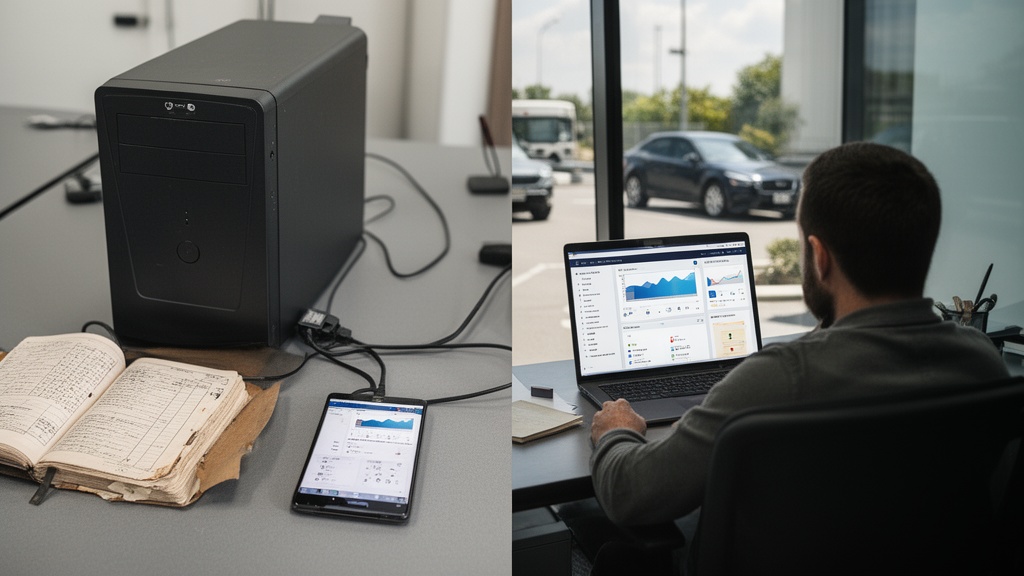
This is where a cloud moving crm with storage earns its cost. In a documented onboarding arc, dispatch went fully digital by day 45 and estimate turnaround dropped from 24 hours to 2 hours by day 90 — speed driven entirely by live data replacing manual handoffs. Crews carry the full job, including storage instructions, in their pocket.
The connected record also lifts conversion. Automated follow-up in the same composite study raised the booking rate from roughly 28% to 38% of qualified leads, because no inquiry slipped through the cracks while staff juggled the warehouse. To see how those operational pieces compound, review the moving business software that scales with you.
Accounting and Billing Integrations for Storage-Based Moving Operations

Recurring storage billing is what makes storage profitable — and what breaks manual systems first. Cloud moving company software with native QuickBooks integration pushes monthly storage invoices into your books automatically, so a 200-unit facility does not require a full-time bookkeeper just to issue invoices.
Look for these accounting capabilities specifically:
- Automated recurring invoices tied to each storage unit's billing date.
- QuickBooks sync so storage revenue posts without re-entry.
- Partial-period proration when a customer releases goods mid-month.
- Aged-receivables visibility on past-due storage accounts.
Manual invoicing does not scale with a storage book. One missed monthly invoice on a long-term unit is pure lost revenue, and at a $1,200 average job value the math adds up fast when storage relationships stretch across many months. Automating the billing loop protects the recurring revenue that storage exists to generate.
Pricing and Plans: What Cloud Moving Software With Storage Actually Costs
Most storage-capable moving platforms use quote-based pricing rather than published flat rates, because cost scales with crew count, job volume, and storage modules. Expect to request a demo and a tailored quote rather than reading a price off a page.
| Platform | Pricing Model | Storage Features | Onboarding |
|---|---|---|---|
| Virtual Estimate | Published tiers + demo | Inventory, units, recurring billing | Phased, ~90-day full adoption |
| SmartMoving | Quote-based | Varies by plan | Guided onboarding |
| Supermove | Quote-based | Varies by plan | Guided onboarding |
| MoveitPro | Quote-based | Included / add-on | Guided onboarding |
Focus less on sticker price and more on payback. Mid-size movers in the composite benchmark reached full ROI within 60–120 days and added $9,600 in monthly revenue from conversion gains alone. Against that, a monthly subscription is rounding error. To compare transparent tiers, review what moving software actually costs before sitting through five sales demos.
Q: How much does cloud moving software with storage cost?
A: Most platforms (SmartMoving, Supermove, MoveitPro) use custom quote-based pricing; the practical benchmark is ROI, which mid-size movers hit in 60–120 days after full adoption.
Virtual Estimate publishes its tiers, which shortens the evaluation. For a storage-heavy operation, confirm at which plan level recurring billing and vault management unlock before committing.
Related Articles
- Moving Company Software Market: A Buyer's Research Guide — How to research and shortlist platforms before you commit budget.
- Moving Company Software with QuickBooks Integration: Top Picks — The best platforms for syncing recurring storage revenue into your books.
- Best Moving Company Management Software for Scheduling, CRM and Billing — A broader look at all-in-one operations tools for movers.
- Moving Company Software Comparison: CRM, Dispatch and Pricing Breakdown — A side-by-side breakdown of features and pricing across platforms.
- Moving Software Pricing: What Moving Companies Actually Pay — Real-world cost ranges and how to evaluate subscription value.
Ready to see it in action?
Book a free 20-minute demo and explore how Virtual Estimate can help your business.