

SEO for moving company websites is one of the highest-ROI growth channels in the industry — yet most movers still depend entirely on paid lead marketplaces and referrals. BrightLocal's Local Business Discovery research confirms that the vast majority of consumers use Google Search as their primary tool for finding local service providers. Moving companies that rank at the top for local searches capture phone calls, form submissions, and booked jobs that competitors are paying platforms to acquire. This guide breaks down every step of moving company SEO — from keyword research through technical optimization and results tracking — so any moving business can build sustainable organic search visibility.

Key Takeaways
| Point | Details |
|---|---|
| Local intent drives high-converting traffic | Queries like "movers near me" and "residential movers [city]" carry explicit purchase intent. City-specific targeting is the foundation of effective moving company SEO. |
| Google Business Profile is the #1 local ranking asset | BrightLocal's consumer research shows most consumers check reviews before contacting a local service provider. An incomplete profile means zero Maps 3-pack visibility. |
| Service-city pages beat generic websites | Dedicated pages for each service-location combination — e.g., "residential movers Denver" — capture targeted traffic that homepage optimization never reaches. |
| Backlinks build domain authority | Listings on Yelp, Angi, the Better Business Bureau, and local chamber sites establish citation consistency and link authority simultaneously. |
| SEO compounds month-over-month | Moving company organic traffic grows steadily once pages rank. For deeper strategy, see the complete SEO guide for moving companies. |
What Is SEO for Moving Companies and Why Does It Matter?
SEO (Search Engine Optimization) for moving companies is the practice of improving a moving business's visibility in unpaid — organic — search results on Google and other search engines. It covers website content, authority signals, and technical site performance so Google surfaces the business when customers search for moving services.
Moving company SEO differs from generic SEO because nearly all purchase intent is local and time-sensitive. A homeowner searching "movers near me" needs a company operating in their specific city that can accommodate their move date — not a national directory or aggregator. Research from Search Engine Journal on organic click-through rates confirms that top organic positions earn dramatically more clicks than lower positions, and the Google Maps 3-pack generates substantial call volume for local service businesses.
Moving company seo marketing that works combines three pillars: content relevance (matching what customers search), authority signals (reviews, links, and citations), and technical performance (fast, mobile-friendly pages). Each pillar reinforces the others. A moving company that invests consistently in all three outranks competitors who focus on only one.
Step 1: Keyword Research for Moving Companies
Effective keyword research for moving companies begins with understanding search intent. Most high-value moving company keywords follow a clear pattern: [service type] + [location]. These phrases carry explicit purchase intent and are specific enough for a local business to rank.
Priority moving company keyword categories:
- Service-city pages: "residential movers Austin," "commercial movers Dallas," "long distance movers Phoenix," "apartment movers Brooklyn"
- Informational content: "how much do movers cost in [city]," "best time to hire movers," "moving checklist [city]"
- Comparison intent: "best moving companies [city]," "[city] moving company reviews," "licensed movers near me"
Use Google Keyword Planner for free volume estimates. Tools like Moz Keyword Explorer provide keyword difficulty scores — for new sites, prioritize terms with difficulty scores below 20 to build initial traction. Research moving company keywords systematically across every service and city combination you want to target before building any pages.
Pro Tip: Open Google and type your top service term ("movers in [your city]") without pressing Enter. Record every autocomplete suggestion that appears. These are real search queries with existing demand — zero cost and immediate insight into the exact language buyers use.

Step 2: On-Page SEO for Your Moving Company Website
Moving company on-page seo covers every optimization made within the website's own pages: title tags, headings, body content, and internal link structure. This is where most moving companies underperform — and where rankings are most directly within an operator's control.
Build dedicated service-city landing pages. One generic "Services" page does not rank for a portfolio of city-service terms. A company serving three cities with four service types needs at least 12 distinct landing pages. Each page targets a single service-city keyword, includes it in the title tag, H1, and first paragraph, and provides at least 600 words of substantive content.
Write content that answers real buyer questions. Each landing page should address what the service includes, how pricing works, what makes the company trustworthy, and what the booking process looks like. Thin pages with under 300 words of generic copy are outranked by competitors who answer specific questions thoroughly.
Optimize title tags and meta descriptions. The title tag is the most direct on-page ranking signal. A clean format is: [Service] in [City] | [Company Name]. Keep titles under 60 characters. Meta descriptions should stay under 160 characters, include the target keyword, and give searchers a specific reason to click.
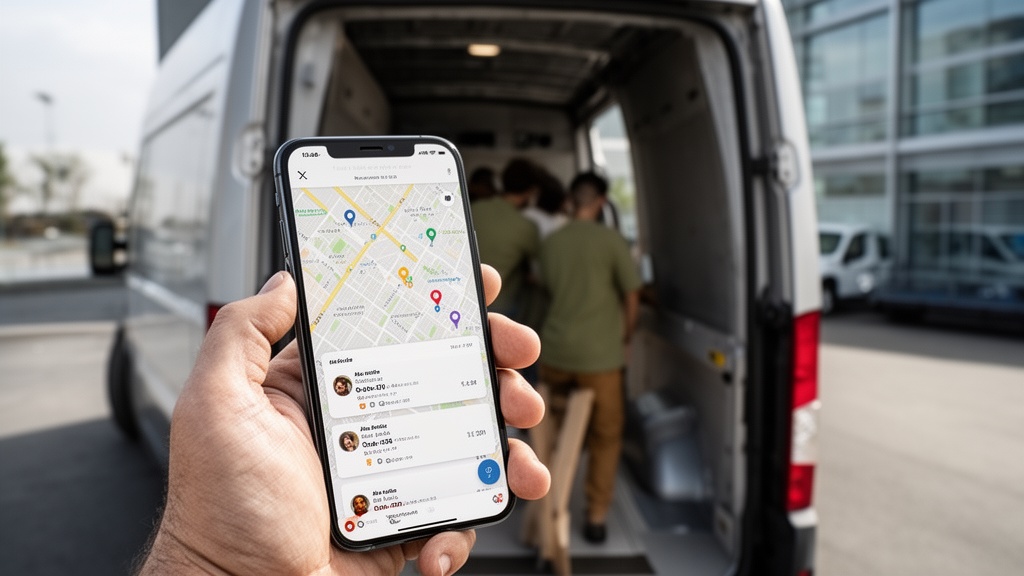
For a detailed breakdown of city-specific page architecture, the guide on local SEO tactics for movers covers how to structure multiple location pages without triggering duplicate-content penalties.
Step 3: Local SEO for Moving Companies
Local SEO for moving companies is focused on ranking in Google's Maps 3-pack — the three business listings that appear above organic results for location-based queries. The Maps pack drives a disproportionate share of phone calls for local service businesses compared to organic results below it.

Moving company local seo encompasses four core elements: Google Business Profile optimization, review management, NAP citation consistency, and geographic proximity signals. Neglecting any one of these suppresses local visibility regardless of how strong the other three are.
Optimize your Google Business Profile. A moving company Google Business Profile is the single most important local SEO asset. Every field matters: business category (select "Moving Company"), service areas, hours, phone number, website URL, photos, and the services list. Google's official guidance on Business Profiles confirms that complete, accurate profiles are significantly more likely to appear in relevant local results.
The local ranking algorithm weighs three factors:
- Relevance — How closely the profile matches the search query
- Distance — Proximity of the business to the searcher's location
- Prominence — Review quantity, review rating, backlinks, and overall web presence
Build a systematic review collection process. Review velocity — the number and recency of new reviews — has a direct effect on moving company Google ranking in local search results. BrightLocal's annual consumer survey consistently shows that most people read reviews before contacting a local service provider. A post-job SMS or email review request, sent within 24 hours of job completion, builds review volume without requiring manual follow-up.
Maintain NAP consistency. NAP — Name, Address, Phone Number — must be identical across every directory, citation, and page of the website. Inconsistencies send conflicting signals to Google and suppress local rankings.
Pro Tip: Add new photos to your Google Business Profile every week. Real job photos — trucks on-site, crew in action, completed rooms — outperform stock images for profile engagement. Active, regularly updated profiles signal to Google that the business is current and legitimate.
Step 4: Building Backlinks for Your Moving Business
Moving company backlinks — links from other websites pointing to a moving company's domain — are a primary authority signal Google uses to determine how pages rank. Higher domain authority from quality backlinks correlates with stronger positions across both organic and local results.
Start with directory citations. The foundational backlink layer for movers includes structured directory listings: Yelp, Angi, the American Moving and Storage Association (AMSA) member directory, the Better Business Bureau, and local chamber of commerce sites. These establish NAP consistency and provide legitimate links from trusted, high-authority domains simultaneously.
Pursue local and niche-relevant links. A link from a local real estate agent's resource page or a neighborhood news site carries more local relevance than a generic entry in an unrelated directory. Identify complementary local businesses — storage facilities, property managers, home staging companies — and explore resource-sharing or content collaboration opportunities.
Create content that earns links naturally. Moving tip guides, local cost breakdowns ("How much do movers cost in [city]?"), and neighborhood move checklists attract editorial links from real estate blogs, local publications, and community resource pages — without active outreach.
| Backlink Source | Difficulty | Authority Signal | Estimated Time to Secure |
|---|---|---|---|
| Yelp / Angi / BBB directories | Low | High (NAP citation) | 1–3 days |
| Local chamber of commerce | Low | High (local authority) | 1–2 weeks |
| AMSA member directory | Low | Very high (niche authority) | 1–3 days |
| Real estate agent resource pages | Medium | High (local + niche) | 2–4 weeks |
| Local news or community sites | Medium | High (local relevance) | 2–4 weeks |
| Guest posts on home/lifestyle blogs | Medium-High | Medium | 4–8 weeks |
Pro Tip: Use Moz's free Link Explorer to analyze which sites link to your top local competitors. Any domain already linking to a competitor has demonstrated interest in the moving niche — making it a warm outreach prospect with a proven appetite for moving-industry content.
Step 5: Technical SEO Checklist for Movers
Technical SEO ensures Google can crawl, index, and correctly interpret every page of a moving company website. Strong content underperforms when technical barriers block indexing or slow load times.
Page speed. Google's Core Web Vitals are a confirmed ranking factor. Pages that fail Core Web Vitals thresholds — particularly on mobile — lose ground to faster competitors. Compress images, eliminate unnecessary plugins, and use hosting with consistent server response times.
Mobile usability. Moving searches are predominantly mobile. Use Google's Mobile-Friendly Test to identify layout, tap target, and viewport issues. A site that is difficult to navigate on a smartphone loses leads before they become inquiries.
HTTPS. All moving company websites must serve content over HTTPS. Google flags HTTP pages as insecure, suppressing both rankings and user trust. Free SSL certificates are available from most hosting providers.
Technical SEO checklist for moving companies:
- XML sitemap submitted to Google Search Console
- Robots.txt correctly configured — no accidental blocking of key pages
- All primary pages confirmed as indexed in Search Console Coverage report
- Canonical tags on duplicate or near-duplicate pages
- Core Web Vitals passing in Search Console
- LocalBusiness schema markup on every service-area page
- 301 redirects in place for changed or deleted URLs
- No broken internal links

Step 6: Tracking and Measuring Your Moving Company SEO Results
SEO investment without measurement produces guesswork. Tracking moving company organic traffic and lead conversions from day one ensures that optimization effort focuses on what actually produces booked jobs.
Google Search Console is free and provides the most direct view of organic performance: which queries drive impressions and clicks, which pages rank, and how positions change over time. Google Search Console also surfaces technical issues — indexing errors, Core Web Vitals failures, and manual penalties — as they arise.
Google Analytics tracks visitor behavior after landing. Configure conversion goals for phone number click events, quote form submissions, and estimate request completions. This connects moving company organic traffic to actual lead volume rather than raw pageviews alone.
Track keywords by service-city combination. Broad metrics are less actionable than monitoring specific target terms weekly. Tracking "residential movers [city]" rank positions shows real progress toward the Maps pack and organic top 10.
The full revenue picture emerges when organic leads flow into a CRM that records every source. Converting organic traffic into tracked and managed moving leads requires attribution from the source keyword through to the booked job — the connection most moving company SEO strategies never close.
| SEO Metric | What It Measures | How to Track |
|---|---|---|
| Organic sessions | Search-driven website visits | Google Analytics |
| Keyword positions | Rank for target service-city terms | Semrush / Ahrefs / Search Console |
| Click-through rate | Clicks ÷ impressions | Google Search Console |
| Organic lead volume | Form fills and calls from organic traffic | GA goals + call tracking |
| Google 3-pack visibility | Maps pack presence for target queries | Manual check / BrightLocal |
| Review count and rating | Local ranking signal (prominence factor) | Google Business Profile |

Common SEO Mistakes Moving Companies Make
Most moving company SEO underperformance stems from predictable, avoidable errors — not complex strategy gaps.
Thin or generic website content. A homepage and a single "Services" page do not rank for a portfolio of city-service terms. Every target keyword needs a dedicated, substantive page built specifically for that query.
Ignoring the Google Business Profile. An unclaimed, incomplete, or inactive profile is invisible in the Maps 3-pack. This single asset, properly optimized, generates more local search visibility than most other SEO activities combined.
Keyword stuffing. Forcing "best affordable local moving company residential movers" into every paragraph signals manipulation. Google's algorithms recognize natural language — write for readers, not crawlers.
No systematic review strategy. Review velocity is a direct ranking factor. A competitor with 300 recent reviews consistently outranks one with 30, regardless of website quality or content investment.
Treating SEO as a one-time project. Algorithms update, competitors improve, and new search behaviors emerge. Moving company seo marketing requires consistent, incremental effort that compounds over months. One-time optimization decays within 6 to 12 months without ongoing maintenance.
For seo for movers looking to connect organic lead generation to revenue, purpose-built moving CRM software provides the lead source attribution layer that closes the loop from keyword to booked job. Moving CRM platforms such as Virtual Estimate AI are built specifically for moving company workflows — connecting organic traffic attribution to job management from first inquiry to final invoice.
Related Articles
- Moving Company SEO: A Step-by-Step Strategy Guide — Build and execute a full SEO strategy for your moving business, from initial audit to ongoing content and link-building maintenance.
- Digital Marketing Strategies for Moving Companies: A Complete Guide — Learn how SEO fits into a broader digital marketing framework alongside paid ads, email, and social channels.
- CRM for Moving Companies: Streamline Operations — How CRM software connects organic lead capture to job management and revenue tracking for moving businesses.
- SEO for Movers: Local Tactics to Get More Leads — Tactical playbook for local SEO specific to the moving industry, including Maps pack optimization and review strategy.
- Moving Company Lead Management: Track, Nurture, Convert — How to manage and convert organic traffic leads through the full booking funnel.
Ready to see it in action?
Book a free 20-minute demo and explore how Virtual Estimate can help your business.