

Moving companies that rely on repurposed CRMs and generic project management tools are running complex operations on instruments calibrated for other industries. The problem isn't that generic software is bad — it's that moving operations have specific, non-negotiable requirements that no general-purpose platform was designed to accommodate. Software built by movers addresses problems that generic vendors don't even know exist. This article examines what industry-native software means, what it enables operationally, and how to verify whether a vendor truly built their platform for the moving industry or just marketed it that way.

| Point | Details |
|---|---|
| Generic tools create compounding ops costs | Moving companies using general-purpose CRMs build manual workarounds for weight calculations, dispatch, and customer follow-up — each workaround compounds error risk as job volume scales. |
| Industry-native means a fundamentally different data model | Software built by movers uses moving-specific entities — jobs, crews, estimates, move dates — as core data structures, not repurposed deal/task frameworks from generic sales tools. |
| Purpose-built features are exclusive to moving platforms | Weight-variable estimates, COI generation, and binding/non-binding compliance workflows exist natively only in moving software. Generic platforms require expensive custom workarounds. |
| Vendor verification requires specific technical questions | Ask vendors how they handle binding vs. non-binding estimates and COI generation. Vague or workaround-based answers confirm a generic platform origin, regardless of marketing language. |
| Moving's operational complexity demands purpose-built tools | The American Moving and Storage Association defines professional moving standards that purpose-built software is designed to meet — from pre-move survey through post-move claims. |
The Hidden Cost of Using Generic Software to Run a Moving Company
Understanding why generic software fails moving companies starts with a fundamental mismatch: generic platforms are built around universal business workflows — contacts, deals, tasks, timelines. Moving operations don't conform to this model.
A single moving job involves weight-based pricing calculations, binding vs. non-binding estimate documentation, multi-crew dispatch with vehicle assignment, COI (Certificate of Insurance) generation for building access, real-time route adjustments, and post-move claims tracking. Generic CRMs have none of these as native capabilities. Teams compensate with spreadsheets, sticky notes, and disconnected text threads.
The cumulative cost compounds with volume. At 10 jobs per week, workarounds are manageable. At 50, they become structural failures. Dispatch errors increase when crew assignments live in text messages. Estimate discrepancies rise when pricing calculations happen in a spreadsheet disconnected from the job record.
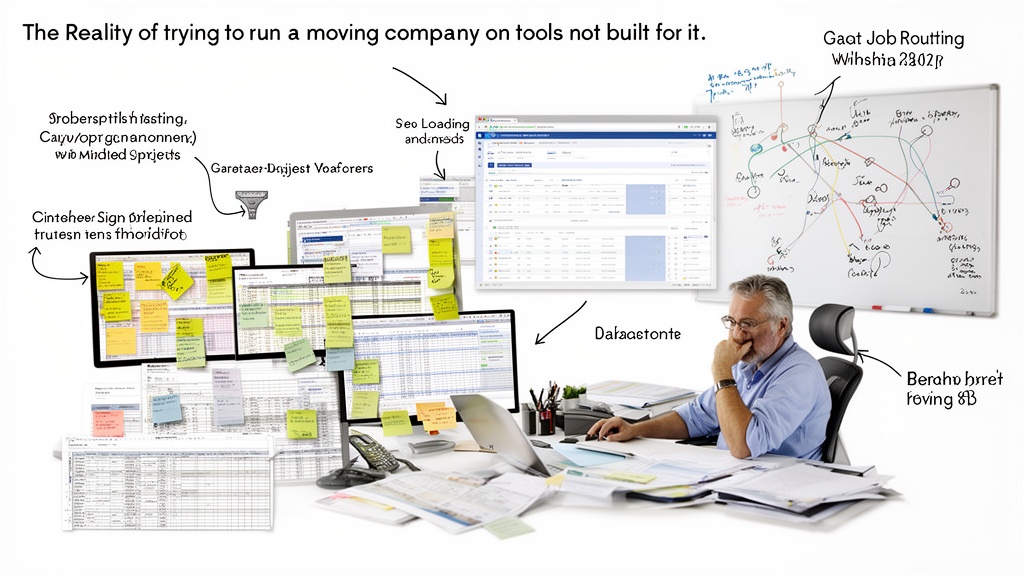
According to the U.S. Bureau of Labor Statistics, transportation and material moving is one of the largest employment sectors in the country — making operational efficiency a direct competitive differentiator for moving companies that eliminate manual process overhead.
Pro Tip: Map every manual handoff your team makes between systems for a single job — from estimate creation to dispatch notification to customer follow-up. Each handoff is an error insertion point. Purpose-built software eliminates most of them by connecting these stages within a single, moving-specific data model.
What 'Industry-Native' Actually Means in Moving Software
Industry-native moving software is designed, built, and continuously refined by people who understand moving operations from the inside — not as casual users, but as domain experts who know why each operational requirement exists.
The distinction goes beyond feature lists. In a purpose-built platform, a "job" is a first-class entity with its own properties: job type (local, long-distance, commercial, storage-in-transit), crew and vehicle assignment, estimate type, and milestone stages. This isn't a "deal" with custom fields bolted on. It's a data structure designed around how moving jobs actually work.
Mover-first technology also means the user experience reflects field realities. Dispatch screens are optimized for fast decisions under operational pressure — not data entry into structured forms. Mobile interfaces function in truck cabs and on loading docks. Customer communication templates account for the stress and urgency that defines most moving-day interactions.
This is the core distinction between moving industry specific software and a generic platform offering "customization." Customization produces a system that looks like it was built for movers. Industry-native software was actually built by movers — with domain expertise baked into the architecture, not layered on top.
Case Study: How One Moving Company Transformed Operations with Purpose-Built Tools
The following is an illustrative composite based on common operational patterns in the moving industry. It does not represent a specific named company.
A mid-size regional moving company — approximately 15 crews across three metro markets — ran operations for several years on a generic CRM, a spreadsheet dispatch board, and a consumer scheduling app. The combination worked at 25-30 jobs per week.
When volume reached 50+ jobs weekly, the operational cracks became structural. Estimate discrepancies increased as weight calculations in a separate spreadsheet drifted from job records in the CRM. Crew assignments communicated via group text had no system of record — rescheduling a job required manually notifying every affected party. Customer follow-up gaps widened because the CRM had no concept of a "move date" as distinct from a "contract close date."
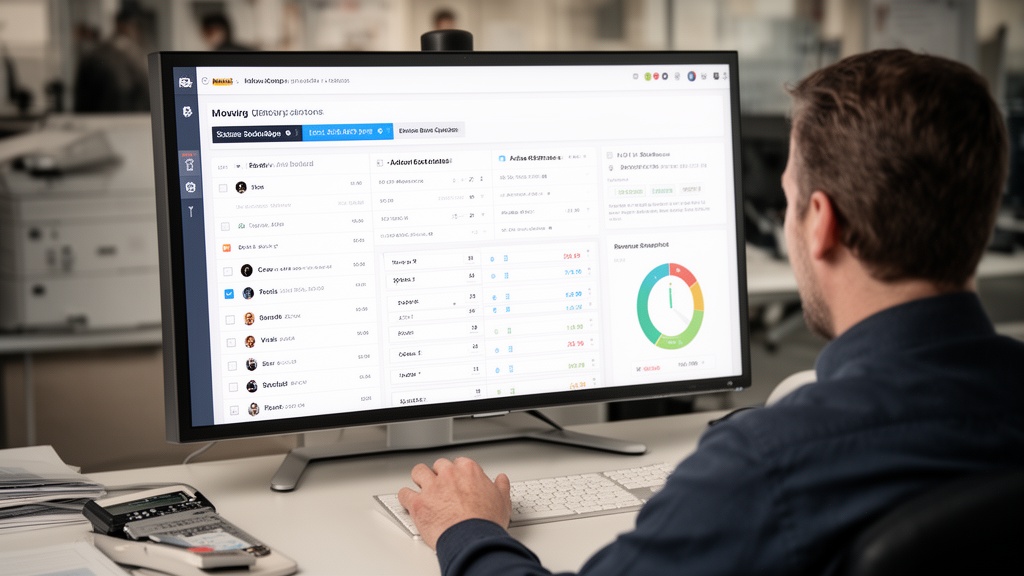
After migrating to moving company operational software built specifically for the industry, the operation reported measurable improvements in three areas:
- Estimate accuracy — weight-based calculation logic embedded in the estimate builder eliminated the manual spreadsheet step, reducing pricing discrepancies on binding estimates.
- Dispatch coordination — all crew assignments, vehicle statuses, and real-time job changes lived in one system, visible to dispatch and field simultaneously.
- Customer communication — automated touchpoints triggered by job milestones replaced ad-hoc outreach and reduced inbound status inquiries significantly.
Understanding what customer experience excellence looks like in moving services starts with operational visibility. That visibility requires software designed to track and communicate job progress — not adapted from a sales pipeline tool that doesn't know the difference between a closing date and a delivery date.
Virtual Estimate can help: Virtual Estimate provides industry-native solutions designed for moving companies — built on the operational logic that reflects how moving jobs actually run, not adapted from generic sales software. Learn more →
Features That Only Exist in Software Designed Specifically for Movers
Software designed for movers contains capabilities that are meaningless outside the moving context. These are not cosmetic customizations — they require deep domain knowledge to design correctly and moving-specific business logic to execute reliably.
| Feature | What It Does | Why Generic Tools Can't Replicate It |
|---|---|---|
| Weight-variable estimate builder | Calculates pricing from inventory weight, cubic footage, and item handling requirements | Requires a moving-specific item database and weight-calculation engine |
| Binding vs. non-binding estimate workflows | Separate legally compliant approval processes for each estimate type | Generic deal stages have no concept of regulated estimate compliance |
| COI generation | Automatically generates Certificates of Insurance for specific building requirements | No generic CRM has building-specific COI generation logic |
| Multi-stop job routing | Handles origin, storage, and multiple delivery destinations within one job record | Generic task tools require multiple disconnected records |
| Crew skill matching | Assigns crews based on specialty certifications — piano, fine art, commercial rigging | Requires a moving-specific competency and credentialing model |
| Post-move claims management | Tracks damage claims linked to job records and inventory line items | Generic ticketing lacks moving-specific claims context and item linking |
| Interstate tariff compliance | Weight-based pricing with regulatory disclosure for FMCSA-regulated moves | Requires knowledge of federal moving regulations, not just date/rate logic |
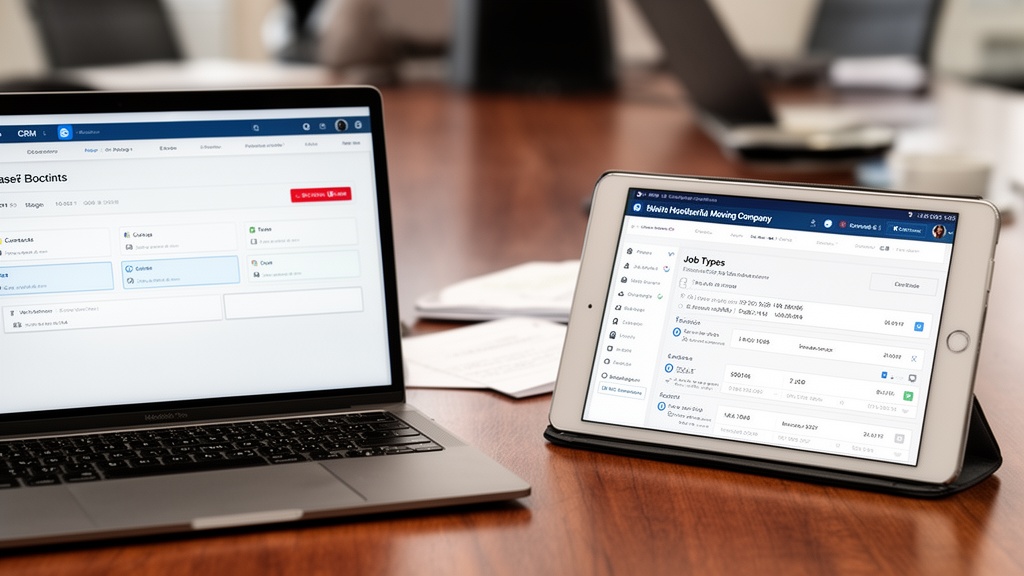
Industry specific moving tools earn their designation through depth of domain knowledge, not breadth of general features. These capabilities don't exist in Salesforce, HubSpot, Monday.com, or any general-purpose platform as native features — only as expensive custom-development workarounds that require ongoing maintenance and still don't reflect actual moving-industry logic.
Pro Tip: Ask any vendor to walk you through their estimate builder live. Watch specifically for how it handles item weight. If the platform asks for a single total weight figure without providing an item-by-item inventory builder, the estimate logic was not built for professional moving operations.
Try Virtual Estimate's virtual survey and estimate tools: Built on real moving-industry weight logic and FMCSA-aware estimate frameworks, Virtual Estimate produces weight-accurate estimates from virtual surveys — giving your team the data to price confidently and dispatch correctly. Get started →
Generic vs. Industry-Native Software: A Direct Comparison
The operational contrast between generic software and moving company niche software becomes concrete when mapped against daily workflow requirements.
| Operational Requirement | Generic CRM / PM Tool | Industry-Native Moving Software |
|---|---|---|
| Weight-based estimates | Manual custom fields, no calculation logic | Built-in inventory weight tables with auto-calculation |
| Dispatch coordination | Task list or Kanban board | Real-time crew, vehicle, and job status dashboard |
| COI generation | Not supported — document attachment workaround | Automatic generation by job and building |
| Binding estimate compliance | Not supported | Separate workflow with required customer sign-off |
| Multi-stop job routing | Multiple disconnected task records | Native multi-destination job entity |
| Move-date milestone tracking | Generic date field, no automation triggers | First-class job date with stage-based communication triggers |
| Field crew mobile access | Generic app with no moving context | Purpose-built field app with job details, inventory, and signature capture |
| Claims management | Not supported | Post-move claim linked to job record and item inventory |
| Long-distance tariff compliance | Not supported | Interstate weight-based pricing with regulatory documentation |
Software built for moving companies wins this comparison not through feature quantity but through coherence. Every capability connects to a unified data model that understands what a moving job is, who's responsible, and what regulatory requirements apply at each stage.
Questions to Ask Any Software Vendor to Verify They Built It for Your Industry
The claim "built for moving companies" appears across vendor marketing materials. Verification requires specific questions that generic platforms cannot answer satisfactorily.
Seven questions that separate industry-native from industry-adjacent:
- Who designed your data model? — The answer should name moving operators or industry veterans with direct field experience, not generalist product teams.
- How does your estimate logic handle binding vs. non-binding estimates? — A purpose-built system has distinct, compliant workflows for each. A generic system offers "two deal stages."
- What triggers customer communications in your platform? — Moving-specific triggers include job confirmation, crew assignment notification, in-transit updates, and delivery completion.
- How does your dispatch board handle same-day job changes? — Native platforms propagate changes automatically. Generic tools require manual rescheduling of every affected party.
- Can your system generate a COI for a specific building? — If the answer involves document attachments or manual creation, this is a workaround, not a solution.
- How do you calculate pricing for interstate long-distance moves? — Regulated interstate moves require weight-based pricing with FMCSA disclosure requirements. Generic tools have no concept of this.
- Which moving companies participated in your product design? — This is the most direct signal of whether the platform was built by movers or adapted for them.
Industry-native solutions designed for moving companies should answer all seven questions without deflection. Vague or workaround-based answers are disqualifiers for any operation beyond the most basic volume.
Pro Tip: Request a product roadmap review during vendor evaluation. Vendors who built software for movers have roadmaps shaped by moving industry feedback — features address moving-specific problems. Generic vendors add features for the broadest possible market, which means moving-specific needs are chronically deprioritized.
Transitioning Your Moving Company to Industry-Native Software
Moving from generic tools to software built for moving companies is a structured process — not a high-risk rip-and-replace. The migration risk is manageable with deliberate sequencing.
Phase 1 — Audit your current tool stack. Identify every system your team uses across a single job lifecycle: estimate tool, CRM, dispatch method, customer communication, billing platform. Map every manual handoff. These handoffs are your pain points and migration priority list.
Phase 2 — Pilot in parallel. Run the new platform alongside existing tools for two to four weeks on a subset of jobs. This surfaces operation-specific edge cases before full cutover, without disrupting ongoing volume or peak-season jobs.
Phase 3 — Migrate with moving logic. Transitioning from a generic CRM to purpose-built mover software requires mapping generic fields to moving entities — deals become jobs, contacts get job histories, tasks become crew assignments. Purpose-built vendors with moving-industry expertise provide migration frameworks because they understand exactly what's being mapped.
Phase 4 — Train by role. Dispatchers, estimators, crew leads, and office staff each use the system differently. Role-specific training accelerates adoption and prevents teams from reverting to familiar generic tools during the adjustment period.

Understanding how Virtual Estimate was built with moving operators in mind clarifies why its onboarding process is structured around moving-specific data migration rather than generic CRM import templates. The platform was designed to receive moving data in the native formats that moving operations generate — not to accept whatever a generic tool happens to export.
Virtual Estimate: Closing the Industry-Native Gap
Virtual Estimate is software built by movers and for moving companies — designed around the operational realities of dispatch, estimating, crew management, and customer communication specific to the moving industry. The platform reflects the expertise of moving operators who understand that a "job" in moving is categorically different from a "deal" in a generic sales CRM.
The platform covers the full job lifecycle: virtual surveys that produce weight-accurate estimates, automated customer communication tied to real moving milestones, dispatch coordination with live crew and vehicle visibility, and CRM functionality built around moving-industry job relationships — not repurposed contact and deal management frameworks.
For moving companies evaluating vendors at the decision stage, the relevant question isn't "does this software have a feature list that looks right?" It's "was this platform designed by people who have run moving operations?" Virtual Estimate's answer is yes — and the product architecture reflects that expertise at every layer.
Related Articles
- Moving Company Operational Efficiency: A Complete Playbook — Learn the full operational framework for running a high-efficiency moving company at scale.
- Best Moving Company Software: Complete Buyer's Guide — An in-depth evaluation of moving software platforms assessed for real operational fit.
- Best CRM for Moving Companies: In-Depth Comparison — A head-to-head comparison of CRM platforms evaluated specifically for moving company needs.
- Moving Company Technology Stack Guide — How to build a complete, integrated technology stack for modern moving operations.
- Digital Marketing Strategies for Moving Companies: A Complete Guide — Proven tactics for growing your moving company's online presence and lead volume.
Ready to see it in action?
Book a free 20-minute demo and explore how Virtual Estimate can help your business.