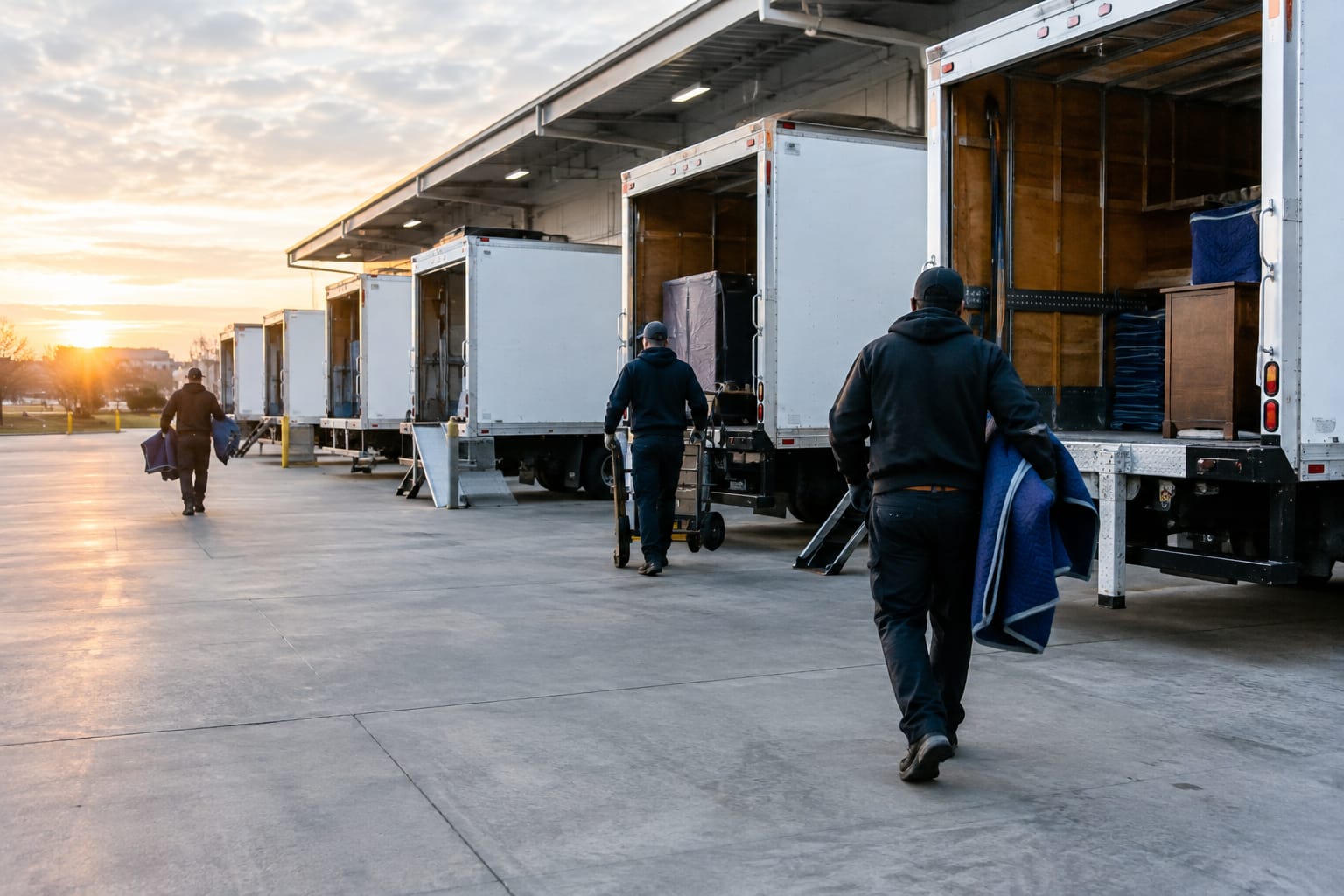

Traditional moving estimates depend on a single variable: human accuracy under pressure. An estimator walks room to room, mentally cataloging furniture, guessing weights, and hoping the final quote holds up against actual truck space and labor costs. The margin for error is substantial — and when estimates miss, moving companies absorb the cost. AI estimation technology for moving companies replaces guesswork with structured data capture, computer vision, and automated pricing logic. This article breaks down exactly how the process works — from customer video submission to final quote delivery — so moving company owners can understand why it produces more consistent, defensible results.

| Point | Details |
|---|---|
| Traditional surveys are costly and inconsistent | In-home estimates require estimator travel, 45–90 minutes per survey, and vary significantly by individual skill level |
| Computer vision powers item detection | Object detection models trained on thousands of household items automatically identify furniture from customer video |
| Weight databases eliminate manual calculations | Each detected item maps to a standardized weight entry, removing the largest single source of estimate error |
| Machine learning improves with each completed job | Feedback from actual move outcomes continuously refines detection accuracy and pricing precision over time |
| Human review stays part of the workflow | Specialty items, access constraints, and high-value goods still require trained estimator judgment before quote delivery — learn more about AI estimation solutions for moving companies |
The Problem With How Moving Estimates Have Always Been Done
The in-home estimate has been industry standard for decades — and it carries structural weaknesses that compound at scale. Estimators rely on experience and memory, room layouts vary, and customers routinely fail to disclose items. Quote accuracy depends more on individual skill than on any repeatable process.
The Federal Motor Carrier Safety Administration mandates that interstate movers provide written estimates and defines three types: non-binding, binding, and binding not-to-exceed. Each carries financial exposure when the underlying inventory is inaccurate. A missed item on a binding estimate means the carrier absorbs the cost difference — there is no recovery mechanism.
Beyond financial risk, in-home surveys are expensive to scale. Each appointment requires an estimator, scheduling overhead, and travel time. For moving companies trying to grow volume without proportional headcount growth, this creates a hard ceiling on daily estimate capacity.
| Estimation Method | Time per Estimate | Key Accuracy Driver | Scalability |
|---|---|---|---|
| In-home manual survey | 45–90 min | Estimator experience and memory | Low — requires travel per job |
| Phone self-reporting | 15–30 min | Customer self-accuracy | Medium — no visual verification |
| Agent-led video call | 20–40 min | Agent real-time observation | Medium — requires scheduling |
| AI virtual survey | 10–20 min | Computer vision + weight database | High — fully asynchronous |
The operational and cost gap between manual and AI-powered estimation compounds significantly at higher job volumes.
Step 1: The Customer Initiates a Virtual Survey
The AI moving estimate process begins when a customer receives a survey link via text or email, typically sent automatically within seconds of an inbound inquiry. This link opens a guided mobile or web interface that walks the customer through recording each room in their home.
The survey interface instructs customers to pan slowly through each space, ensuring the camera captures furniture from multiple angles. Some platforms use asynchronous video upload — the customer records at their own pace and submits when ready. Others support live video sessions with an agent present. Both approaches feed the same AI processing pipeline.
Pro Tip: Moving companies that send survey links within five minutes of an inbound inquiry see measurably higher completion rates. Embedding the link in an automated first-response message removes scheduling friction entirely and captures the customer at their peak engagement window.
For a detailed breakdown of how the virtual survey experience is structured for customers, how to conduct a virtual pre-move survey covers the full workflow step by step.
Step 2: AI Scans and Identifies Items in Real Time
Computer vision moving estimates rely on object detection models to identify household items from video frames. The AI processes frames continuously, drawing bounding boxes around detected items and assigning each a classification label and a confidence score.
Modern object detection architectures, benchmarked against datasets like the COCO common objects dataset, can classify hundreds of household item categories — including sub-types such as loveseat versus sectional sofa, or twin versus queen mattress. That granularity matters. Identifying "a sofa" is not actionable; identifying "a 3-seater fabric sofa, approximately 85 inches" maps directly to a specific weight class and cubic footage range — the inputs the pricing engine requires.

The AI inventory detection for moving pipeline also applies several mechanisms to improve reliability:
- Frame sampling: Multiple frames per second reduce missed items caused by camera movement or partial occlusion
- Confidence thresholding: Low-confidence detections are flagged for human review rather than silently included in the inventory
- Duplicate suppression: Items visible from multiple angles across multiple frames are deduplicated before the final inventory is compiled
The result is a detection output that is both comprehensive and auditable — every item in the list has a traceable confidence score and source frame.
Step 3: The System Builds an Automated Inventory List
Once item detection completes, the AI compiles a structured, editable inventory list from the video data. This is the primary deliverable of the estimation pipeline: a line-item inventory that drives every subsequent pricing calculation.
Each detected item appears with its category, size class, standard weight, and cubic footage estimate. The list is generated automatically but remains fully editable before the estimator sends any quote to the customer.
Room-level context adds another layer of accuracy. Items detected in a kitchen are cross-referenced against appliance categories with specific weight ranges. Items in a garage trigger prompts for heavy or partially obscured equipment — machinery, stored boxes, outdoor power tools — that the AI may have detected partially or not at all.

The estimator's role at this stage is review, not construction. Instead of building an inventory from scratch, they verify the AI output, correct any misidentifications, and flag specialty items for separate treatment. This shifts the job from data entry to quality control — a fundamentally more efficient use of skilled labor time.
Step 4: Pricing Logic and Weight Calculations Are Applied
With the inventory confirmed, the powered estimation technology applies its pricing layer. This is where detected items convert into commercial moving rates through a structured, repeatable calculation sequence.
- Each item's size class maps to a standard weight from the carrier's weight reference database
- Total shipment weight is calculated across all confirmed line items
- Cubic footage is estimated from item dimension data stored in the database
- Truck capacity requirements are derived from the total cubic footage
- Labor hours are estimated based on item count, total weight, and floor-access data collected during the survey
- Pricing rules — fuel surcharges, origin and destination rates, access fees, elevator charges — are applied to generate a final estimate figure
| Common Household Item | Standard Weight | Cubic Footage |
|---|---|---|
| Queen mattress + box spring | 160 lbs | 35 cu ft |
| 3-seater upholstered sofa | 200 lbs | 40 cu ft |
| Standard refrigerator | 250 lbs | 30 cu ft |
| Dining table + 6 chairs | 250 lbs | 45 cu ft |
| Upright piano | 400 lbs | 25 cu ft |
| Full dresser with mirror | 180 lbs | 25 cu ft |
These weight standards are derived from carrier tariff tables and industry reference guides widely used across the moving industry.
Pro Tip: Review and update your weight database at least twice per year. Appliance manufacturers regularly revise product weights, and outdated database entries cascade into pricing errors across every estimate the system generates — a small maintenance task with outsized financial impact.
The Virtual Estimate's AI-powered platform supports custom pricing rules adjustable by service area, season, or move type — ensuring the AI applies company-specific pricing logic rather than a generic industry default.
Step 5: The Estimate Is Generated, Reviewed, and Sent
Automated estimate generation for movers is the final step in the pipeline. The system produces a formatted quote document — including item counts, total weight, cubic footage, estimated labor hours, and a final price — that the estimator reviews before it reaches the customer.
This review step is by design. The AI surfaces its complete calculation for human confirmation, not direct customer delivery. The estimator can adjust line items, add notes about access conditions, or route specialty items to a separate quote. Human judgment stays in the loop on every estimate, regardless of how much the automation handles.
Once approved, the estimate is transmitted with the full inventory breakdown attached. Showing customers exactly what was detected and counted is a meaningful trust differentiator over opaque quotes that present only a single final number with no supporting detail.

Total elapsed time from customer survey submission to estimate delivery, in typical deployments, is 15 to 30 minutes. Compare that to the 24–48 hour turnaround standard with scheduled in-home surveys. Faster estimates close at higher rates because customers are still actively engaged, still comparing options, and still in a decision-making mindset.
How Accuracy Improves Over Time With Machine Learning
Machine learning moving estimates improve through a feedback mechanism called supervised learning. When a completed move's actual weight differs from the estimate, that discrepancy becomes a data point that is fed back into the model's training dataset.
Over time, the system identifies which item categories are systematically underestimated — packed garage boxes, items described by customers as "a few things" that turn out to be significantly more, or appliances that camera angles consistently capture at misleading angles. It adjusts weight assumptions in those categories based on real-world outcome data rather than static database entries.
McKinsey Global Institute research on enterprise AI adoption consistently identifies data volume as the primary predictor of AI model performance — a finding directly applicable to moving company estimation tools. Companies processing higher move volumes accumulate richer feedback loops and see faster accuracy gains than lower-volume operators using the same underlying technology.
Improvement also applies to detection accuracy itself. When estimators correct misidentified items during their review, those corrections become training data. Precise corrections — "this was a sectional sofa, not a 3-seater" — generate stronger training signals than vague ones. Training review teams to make specific corrections from day one accelerates model calibration significantly.
Pro Tip: Even without a formal AI feedback system in place, moving companies that log actual versus estimated weight on every completed job are building the dataset they will need when they adopt AI estimation tools. Start the tracking habit now — the data has compounding value and becomes a genuine competitive asset.
What AI Estimation Cannot Yet Replace
Virtual survey AI technology handles what is measurable, visible, and standard. It struggles with anything requiring contextual judgment outside its training data or beyond what a camera can capture.
Current limitations include:
- Specialty and high-value items: Fine art, antiques, custom pianos, and fragile collections require human assessment of condition, packing requirements, and liability exposure — none of which are derivable from a video frame
- Access constraints: Narrow stairwells, parking restrictions, building elevator access windows, and complex entry logistics need direct confirmation from the customer or a site visit — not video inference
- Partially visible inventory: Closed cabinets, unrecorded rooms, and items stored inside unmarked boxes require estimator follow-up to quantify accurately
- Customer relationship management: Negotiating scope, managing timeline expectations, and building rapport with high-value clients remain human-dependent functions that no current AI system replicates
NIST guidance on responsible AI deployment emphasizes that high-stakes AI applications require clear human oversight mechanisms. Moving estimates — where errors translate directly into financial loss or customer disputes — meet that threshold precisely.
The practical operating model is augmentation, not replacement. AI handles the routine, the repeatable, and the scalable. Human estimators handle judgment calls, edge cases, and relationship management. The combination produces better outcomes than either approach delivers in isolation, and it positions moving companies to compete on both speed and accuracy simultaneously.
Related Articles
- Types of Moving Estimates: Choosing the Best Option — Understand the differences between binding, non-binding, and not-to-exceed estimates and how each structure interacts with AI-generated pricing.
- How to Conduct a Virtual Pre-Move Survey: Step-by-Step Guide — A practical walkthrough of the virtual survey process from the customer's perspective, including preparation tips that improve AI detection accuracy.
- Pricing Strategies for Moving Companies: Maximizing Profitability — Data-driven approaches to structuring rates, protecting margins, and connecting your pricing logic to estimate accuracy.
- Digital Marketing Strategies for Moving Companies: A Complete Guide — How faster, more accurate AI estimates fit into a broader lead conversion and customer acquisition strategy.
Ready to see it in action?
Book a free 20-minute demo and explore how Virtual Estimate can help your business.