

The moving industry generates over $86 billion annually in the United States, yet most moving companies still depend on paid lead platforms — paying $15–80 per lead for traffic they could own outright through organic search. SEO for moving companies fundamentally changes this equation by building a self-compounding pipeline of inbound estimate requests that doesn't carry a per-lead fee. The companies dominating Google's first page in competitive markets like Dallas, Chicago, and Miami haven't simply outspent competitors on ads — they've invested in a technical and content foundation that compounds over time. This guide delivers every step of a proven SEO strategy for movers, from initial audit through to revenue attribution.

Key Takeaways
| Point | Details |
|---|---|
| Local pack captures 44% of clicks | Google's 3-pack dominates local service searches — GBP optimization delivers the fastest measurable ROI of any moving company SEO tactic |
| City + service keyword clusters drive volume | "Long distance movers [city]" keywords carry 300–1,500 monthly searches in mid-size markets; each high-volume cluster justifies a dedicated page |
| NAP inconsistency suppresses rankings | Citation mismatches across directories can push a local pack position down 10–20 spots; audit with Moz Local or BrightLocal |
| Content is a long-term lead engine | Moving companies publishing 4+ posts per month generate significantly more organic traffic; see digital marketing strategies for moving companies for the full framework |
| Connect SEO to booked jobs | Track organic conversions in GA4 and link to CRM data — rankings are a vanity metric without revenue attribution |
Step 1: Audit Your Moving Company's Current SEO Performance
Before investing time or budget in optimization, establish a baseline. A structured SEO audit reveals where a moving company stands across three dimensions: technical health, keyword visibility, and local presence. Attempting to build rankings on a broken technical foundation is the single most common reason moving company SEO campaigns underperform.
Technical Audit Checklist
Run Google Search Console (free) to surface crawl errors, indexing gaps, and Core Web Vitals scores immediately. Moving company websites — frequently built on low-cost templates — often fail on mobile performance. Google's mobile page speed research confirms that 53% of mobile visitors abandon a page taking more than 3 seconds to load, a threshold many moving company sites fail.
Work through these technical checkpoints before anything else:
- Mobile responsiveness verified with Google's Mobile-Friendly Test
- PageSpeed Insights score above 75 on mobile
- SSL certificate active across all pages (HTTPS sitewide)
- XML sitemap submitted to Google Search Console
- No 404 errors on service or location pages
- LocalBusiness schema markup implemented on the homepage and contact page
Competitive Keyword Gap Analysis
Search your primary target terms — "movers [your city]," "[city] moving company" — in an incognito browser and identify the top 5 ranking competitors. Use the free tier of Semrush, Ubersuggest, or Google's Keyword Planner to find keywords where competitors rank in positions 1–10 that your site doesn't. This gap list becomes the entire content roadmap for Steps 2 through 5. Understanding the seo strategy for movers starts with knowing exactly where you trail competitors, not where you assume you do.
Pro Tip: In Google Search Console, filter the "Performance" report for queries where your site appears in positions 8–15. These keywords already generate impressions — moving them to the top 5 requires on-page optimization of existing pages, not new content creation. A moving company can often capture 200–400 additional monthly organic visits purely by improving pages already sitting in near-page-one positions.
Step 2: Research the Right Keywords for Moving Companies
Keyword research for moving company SEO follows a structured matrix: service type × geographic modifier. The goal is to map every combination of what you offer and where you offer it, then assign dedicated pages to each high-value cluster. This is the core of how to rank a moving company on Google — not clever tricks, but systematic coverage of the queries your customers are actually typing.
Primary Keyword Clusters
Every moving company SEO campaign should cover four keyword categories:
- Brand + local generic: "movers [city]," "moving company [city]," "[city] movers"
- Service-specific: "apartment movers [city]," "long distance movers [city]," "office movers [city]," "piano movers [city]"
- Intent-based: "how much do movers cost in [city]," "best rated movers [city]," "affordable movers [city]"
- Micro-local: "movers in [neighborhood]," "[suburb] moving company"
A mid-size market such as Sacramento, Charlotte, or Denver yields 50–80 keyword targets across these four categories. Identifying which services generate the most revenue per job shapes prioritization — review moving company pricing strategies to determine which service lines deserve Tier 1 keyword investment. The right keywords for moving company SEO are always the ones tied to your highest-margin services.
Keyword Prioritization Framework
| Keyword Type | Monthly Volume | Conversion Rate | Priority |
|---|---|---|---|
| "movers [primary city]" | 500–5,000 | High | Tier 1 |
| "long distance movers [city]" | 200–1,500 | Very High | Tier 1 |
| "apartment movers [city]" | 200–800 | High | Tier 2 |
| "cheap movers [city]" | 200–800 | Medium | Tier 2 |
| "how much do movers cost [city]" | 100–500 | Medium-High | Tier 2 |
| "movers in [neighborhood]" (×15–20) | 50–200 each | High | Tier 3 |
Long-distance moves generate 3–5× more revenue per job than local moves in most markets. That makes long-distance keyword clusters a disproportionately high-value target even when search volume is lower than generic city-level terms. Moving company lead generation SEO prioritizes revenue per ranking, not rankings per keyword.
![A whiteboard in a small moving company office with a hand-drawn keyword map — 'moving company [city]](/storage/media/08e5e476-f065-4103-83af-db69d3c51d8b.jpg)
Step 3: Optimize Your Google Business Profile for Local Search
The Google Business Profile (GBP) is the highest-ROI free asset in moving company search engine optimization. A fully optimized profile consistently accounts for 30–50% of total inbound lead volume for moving companies operating in competitive metro areas. Yet the majority of moving company profiles remain incomplete, under-reviewed, and under-photographed — making this the easiest place to gain ground on competitors immediately.
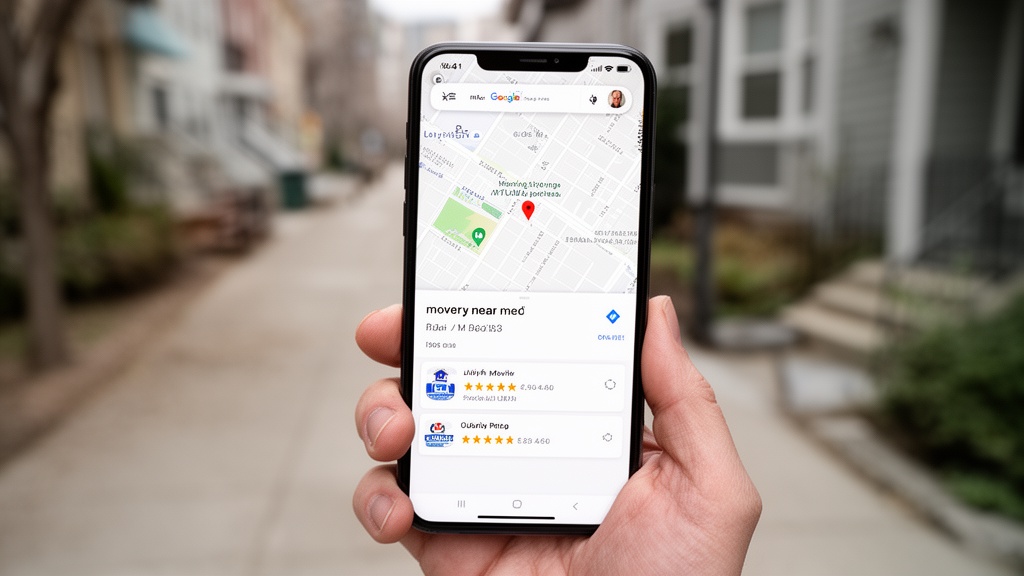
GBP Optimization Checklist
Every available field must be complete and keyword-rich to maximize Google business profile for movers performance:
- Primary category: "Moving Company" — not "Mover," as these produce distinct ranking signals
- Additional categories: "Piano Moving Service," "Packing Service," "Storage Facility" (if applicable)
- Service area: List every city, suburb, and neighborhood you serve (up to 20 service areas)
- Business description: 750 characters using natural keyword language — include your city, primary service types, and differentiators
- Services section: Add every service with individual 300-character descriptions; Google uses this structured data to match your profile to specific service-level searches
- Photos: Minimum 25 photos — trucks, uniformed crews, packed homes, before/after; profiles with 100+ photos receive 520% more calls than those with under 10 photos
- GBP posts: Publish weekly posts about promotions, seasonal availability, or new service areas
- Q&A section: Pre-populate 10 questions with keyword-rich answers to capture featured-answer visibility
Reviews Drive Local Pack Rankings
Review velocity — the frequency at which new reviews arrive — outperforms cumulative review count as a local pack ranking signal. A moving company with 90 reviews averaging 4.7 stars and 10 new reviews per month outranks a competitor with 500 reviews at 4.4 stars that received its last review 45 days ago.
Build a systematic review process: send an automated SMS with a direct Google review link within 2 hours of job completion. Review request conversion rates in this window run 35–45%, versus under 10% for next-day outreach. This single process, implemented consistently, is the most scalable driver of moving company Google ranking improvement available.
Pro Tip: Use the GBP "Services" feature to list every service your company offers — piano moving, junk removal, packing, short-term storage — each with its own description. Google treats each service entry as a distinct relevance signal, expanding the range of specific queries where your profile appears in the local map pack without any additional website work required.
Virtual Estimate can help: Moving companies using Virtual Estimate's instant AI-powered moving estimates that reduce bounce rate convert SEO traffic into booked jobs at 2–3× the industry average — because every site visitor gets a personalized quote immediately, without waiting for a callback. Learn more →
Step 4: Build SEO-Optimized Service and Location Pages
Generic moving company websites — homepage, about page, contact form — rank for nothing beyond the brand name. Moving company website optimization requires dedicated pages for every core service and every target geography. This page architecture is the structural foundation on which all other SEO efforts compound.
Service Page Framework
Each service page should target one primary keyword and run 800–1,200 words. Build every page around this structure:
- H1: "[Service Type] in [City] — [Brand Name]"
- Opening paragraph: Service benefit in the first sentence, target keyword in the first 100 words
- What's included: Specific bullet list of inclusions — floor protection, free disassembly, blanket wrapping, etc.
- Pricing transparency: Embed or link to AI-powered moving estimate software so visitors receive an instant quote rather than bouncing to a competitor's site
- Service area list: Explicitly name every city and neighborhood served from this specific service
- FAQ: 4–6 questions drawn from Google "People Also Ask" results for this service
- Reviews: Surface Google reviews that mention this specific service by name
- CTA: Phone number and estimate form visible above the fold and at the bottom of the page
Location Page Strategy
Build a dedicated page for every city and suburb in your service area with a population above 30,000. Each page needs genuinely unique content — swapping a city name in duplicated template text signals thin content and can result in ranking suppression. Include city-specific elements: local landmarks, moving permit requirements, distance from your office, and testimonials from customers in that specific area.
A moving company serving 15–20 suburbs can build 15–20 location pages, each targeting a distinct "movers [suburb]" keyword that the homepage will never rank for. Moving business online visibility scales linearly with this page count.
| Page Type | Target Keyword | Monthly Volume | Revenue Potential |
|---|---|---|---|
| Homepage | "movers [main city]" | 1,000–5,000 | High |
| Long distance service page | "long distance movers [city]" | 300–1,500 | Very High |
| Apartment moving service page | "apartment movers [city]" | 200–800 | High |
| Location page (suburb) ×15 | "movers [suburb]" | 50–300 each | High (aggregate) |
| Moving cost blog post | "how much do movers cost [city]" | 100–500 | Medium |
Step 5: Create Content That Attracts Moving Leads
Content marketing is the engine behind long-term moving company organic traffic growth. Service and location pages capture transactional searches from customers ready to book. Blog and resource content captures informational searches from customers planning a move 2–8 weeks out — the exact window when moving company preference forms. For the complete picture of how content fits into a multi-channel strategy, explore digital marketing strategies for moving companies.
High-Converting Content Topics for Moving Companies
Prioritize content that answers specific questions customers ask before selecting a mover:
- Cost guides: "How Much Does It Cost to Move a 2-Bedroom Apartment in [City]?" — high intent, high volume
- Neighborhood relocation guides: "Moving to [Neighborhood]: Everything You Need to Know" — captures out-of-state relocators already committed to the move
- Checklists: "Complete Moving Checklist: 8 Weeks Before Your Move" — earns editorial backlinks naturally from real estate and lifestyle sites
- Service comparisons: "Full-Service vs. DIY Moving: True Cost Comparison" — serves mid-funnel decision-makers still evaluating options
- Local logistics guides: "[City] Parking Permit Guide for Moving Day" — hyper-local queries with near-zero competition
Every content piece should link internally to relevant service pages and close with an estimate CTA. Substantive customer experience improvements that support SEO conversion — transparent pricing, instant quotes, real-time crew communication — reduce friction between content consumption and booked job.
Content Frequency Benchmark
Moving companies that publish 4 or more blog posts per month generate significantly more inbound leads than those publishing once monthly or less. Map every content piece to one keyword target from the matrix built in Step 2. Minimum viable cadence for a local market: 2 posts per month. For multi-city or regional reach: 4 posts per month. Every piece published compounds — a cost guide written today generates estimate requests for years without additional investment.
Step 6: Build Local Citations and Backlinks
Local citations — structured mentions of your business Name, Address, and Phone number (NAP) across directories, review platforms, and local databases — are a core local SEO moving company ranking signal. Google cross-references NAP data across hundreds of sources to validate geographic legitimacy. Even minor inconsistencies — "Ave." vs. "Avenue" or a transposed phone digit — generate conflicting signals that actively suppress local pack positions.
Priority Citation Sources for Moving Companies
Build and verify citations on these platforms as a non-negotiable baseline:
- Google Business Profile and Bing Places for Business
- Yelp, Angi, HomeAdvisor, Thumbtack
- American Moving & Storage Association (AMSA) member directory
- Better Business Bureau (BBB)
- Local Chamber of Commerce website
- Apple Maps Connect
- Yellow Pages, Manta, Foursquare, Citysearch
- City-specific business directories and neighborhood portals
Use Moz Local or BrightLocal ($14–30/month) to audit citation consistency across 50+ directories and push corrections at scale. Moving company local citations that are complete and consistent across all sources deliver a compounding trust signal that underpins every other local SEO tactic.
Moving Company Backlink Strategy
Backlinks remain a top-3 Google ranking factor. The most effective moving company backlink strategy uses five acquisition channels:
- Local press and PR: Announce charitable donations, community sponsorships, or business milestones to local news outlets with a link request
- Real estate agent partnerships: Pitch local agents and brokerages to include your company in their "resources for home buyers" or "relocation guides" — these pages carry strong local domain authority
- Trade association membership: AMSA and local trucking associations provide authoritative backlinks from industry-specific domains with established trust scores
- Content-driven links: Moving checklists, cost calculators, and city relocation guides earn editorial links organically from real estate blogs and community sites
- Supplier and partner links: Packing supply vendors, self-storage partners, and business associations often link to preferred movers on their partner pages
Pro Tip: Search Google for "[your city] relocation guide" and "[city] real estate moving resources." These pages are actively maintained by agents and community organizations — and most accept link suggestions via a simple contact form. A single link from a local real estate website with Domain Authority 40+ can move a location page from position 12 to position 4 within 30–60 days. This is the highest-leverage manual outreach tactic in moving company SEO.
Step 7: Track Rankings and Measure SEO Results
Moving company SEO without measurement produces no accountability and no clear improvement path. The goal is a simple dashboard that connects keyword rankings to the metric that actually matters: booked jobs from organic search. Moving company organic traffic is meaningless without attribution to estimate submissions and confirmed revenue.
Four-Layer SEO Tracking Stack
Layer 1 — Rankings: Use Semrush, Ahrefs, or Google Search Console to track weekly position changes for the top 30 target keywords. Monitor position, impressions, and click-through rate separately — a keyword moving from position 8 to position 3 can triple CTR with no change in search volume.
Layer 2 — Traffic: Google Analytics 4 shows organic sessions by landing page. A custom organic-only segment reveals which service and location pages drive the most visits and which need attention.
Layer 3 — Leads: Tag estimate form submissions, phone call click events, and live chat initiations as GA4 conversion events. This creates a direct line from organic sessions to lead volume tracked in one place.
Layer 4 — Revenue: Connect GA4 to your CRM or job management system to close the attribution loop from search to booked revenue. Moving companies exploring how AI agents can automate moving business lead workflows can automate this attribution entirely, eliminating the manual data entry gaps that distort ROI calculations.
SEO Performance Benchmarks by Timeline
| Metric | Month 1 Baseline | Month 6 Target | Month 12 Target |
|---|---|---|---|
| Organic sessions/month | 100–500 | 1,000–3,000 | 3,000–8,000 |
| Local map pack appearances/week | 5–10 | 25–50 | 60–120 |
| Organic leads/month | 5–20 | 50–120 | 120–350 |
| Average ranking (top 20 keywords) | 15–35 | 8–15 | 3–8 |
| Citation accuracy score | 60–70% | 90%+ | 95%+ |
Common SEO Mistakes Moving Companies Make (and How to Fix Them)
Most moving companies underperforming in organic search share the same identifiable errors. Diagnosing and correcting these produces faster results than any new optimization tactic.
No dedicated service or location pages. A five-page website cannot rank for "apartment movers [city]" or "long distance movers [suburb]" because those pages don't exist. Fix: Build the page architecture from Step 4 — every major service gets its own page, every major geography gets its own page.
Ignoring review management. 91% of consumers read online reviews before choosing a service provider. The top-rated moving companies in New York City consistently maintain 200+ recent, high-quality reviews. Fix: Automate review requests via SMS within 2 hours of every completed job.
Keyword cannibalization. When multiple pages target the same "movers [city]" query, Google cannot determine which to rank — so it often ranks none of them effectively. Fix: Assign each target keyword to exactly one page; differentiate competing pages with distinct geographic or service modifiers.
Orphan pages. Location and service pages with no internal links pointing to them receive minimal crawl budget and rarely rank. Fix: Link from the homepage, blog posts, and related service pages to every core page using descriptive, keyword-rich anchor text.
Treating SEO as a one-time project. Algorithm updates, competitor activity, and seasonal search patterns require ongoing response. Moving company search engine optimization is a function of consistent, compounding effort — not a single campaign executed once.
Weak conversion optimization. Ranking #1 for a target keyword generates zero revenue if visitors leave without contacting you. Replacing a basic callback form with instant AI-powered moving estimates that reduce bounce rate on service pages consistently lifts contact rates by 40–60%, turning SEO traffic into actual revenue rather than vanity metrics.
Related Articles
- Digital Marketing Strategies for Moving Companies: A Complete Guide — The full playbook for combining SEO, PPC, social media, and email to grow a moving business across every channel.
- Customer Experience Excellence in Moving Services — How improving customer touchpoints across the move lifecycle directly impacts reviews, repeat bookings, and SEO performance.
- CRM for Moving Companies: Streamline Operations — How a moving-specific CRM connects SEO-generated leads to dispatch, follow-up sequences, and closed revenue.
Ready to see it in action?
Book a free 20-minute demo and explore how Virtual Estimate can help your business.