

Moving software cost is the first question operators ask before they automate — and the price listed on a vendor homepage rarely reflects what you actually pay. Setup fees, per-user charges, training hours, and annual contracts quietly inflate the number on your invoice. This guide breaks down real subscription pricing, the twelve-month total cost of ownership, and the exact point where automation pays for itself. By the end, you will know what to budget, what to question, and how software cost stacks up against the hidden expense of running on spreadsheets.

Key Takeaways
| Point | Details |
|---|---|
| Mid-size monthly price | Mid-size movers pay $200 to $400 per month per Virtual Estimate's ROI case study. |
| Sticker price isn't total | Onboarding, data migration, training, and add-ons push the real first-year number well above the monthly rate. |
| Payback is fast | Full ROI typically lands within 60 to 120 days of adoption for operators running 40+ jobs monthly. |
| Manual work has a price | A composite case study reclaimed 13 office hours per week at $22/hour after automating dispatch. |
| Net savings beat the fee | Estimated savings of ~$1,181/month exceed a $200–$400 subscription on cost reduction alone. |
What Drives Moving Software Cost: 5 Pricing Variables

How much does moving software cost? Most platforms charge a monthly SaaS subscription that scales with three things: company size, user count, and feature depth. Per Virtual Estimate's moving software ROI real-world case study, mid-size operators pay $200 to $400 per month before add-ons.
Understanding moving company software pricing 2026 starts with separating the sticker price from the total you pay over twelve months. Five variables drive the final number on your invoice:
- Company size and user count — most vendors use per-user pricing, so every dispatcher and estimator you add raises the monthly fee.
- Feature scope — a basic moving CRM costs less than a suite bundling AI estimating, dispatch software, and customer messaging.
- Onboarding fee — one-time setup and data migration charges vary widely and are often negotiable.
- Contract length — annual contracts lower the monthly rate but lock you in.
- Add-ons — SMS, payment processing, storage, and integrations are usually billed separately.
Q: How much does moving software cost per month?
A: Mid-size moving companies pay $200 to $400 per month, per Virtual Estimate's ROI case study, with entry tiers costing less and enterprise suites costing more.
The table below shows where most operators land. The mid-size figure comes from the case study above; review current Virtual Estimate software pricing for live, usage-based rates.
| Company size | Typical monthly subscription | Best fit |
|---|---|---|
| Solo / owner-operator (1–3 users) | Entry tier | Testing automation for the first time |
| Small (4–8 users) | Lower mid tier | Growing local movers |
| Mid-size (40+ jobs/month) | $200–$400 (source) | Multi-crew regional movers |
| Enterprise (multi-branch) | Custom / highest tier | Van lines and franchises |
Pricing by Business Size: Small, Mid-Sized, and Enterprise
Your moving management software price depends heavily on user count and how many of your workflows you automate. Small operators automating just estimates pay the least; enterprises wiring dispatch, billing, and reporting together pay the most.
Small movers should look hard at affordable moving software options that cover estimating and lead tracking without enterprise overhead. Mid-size operators benefit most from full moving company software solutions that connect lead intake to delivery in one system.
Pro Tip: Count seats honestly before you request a quote. Many vendors advertise a low base price for two or three users, then apply per-user overages once your crew leaders and office staff all need logins — a four-person team can double the headline rate.
Enterprise buyers face a different math. Custom pricing usually buys dedicated onboarding, API access, and multi-branch reporting, but those contracts almost always require annual commitment and a larger upfront onboarding fee.
Full Cost Breakdown: Subscription, Setup, Training, and Add-Ons
Calculating your moving crm total cost means adding every line item, not just the monthly fee. Vendors publish the subscription prominently and bury the rest in onboarding paperwork.
Here is how recurring and one-time costs separate across a typical contract:
| Cost component | Type | What to expect |
|---|---|---|
| Subscription | Recurring monthly | $200–$400/mo for mid-size (source) |
| Onboarding / setup | One-time | Varies by vendor; often waived on annual plans |
| Data migration | One-time | Quoted by record volume |
| Training | One-time or ongoing | Included by some vendors, billed by others |
| Add-ons (SMS, integrations) | Recurring | Usually usage-based |
The recurring costs are predictable. The one-time costs are where budgets break, because they hit in month one alongside the first subscription payment.
Virtual Estimate can help: Built by movers for movers, our moving CRM consolidates estimating, dispatch, and follow-up so you pay for one platform instead of stitching together five separate tools. Learn more →
The True Cost of Free and Low-Cost Software
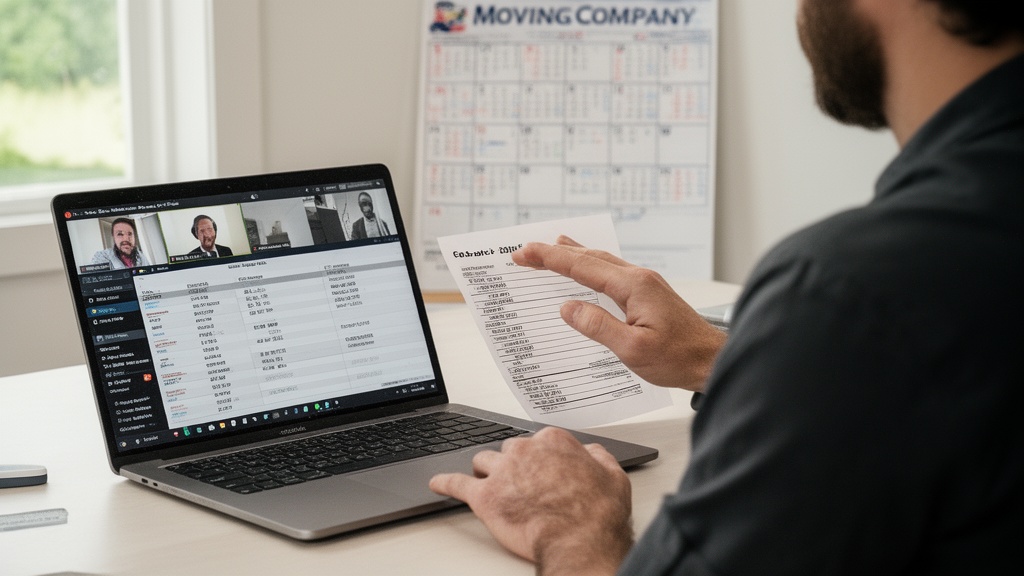
Affordable moving software options exist, but "cheap" and "low total cost" are not the same thing. Free tools and generic CRMs shift expense from your bank account to your calendar.
Q: Is free moving software actually free?
A: No. Free tools push cost onto your time — manual data entry, missed follow-ups, and quote errors that a purpose-built moving CRM automates away.
A generic spreadsheet or repurposed sales CRM cannot generate a room-by-room inventory, schedule crews, or track truck logistics. Your team rebuilds those workflows by hand, every job, forever.
Pro Tip: Before adopting a free tool, log how many hours your office spends weekly on tasks the software won't handle — estimate prep, follow-up calls, paperwork. Multiply by your loaded hourly rate. That number is the real price of "free."
Low-cost generic platforms carry a similar trap. They look affordable until you account for the integrations and manual workarounds needed to make them behave like software built for movers.
Building a Realistic Software Budget for Your Business
Effective moving software budget planning accounts for the full first-year number, not the monthly sticker. Add twelve subscription payments, the one-time onboarding fee, migration, and any add-ons you'll actually use.
The smartest operators budget for moving software total cost of ownership — every dollar over the contract term divided by the value it returns. Treat your moving company technology investment like any capital decision: project the cost, project the return, and set a payback target.
A simple budgeting sequence keeps you honest:
- Step 1: List required features (estimating, dispatch software, CRM, messaging).
- Step 2: Get itemized quotes separating recurring from one-time costs.
- Step 3: Add a contingency for training time and temporary productivity dips.
- Step 4: Compare the annual total against your current admin overhead.
Try Virtual Estimate's AI video estimating: Turn a customer's phone video into a room-by-room inventory and quote in about 10 minutes instead of a 2-hour on-site survey. Get started →
Software ROI: When Does the Cost Pay for Itself?
Moving software ROI follows a predictable three-phase arc. Phase one (days 1–60) delivers time savings as scheduling and dispatch automate. Phase two (months 2–3) shows conversion gains as follow-up sequences mature. Phase three (months 3+) compounds cost reductions as error rates fall.
Q: When does moving software pay for itself?
A: Most mid-size movers reach positive ROI within 60 to 120 days, once automation eliminates 10 to 15 admin hours weekly and improves booking rates by 8 to 12 percentage points.
The numbers come from a composite case study: estimated savings of ~$1,181 per month across reallocated admin labor, fewer no-shows, fewer estimate errors, and lower paper costs. That figure exceeds a typical $200–$400 subscription on cost reduction alone — before any revenue growth.
The American Moving & Storage Association identifies operational inefficiency as a primary driver of revenue plateaus among mid-size movers, which is exactly what automation targets.
Comparing Software Against the Cost of Manual Operations

The fairest way to judge moving software cost is against what manual operations already cost you. That expense is invisible because it sits inside salaries you're already paying.

The median wages for office and administrative support occupations reported by the Bureau of Labor Statistics make clear that clerical hours are not cheap. When software reclaims those hours, the savings are real payroll capacity, not theory.
| Cost area | Manual operations (monthly) | With moving software | Source |
|---|---|---|---|
| Admin labor | 22 hrs at $22/hr | 9 hrs at $22/hr | Case study |
| No-show events | 5–6 | 2–3 | Case study |
| Estimate errors | 3–4 | <1 | Case study |
| Paper / printing | $80 | $15 | Case study |
| Net monthly savings | — | ~$1,181 | Case study |
Post-job paperwork in that case study dropped from 25 minutes to under 8 minutes per job, and the office reclaimed 13 hours per week — more than half a full-time employee — without adding payroll. Run your own numbers against the moving software ROI real-world case study to see where your operation lands.
Questions to Ask Vendors Before You Sign
The gap between advertised and actual moving software cost lives in the contract details. Ask these questions before committing:

- What is the per-user price, and at how many users does it change?
- Is there a one-time onboarding fee or data migration charge?
- Is training included, and for how many sessions?
- What is the contract term, and what are the early-cancellation terms?
- Which features are add-ons billed separately?
- How is the AI estimating accuracy measured and supported?
Pro Tip: Ask every vendor to quote the full twelve-month total in writing, itemized into recurring and one-time costs. A vendor that won't put the all-in number on paper is telling you something about the surprises ahead.
Virtual Estimate's AI achieves 95% accuracy in volume calculations, backed by extensive testing — the kind of proof point worth requesting from any platform you evaluate.
Predictable Pricing With Virtual Estimate
Most cost surprises come from buying software that wasn't built for movers, then paying to bolt on the missing pieces. Virtual Estimate was built by industry insiders — co-founded by a 15-year logistics veteran who ran a regional moving company — to solve exactly that.

The platform consolidates room-by-room AI estimating, lead pipeline management, dispatch, and customer messaging in one system, with simple usage-based pricing and a 14-day free trial — no credit card required. What used to take 2+ hours with manual surveys now takes about 10 minutes with AI-powered scanning.
That structure keeps your moving company technology investment predictable: one platform, one bill, no surprise integrations. See plans and start your free trial →
Related Articles
- Moving Management Software Benefits Your Customers Actually Notice — see how automation improves the customer experience, not just back-office efficiency.
- How to Automate Your Moving Business Operations: A Practical Guide — a step-by-step path to replacing manual workflows with software.
- Moving CRM Reviews: A Scorecard for Evaluating Your Options — a structured framework for scoring vendors before you buy.
- Moving Company Automation Software: The Complete Buyer's Guide — what to prioritize when choosing an automation platform.
Recommended Reading
- Virtual Estimate Pricing — See Plans and Costs
- Moving CRM Pricing Guide: What to Budget and What to Expect
- Moving Company Software ROI: A Real-World Case Study
- Best Moving Company Software: Complete Buyer's Guide
- Best Free Moving Company Software Options
Ready to see it in action?
Book a free 20-minute demo and explore how Virtual Estimate can help your business.