

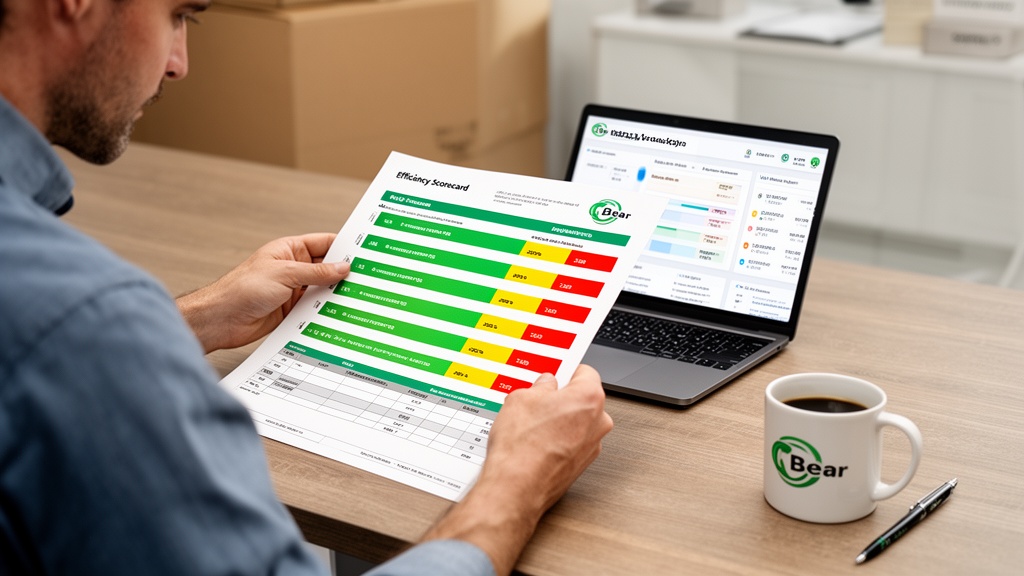
Most moving company owners measure performance by gut feel — a packed schedule feels efficient, a strong week feels profitable. But intuition doesn't identify where revenue is leaking or which process gaps are costing booked jobs. A moving company efficiency scorecard replaces guesswork with objective measurement across the six areas that most directly drive profitability. This article delivers a fill-in scorecard, verified industry benchmarks, and a clear method for translating your score into targeted operational action.
Key Takeaways
| Point | Details |
|---|---|
| Lead response time is the top conversion lever | Top-quartile movers respond to new leads within 15 minutes. Response times above 60 minutes consistently produce below-average booking rates. |
| Booking conversion benchmark: 32–38% | The moving industry average booking conversion rate falls between 32% and 38%. Structured follow-up processes push top performers above 40%. |
| Revenue per crew day: $1,800–$2,400 | Top-quartile local residential operators use revenue per crew day — not revenue per job — as the primary profitability benchmark. |
| Six-area scorecard, 120-point maximum | The scorecard covers estimating, lead response, scheduling, satisfaction, revenue, and technology — scored 0–10 each for a 120-point total. |
| Technology drives the fastest score gains | Companies using CRM and digital estimating tools consistently report measurable scorecard improvements across multiple areas within 90 days of adoption. |
Why Moving Companies Need a Performance Scorecard
Running a moving operation without defined metrics is like dispatching crews without confirmed addresses. The moving and storage industry encompasses thousands of firms competing for local market share, and customer expectations are rising as digital lead generation makes it trivial to request multiple quotes simultaneously.
A moving company operations benchmark isn't about tracking numbers for their own sake — it's about pinpointing the exact gap between your current performance and top-quartile operators. Companies that formally track moving business performance metrics consistently demonstrate faster lead response, higher booking rates, and better crew utilization than those relying on experience alone.
The scorecard format works because it forces specificity. Instead of knowing you "need more bookings," you discover your lead response time is 47 minutes when top performers respond in under 15. That specificity is what makes targeted improvement possible.
The 6 Core Efficiency Areas to Benchmark
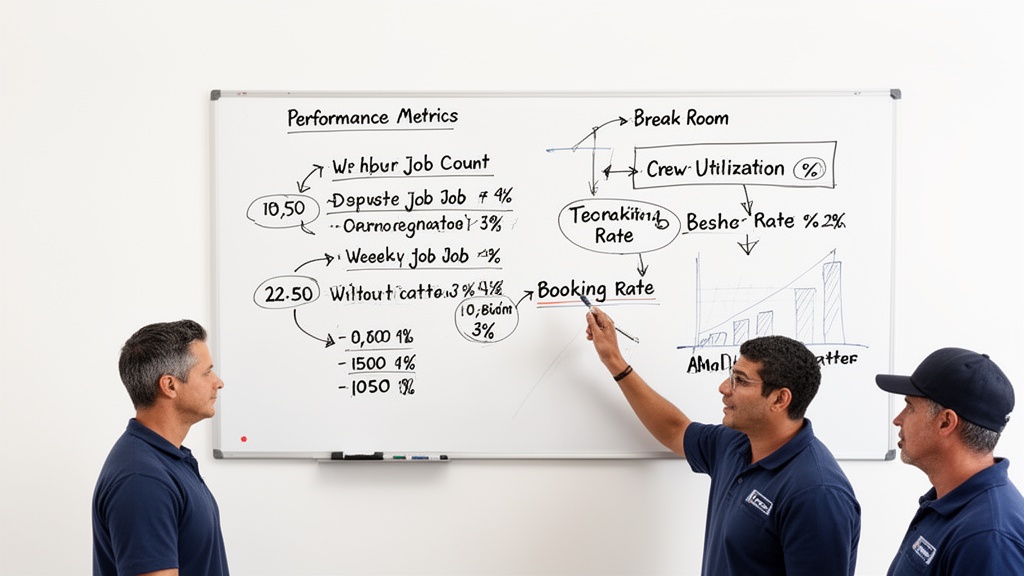
A moving company KPI scorecard built around the right areas captures the full picture of operational health. These six areas cover the entire job lifecycle — from the moment a lead arrives to final payment and review.
- Estimating Accuracy and Turnaround Speed — Are estimates close to actual job cost, and do they reach the customer faster than competitors?
- Lead Response Time and Booking Conversion Rate — How quickly does your team respond, and what percentage of leads become booked jobs?
- Job Scheduling and Dispatch Efficiency — Are crews deployed optimally, and how often do last-minute changes disrupt the day?
- Customer Communication and Satisfaction Score — Are customers informed throughout the move and leaving positive reviews?
- Revenue Per Job and Crew Productivity — What is each job and each crew day actually generating in billable revenue?
- Technology Adoption and Automation Level — Are manual processes slowing operations and adding unnecessary overhead?
This moving operations assessment framework scores each area from 0–10, for a maximum total of 120 points. The benchmarks in each section draw from moving industry operator data and allow direct comparison against industry peers.
Scorecard Area 1: Estimating Accuracy and Turnaround Speed
Estimating accuracy measures the percentage of jobs where the final invoice falls within 10% of the original estimate. Turnaround speed measures hours from initial customer contact to estimate delivery.
Inaccurate estimates erode trust and create post-move disputes. Top-performing companies maintain estimate accuracy above 90% — nine out of ten jobs close within 10% of the quoted price. Turnaround times under two hours capture leads before competitors have responded.
| Metric | Top Quartile | Average | Below Average |
|---|---|---|---|
| Estimate turnaround time | < 2 hours | 4–8 hours | > 24 hours |
| Estimate accuracy (within 10% of actual) | > 90% | 75–89% | < 75% |
| Area Score (0–10) | 9–10 | 5–7 | 0–4 |
Pro Tip: Virtual pre-move video surveys dramatically improve estimate accuracy by giving estimators a visual walk-through before pricing. Companies using video-based surveys report significantly fewer post-move pricing disputes than those relying on phone-only inventory collection.
Scorecard Area 2: Lead Response Time and Booking Conversion Rate
Speed is the defining competitive factor in moving sales. Research on lead response across service industries demonstrates that contact rates drop sharply after the first five minutes. Top-quartile moving operators respond to new leads within 15 minutes, seven days a week — including weekends when residential moves are most commonly booked.
Booking conversion rate — the percentage of leads that become confirmed jobs — is the clearest indicator of sales process efficiency. The average moving company conversion rate falls between 32% and 38%. Companies running structured follow-up sequences with CRM tools consistently exceed 40%.
The moving company performance indicators for this area reveal whether the business is losing jobs to competitors before estimates are even delivered.
| Metric | Top Quartile | Average | Below Average |
|---|---|---|---|
| Lead response time | < 15 minutes | 15–60 minutes | > 60 minutes |
| Booking conversion rate | > 40% | 32–38% | < 32% |
| Area Score (0–10) | 9–10 | 5–7 | 0–4 |
Virtual Estimate can help: Virtual Estimate automates lead capture, instant response notifications, and structured follow-up sequences — so your team never misses the response window that determines whether you win or lose the job. Learn more →
Scorecard Area 3: Job Scheduling and Dispatch Efficiency

Scheduling inefficiency surfaces in two costly patterns: underutilized crews sitting idle between jobs and last-minute schedule changes that create customer experience failures. Top-performing operations target 2.5–3 jobs per crew per day for local moves, with a schedule-change rate below 10%.
Benchmarking moving company operations on dispatch efficiency reveals hidden cost leakage. A crew running 1.5 jobs per day when capacity allows 2.5 jobs leaves substantial revenue uncaptured each month. Dispatch inefficiency also drives overtime — poorly planned days extend shift hours and inflate labor costs without generating additional revenue.
| Metric | Top Quartile | Average | Below Average |
|---|---|---|---|
| Jobs per crew per day (local moves) | 2.5–3 | 1.5–2 | < 1.5 |
| Schedule change rate | < 10% | 10–20% | > 20% |
| Crew utilization rate | > 85% | 65–84% | < 65% |
| Area Score (0–10) | 9–10 | 5–7 | 0–4 |
A CRM platform for tracking moving company performance provides real-time visibility into crew location, job status, and daily utilization — the operational foundation for improving your dispatch score.
Scorecard Area 4: Customer Communication and Satisfaction Score

Customer satisfaction is the most forward-looking metric in the scorecard. A high satisfaction score today predicts referrals, repeat bookings, and positive reviews that drive organic lead generation tomorrow. Top-performing movers maintain an average star rating above 4.5/5 and a review response rate above 80%.
Poor communication is the leading driver of negative reviews in the moving industry — customers who aren't updated on arrival times, delays, or crew assignments leave negative feedback even when the physical move goes well. Proactive text updates during the job and post-move satisfaction surveys are the two highest-return communication investments available to moving operators.
| Metric | Top Quartile | Average | Below Average |
|---|---|---|---|
| Average star rating (Google/Yelp) | > 4.5 / 5 | 4.0–4.4 | < 4.0 |
| Review response rate | > 80% | 50–79% | < 50% |
| Post-move survey completion rate | > 60% | 30–59% | < 30% |
| Area Score (0–10) | 9–10 | 5–7 | 0–4 |
Pro Tip: Send the post-move satisfaction request within two hours of job completion — not the next day. Response rates drop significantly when the request arrives after the customer has mentally moved on from the experience.
Scorecard Area 5: Revenue Per Job and Crew Productivity
Revenue per job and revenue per crew day are the two numbers that determine whether a moving company generates sustainable profit. Top-quartile operators generate between $1,800 and $2,400 per crew day for local residential moves, with revenue per job averaging $1,200–$1,800 depending on market and service mix.
These numbers directly answer the fundamental question operators face: "how efficient is my moving company, really?" If your revenue per crew day sits at $1,100, the gap to the top quartile represents a concrete profit improvement target — not an abstract benchmark.
| Metric | Top Quartile | Average | Below Average |
|---|---|---|---|
| Revenue per crew day (local residential) | > $2,400 | $1,800–$2,400 | < $1,800 |
| Revenue per job (local residential) | > $1,800 | $1,200–$1,800 | < $1,200 |
| Labor cost as % of revenue | < 35% | 35–50% | > 50% |
| Area Score (0–10) | 9–10 | 5–7 | 0–4 |
Tracking moving business performance metrics in this area alongside your pricing strategy reveals whether low revenue per job is a pricing problem or a job-mix problem — two very different fixes.
Scorecard Area 6: Technology Adoption and Automation Level
The International Association of Movers consistently identifies technology adoption as a primary differentiator between high-growth and stagnant moving companies. Operators still relying on paper estimates, phone-only booking, and manual follow-up carry structural cost disadvantages — every manual step adds time, error risk, and labor overhead that compresses margin.
Moving company performance indicators for technology adoption include CRM usage, digital estimating penetration, automated follow-up sequences, and online payment collection. Each represents a manual process that technology replaces with speed and consistency.
| Metric | Top Quartile | Average | Below Average |
|---|---|---|---|
| CRM in active use (> 80% of jobs) | Yes | Partial | No |
| Digital/virtual estimates (% of all jobs) | > 75% | 40–75% | < 40% |
| Automated lead follow-up sequence | Yes | Partial | No |
| Online payment option offered | Yes | Partial | No |
| Area Score (0–10) | 9–10 | 5–7 | 0–4 |
Companies that deploy tools to improve your moving company's efficiency scores across estimating, CRM, and scheduling report measurable improvements across multiple scorecard areas within the first 90 days. Technology changes typically produce faster scorecard gains than process changes alone.
Pro Tip: Score yourself on current tool usage, not intended usage. If your CRM has data for fewer than 80% of recent jobs, score it as "Partial" — partial adoption produces partial results and partial improvement.
How to Use Your Score to Prioritize the Right Improvements

Once you've scored all six areas, record your totals in the master scorecard below and compare your combined score to the performance bands that follow. Score what your team actually does consistently — not what happens on a good day.
Master Moving Company Efficiency Scorecard
| Scorecard Area | Your Current Metrics | Area Score (0–10) |
|---|---|---|
| 1. Estimating Accuracy & Turnaround | [fill in] | ___ |
| 2. Lead Response & Booking Conversion | [fill in] | ___ |
| 3. Job Scheduling & Dispatch Efficiency | [fill in] | ___ |
| 4. Customer Communication & Satisfaction | [fill in] | ___ |
| 5. Revenue Per Job & Crew Productivity | [fill in] | ___ |
| 6. Technology Adoption & Automation | [fill in] | ___ |
| TOTAL SCORE | ___ / 120 |
How to Interpret Your Results
| Total Score | Performance Band | Priority Action |
|---|---|---|
| 100–120 | Top Quartile | Focus on scale and market expansion |
| 80–99 | Above Average | Target the 1–2 lowest-scoring areas |
| 60–79 | Average | Build a 90-day improvement plan |
| 40–59 | Below Average | Conduct a full moving operations assessment |
| < 40 | Critical | Prioritize immediate technology and process audit |
The most effective improvement strategy focuses on the single lowest-scoring area first. Spreading effort across all six simultaneously produces slow results in every category. Close the biggest gap, re-score after 90 days, then advance to the next priority.
Areas scoring below 5 represent urgent priorities requiring dedicated attention. Areas scoring 5–7 represent planned improvement projects. Areas scoring 8 or higher need only periodic maintenance. If technology adoption is your lowest-scoring area, review Virtual Estimate pricing as a starting point — software improvements consistently produce the fastest measurable gains in this scorecard.
Schedule a formal moving company operations benchmark review quarterly. Conduct a comprehensive moving operations assessment annually, or whenever the business adds crews, enters new markets, or launches new service types. Consistent review cadence separates companies that measurably improve from those that track without acting.
Related Articles
- Moving Company Operational Efficiency: A Complete Playbook — A comprehensive guide to optimizing every phase of your moving operation, from dispatch to delivery.
- Accurate Moving Estimates: Why Speed and Precision Drive More Leads — Learn how estimate turnaround time and accuracy directly affect your booking conversion rate.
- Best CRM for Moving Companies: In-Depth Comparison — Compare the leading CRM platforms built for moving companies, with pricing, features, and real operator feedback.
- Pricing Strategies for Moving Companies: Maximizing Profitability — Discover how to structure your pricing to increase revenue per job without losing bookings to competitors.
- Digital Marketing Strategies for Moving Companies: A Complete Guide — A proven framework for generating more qualified leads and improving your overall booking conversion rate.
Recommended Resources
Ready to see it in action?
Book a free 20-minute demo and explore how Virtual Estimate can help your business.