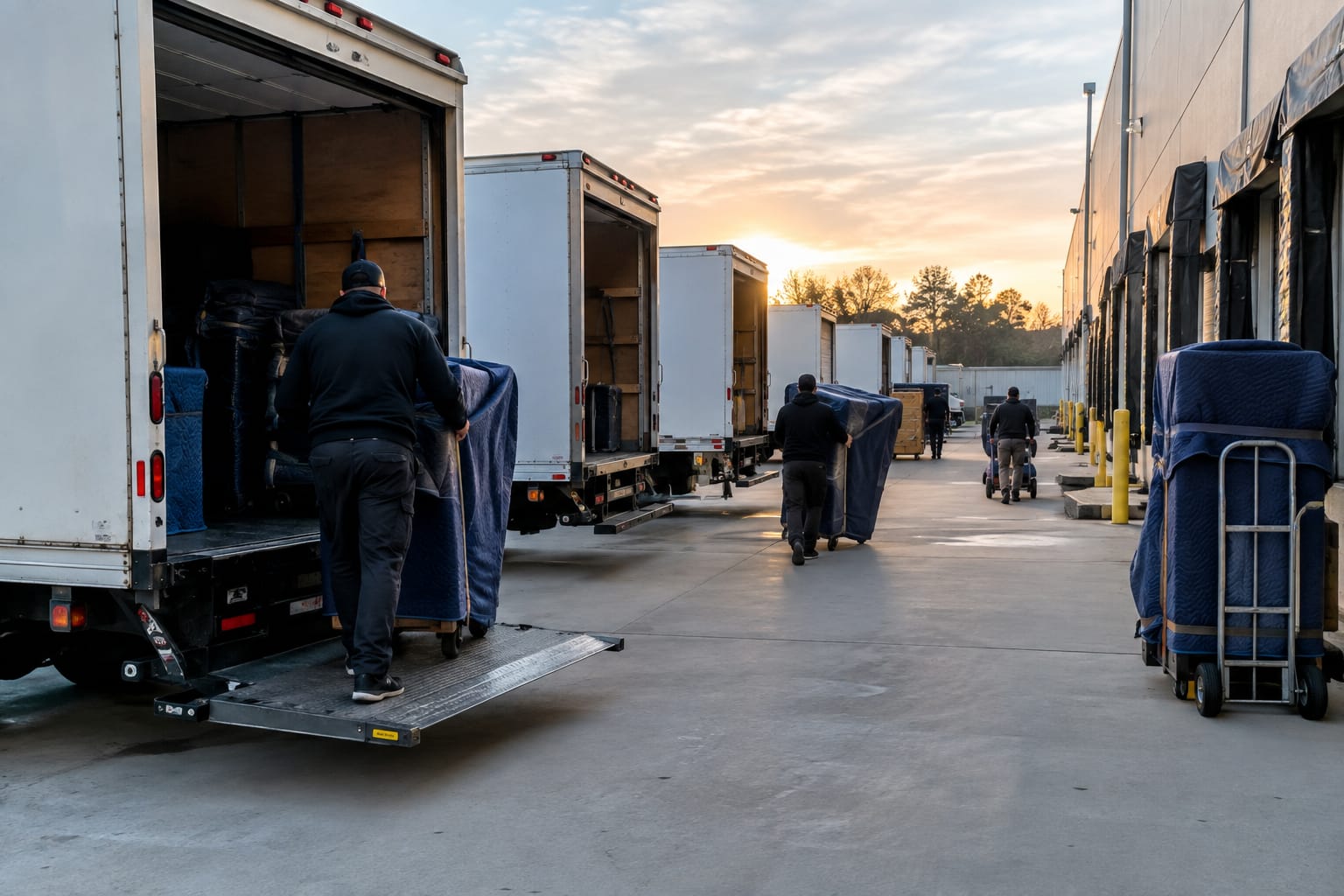

Moving companies lose more booked jobs to slow response times than to price. When a prospective customer submits an estimate request, a clock starts — and every hour of delay shrinks the probability of conversion. Accurate moving estimates are the foundation of a high-performing sales pipeline, yet most companies treat quoting as administrative overhead rather than a competitive weapon. This article examines the business case for speed and precision in your quoting process — using response-time benchmarks, conversion data, and dispute analysis to show exactly where revenue is being left on the table.
| Point | Details |
|---|---|
| Speed drives conversion | Leads contacted within one hour qualify at far higher rates, per HBR lead response research. |
| Inaccuracy costs twice | Inaccurate estimates generate both lost leads and post-move disputes, chargebacks, and negative reviews. |
| Three root causes dominate | Incomplete inventory, non-standard items, and time/access miscalculation account for most estimate variance. |
| Technology removes the trade-off | Video surveys and AI pricing engines produce same-day accurate quotes, removing the speed-accuracy conflict. |
| Benchmark targets exist | Best-in-class: under 1-hour response, 45%+ booking rate, under 5% variance. See Virtual Estimate pricing. |
The Hidden Cost of Slow or Inaccurate Estimates
Every estimate request that goes unanswered for more than a day carries a real cost. Customers comparing moving companies contact multiple providers simultaneously — the first to deliver a credible, accurate quote typically controls the conversation.
The problem runs deeper than slow response. Inaccurate estimates create a second wave of damage: move-day disputes, chargebacks, and one-star reviews that suppress future inbound volume. A single disputed estimate can consume more customer service hours than ten successful moves combined.
Moving companies that underestimate consistently put pressure on every job — crews arrive underprepared, moves run long, and customers receive unexpected bills. Overestimates drive prospects directly to competitors. The margin for error is narrower than most operators realize.
What the Data Says: Response Time and Booking Rate Correlation
Research published in Harvard Business Review found that companies contacting leads within one hour were nearly seven times more likely to qualify those leads than companies that waited two or more hours. Moving estimate response time works the same way: fast response signals professionalism and availability before the customer speaks to anyone on your team.
Moving quote accuracy alone cannot compensate for slow delivery. The first company to respond with a credible quote frequently wins the booking — not because they priced lowest, but because they established trust first. Customers who mentally commit to one provider are difficult to displace, even when a lower quote arrives later.
For context on strong conversion benchmarks, review what a good booking rate looks like for contractor services — the same principles apply directly to moving companies operating in competitive local markets.
Pro Tip: Set an internal SLA of 30 minutes for estimate requests received during business hours. Post this commitment on your website as a visible trust signal and track compliance weekly as part of your sales review.
Why Estimate Accuracy Directly Impacts Customer Trust and Reviews
Customers rarely separate a wrong estimate from deliberate dishonesty. When a move costs 35-40% more than the quoted price, the customer's perception is deception — regardless of the underlying operational reason. That perception shapes your review profile directly.
The FMCSA's consumer protection guidance identifies estimate disputes as one of the leading drivers of moving complaints filed with federal regulators. Regulatory exposure compounds reputational risk: a consistent pattern of estimate inaccuracy can attract audit attention alongside public review damage.
High-accuracy estimates produce the opposite outcome. When a customer's final bill lands within 5-10% of the original moving quote, they experience the move as smooth and professionally managed — even if minor logistical complications occurred. That experience converts into reviews, referrals, and repeat bookings.
Virtual Estimate can help: Virtual Estimate delivers AI-powered moving quotes in minutes, combining video inventory assessment with real-time pricing to produce estimates customers trust — and that hold up on move day. Learn more →
Common Sources of Estimation Error in Moving Companies
Understanding where estimates go wrong is the prerequisite for fixing them. Three factors account for the majority of estimate variance in residential moving operations.
1. Incomplete inventory assessment. Phone-based estimates rely entirely on customer self-reporting. Customers routinely forget attic storage, garage contents, and furniture assembled in place. The result is systematic underestimation — customers describe what comes to mind, not everything in the home.
2. Non-standard items and access conditions. Grand pianos, gun safes, antiques, and multi-floor properties without elevator access require specialized labor and equipment. Standard per-room pricing frameworks miss these variables. Estimators who don't probe for non-standard conditions produce quotes that are structurally underpriced.
3. Distance and time miscalculation. Local moves crossing traffic corridors, requiring multiple stops, or involving constrained urban access take significantly longer than point-to-point distance implies. Estimators using map distance rather than real-world drive time and access complexity consistently underperform against their quotes.
| Error Source | Primary Cause | Typical Impact |
|---|---|---|
| Incomplete inventory | Customer self-reporting gaps | Moderate to significant underestimate |
| Non-standard items | No specific intake probing | Significant underestimate |
| Access and time conditions | Distance-only calculation | Moderate underestimate |
| Seasonal demand variance | Fixed labor rate assumptions | Margin compression |
| Fuel and toll omission | Template-based quoting | Small but recurring underestimate |
How Speed-to-Estimate Affects Your Competitive Win Rate
Moving is a high-urgency purchase. Most customers submit requests 2-6 weeks before a scheduled move — close enough to feel pressure, far enough to compare options. In that window, the company that responds fastest establishes an anchor position: the customer evaluates every subsequent quote against the first one received.
Fast moving estimates convert for a second reason: they reduce customer anxiety. A customer waiting 48 hours for a quote has time to browse competitors, read negative reviews, and second-guess their timeline. Anxiety drives inertia. Speed drives commitment.
The competitive arithmetic is direct. If three companies respond to the same lead — one within 30 minutes, one within 4 hours, one the next day — the fast responder controls the first impression, sets the price anchor, and benefits from the customer's natural tendency to decide and stop searching.
Pro Tip: Track your average estimate response time as a weekly KPI alongside booking rate and revenue. Companies that treat response speed as a sales metric — not just an operations metric — see measurable improvements in fast moving estimates conversion within the first quarter of consistent measurement.
Precision Estimates Reduce Disputes, Chargebacks, and Negative Reviews
The downstream economics of accurate estimates are significant and compounding. Each move-day dispute generates customer service time, potential refunds, chargeback fees, and review damage that suppresses future inbound leads. Moving companies operating with systematic estimate error pay these costs repeatedly.
The American Moving and Storage Association tracks industry complaint patterns across member carriers. Estimate-related disputes rank among the top escalation reasons — and the most effective mitigation is a binding or well-calibrated non-binding written estimate backed by a thorough pre-move survey.
The ROI calculation favors precision investment. Reducing the share of moves resulting in post-job disputes produces compounding returns: stronger average review scores, fewer refund situations, lower chargeback exposure, and customers who return for future moves and generate referrals.
| Outcome | Low-Accuracy Estimates | High-Accuracy Estimates |
|---|---|---|
| Move-day disputes | Frequent | Rare |
| Chargeback exposure | Elevated | Minimal |
| Average review score | Suppressed | Consistently higher |
| Repeat booking rate | Lower | Meaningfully higher |
| Referral conversion | Below potential | Significantly higher |
To reduce estimate disputes for movers at scale, the most effective single intervention is a structured pre-move survey — either in-person or via video — that gives estimators direct visibility into actual job scope.
Closing the Speed-Accuracy Gap With Technology
The traditional trade-off between speed and accuracy is a technology problem, not an inherent constraint. Manual estimation — phone intake, spreadsheet calculation, email delivery — is slow by design. Technology eliminates each bottleneck in sequence.
Virtual pre-move surveys allow estimators to see actual home contents via video walkthrough, dramatically reducing inventory gaps compared to phone-only intake. AI-powered pricing engines incorporate distance, labor time, non-standard items, and access conditions in real time — producing quotes that reflect actual job variables, not approximations. Automated delivery systems send formatted, branded estimates via SMS or email within minutes of the survey closing.
Tools that deliver fast, accurate moving estimates combine these capabilities into a single workflow: the customer schedules a 15-minute video walkthrough, the estimator assesses the home live, and the quote is generated and delivered automatically. Response times measured in minutes replace response times measured in days. This approach represents the current standard for moving estimate best practices in tech-forward operations.
Pro Tip: For moves valued above $1,500, implement video-based pre-move surveys as standard practice. The accuracy improvement is substantial, the time investment is small, and customers perceive video surveys as a premium, trust-building service — which itself improves conversion before the job begins.
Benchmarks: What Good Looks Like for Moving Estimate Performance
Performance benchmarks give operators a reference point for improvement. Without targets, there is no pressure to change. The following benchmarks reflect strong performance in competitive residential moving markets.
| Metric | Baseline | Strong Performance | Best-in-Class |
|---|---|---|---|
| Estimate response time | 24-48 hours | 4-8 hours | Under 1 hour |
| Estimate-to-booking rate | 15-25% | 30-40% | 45%+ |
| Estimate variance (actual vs. quoted) | Over 20% | 10-15% | Under 5% |
| Dispute rate (% of completed moves) | Over 5% | 2-4% | Under 1% |
| Same-day quote capability | No | Partial | Yes, all moves |
Same-day moving quotes represent the practical ceiling for response-time performance. Companies that deliver accurate same-day estimates consistently operate from a structural competitive advantage — and their moving company lead conversion rate reflects it across every market served.
To evaluate whether technology investment is justified by your current conversion rates, review Virtual Estimate pricing. The calculation is typically straightforward: one or two additional booked moves per month covers the cost of most modern quoting platforms.
You May Also Like
- Types of Moving Estimates: Choosing the Best Option — Understand the differences between binding, non-binding, and not-to-exceed estimates and how each affects liability and conversion rate.
- How to Conduct a Virtual Pre-Move Survey: Step-by-Step Guide — A practical walkthrough for running accurate video-based surveys that reduce inventory gaps and improve quote precision.
- Pricing Strategies for Moving Companies: Maximizing Profitability — Learn how to structure pricing to compete on value while protecting margins.
- Customer Experience Excellence in Moving Services — Discover how the estimate experience sets the tone for the entire customer relationship and drives referral business.
- Digital Marketing Strategies for Moving Companies: A Complete Guide — Generate more inbound estimate requests through SEO, paid search, and reputation management.
Ready to see it in action?
Book a free 20-minute demo and explore how Virtual Estimate can help your business.