

Inaccurate moving job quotes cost more than margin — they cost reputation, referrals, and repeat business. Many operators still rely on rough mental calculations or years-old spreadsheets, leading to systematic underquoting on complex jobs. This guide delivers a six-step framework for building efficient project cost estimates that protect profitability and convert more leads into booked jobs.

Key Takeaways
| Point | Details |
|---|---|
| Pre-move assessment is foundational | Skipping the inventory survey is the primary cause of underquoting — accurate estimates require complete job data before any calculation begins. |
| Labor is the largest variable cost | Crew wages plus burden rate (payroll taxes, workers' comp, benefits) account for the majority of job costs. Miscalculate this and no other line item saves your margin. |
| Contingencies prevent margin erosion | A 10-15% contingency buffer on variable-cost estimates protects against access delays, traffic, and scope changes that erode profit on otherwise well-priced jobs. |
| Software standardizes estimate quality | Moving estimation software eliminates calculation errors and ensures every estimator follows identical pricing logic, regardless of experience level. |
| Professional presentation drives conversion | Detailed, itemized estimates signal competence and reduce price objections. Estimation solutions designed for moving companies can automate this process end-to-end. |
Why Accurate Cost Estimates Drive Profitability and Trust

Efficient project cost estimates are the financial foundation of a moving company. A quote too low destroys margin on delivery. A quote too high loses the job before the first truck rolls. The operators who build lasting businesses solve this quoting equation precisely — every time.
The moving industry's labor-intensive structure means small errors compound quickly. An underestimate of just two hours on a three-crew job eliminates the entire margin on that job when fully burdened labor rates are applied. Multiply that error across dozens of monthly jobs and the impact becomes structural, not situational.
Clients judge moving company professionalism by the quality of the estimate. A detailed, itemized moving company pricing estimate signals competence before a single box is lifted. It reduces billing disputes, prevents surprise charges, and builds the trust that generates referrals and repeat business.
Step 1: Conduct a Thorough Pre-Move Assessment
The pre-move assessment determines the volume, complexity, and access conditions of every job. This single step makes every subsequent calculation possible. Without it, you are pricing blind.
Capture every variable during the assessment:
- Total cubic footage or item count (use an inventory list, not room estimates)
- Floor levels and elevator access at origin and destination
- Parking restrictions or long-carry distances (over 75 feet)
- Specialty items: pianos, safes, antiques, pool tables, large artwork
- Packing scope: customer-packed, partial-pack, or full-service
- Move type: local, intrastate, or interstate (note: FMCSA regulations govern interstate moving and affect both liability and pricing structures)
- Access conditions and restrictions at both locations
Virtual pre-move surveys have made assessments faster and more scalable without requiring in-home visits for every job. The data quality from a structured virtual survey — when conducted correctly — matches or exceeds a rushed in-person walkthrough.
Pro Tip: Require photos or video of every specialty item during the assessment phase. Piano moves, gun safes, and oversized furniture each add one to two hours of unplanned crew time. Capture them during assessment or absorb the cost on moving day.

Step 2: Break Down Every Cost Component Before Writing the Quote
An accurate moving cost breakdown treats every dollar as a separate line item. Bundling costs into a single number makes it easy to miss items — and impossible to justify the quote when customers push back on price.
| Cost Category | What to Include |
|---|---|
| Labor | Hourly wages × crew size × estimated hours + burden rate (payroll taxes, workers' comp, benefits) |
| Transportation | Truck depreciation or rental, fuel, tolls, parking permits |
| Packing materials | Boxes, tape, stretch wrap, wardrobe boxes, mattress bags, dish packs |
| Specialty services | Piano handling, art crating, furniture disassembly/reassembly, appliance servicing |
| Overhead allocation | Proportional share of insurance, dispatch, admin, and marketing per job |
| Profit margin | Target 15-25% net on total job cost before contingency |
Fuel surcharges deserve a dedicated line item in every moving job cost estimate. Diesel price fluctuations are persistent — absorbing them in a base rate creates invisible margin risk. Build surcharges as a transparent, customer-visible item and update them on a regular schedule.
Step 3: Apply Labor Hours, Crew Size, and Time Calculations
Labor cost calculation is where most moving estimates fail. The variables are complex: crew size, hourly rate, estimated hours, and the burden rate — the true cost of employing a worker beyond their base wage.
The core calculation framework:
Labor Cost = (Crew Size × Hourly Rate × Estimated Hours) × Burden Rate Multiplier
According to Bureau of Labor Statistics employer compensation data, total employer costs consistently and significantly exceed base wages once benefits, payroll taxes, and insurance are factored in. For moving workers, this premium is material — calculate your specific burden rate rather than estimating it, and apply it to every labor line item without exception.
Use historical job data to calibrate time estimates. If three-bedroom local moves consistently complete in six to seven hours, price for seven — not five and a half. The optimistic time estimate is the single most common source of unprofitable jobs in this industry. Price for the median outcome, not the best case.
Virtual Estimate can help: Virtual Estimate's platform integrates real-time labor cost modeling and automated surcharge calculations directly into your estimate workflow, so crew costs and contingencies are always accurately priced. Learn more →
Step 4: Account for Variables, Surcharges, and Contingencies
Every project cost estimate for a moving job carries uncertainty. Weather delays, traffic, access problems, and customer-added scope all erode margin when they aren't priced upfront. The goal is systematic buffers that hold margin across a high volume of jobs — not pricing for every possible scenario individually.
Surcharges to standardize in every estimate workflow:
- Fuel surcharges: Index to current diesel prices. Update monthly or quarterly to stay accurate.
- Long-carry charges: Apply a per-foot rate when truck-to-door distance exceeds 75 feet.
- Stair and elevator charges: Per-flight fee or per-elevator-trip rate at both origin and destination.
- After-hours and weekend premiums: Apply a 20-30% labor surcharge for peak-demand and weekend moves.
- Cancellation and rescheduling fees: Protect dispatch commitments and recover lost time-slot revenue.
- Storage-in-transit fees: For jobs requiring temporary warehousing between pickup and delivery.
A contingency buffer of 10-15% on variable-cost estimates is standard practice on complex moves. On straightforward local jobs, a tighter buffer works. The key is applying the buffer systematically — not ad hoc — so margin protection is structural, not luck-dependent.
Step 5: Use Software to Automate and Standardize Your Estimates

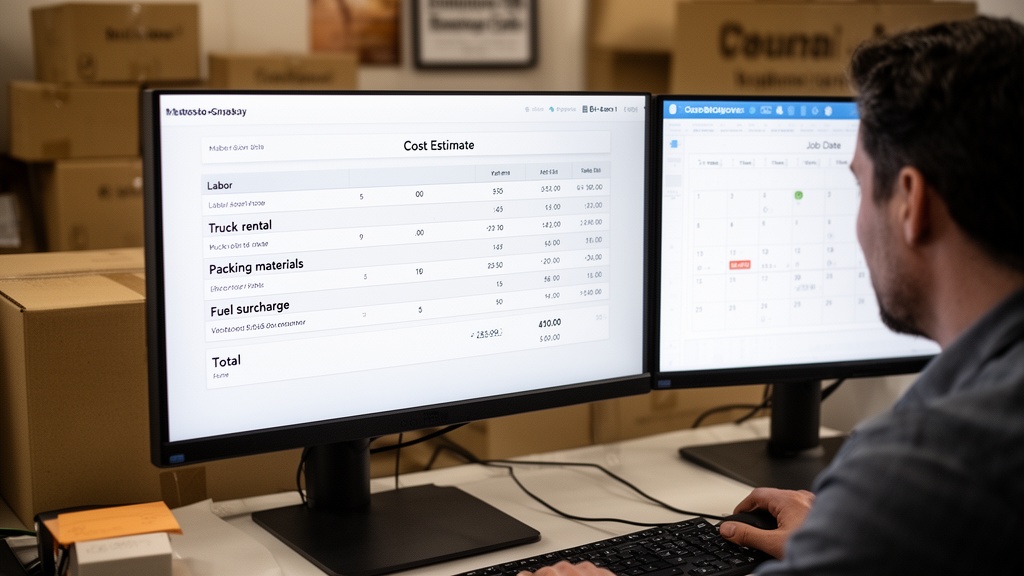
Manual estimates built in spreadsheets introduce calculation errors and create inconsistency when multiple estimators quote the same job type differently. Moving estimation software locks pricing logic into repeatable templates that every team member follows — regardless of experience level.
Key software capabilities that improve estimate accuracy and speed:
- Inventory-linked pricing: Automatically calculate cubic footage and weight from item lists
- Rule-based surcharge application: Trigger surcharges based on job parameters — stairs, long carry, access type, move date
- Labor time modeling: Estimate hours based on item count and a complexity scoring framework
- Template standardization: Guarantee every estimator follows identical pricing structure on every quote
- CRM integration: Feed estimate data directly into job scheduling, invoicing, and automated follow-up
The estimation solutions designed for moving companies category has matured considerably. Modern platforms include virtual survey integration, real-time pricing updates, and automated follow-up sequences — compressing the time from survey to signed estimate to under 24 hours on most jobs.
Pro Tip: Before investing in estimating software, map your current estimate workflow step by step and identify the three most error-prone steps. The right software should directly eliminate those specific gaps — not just add features. Buy for your problems, not the feature list.
Step 6: Present Your Estimate Professionally to Win the Job
The estimate document is a sales asset as much as a cost calculation. Format, delivery speed, and follow-up discipline all affect conversion rate — and conversion rate determines how many of your efficient project cost estimates actually generate revenue.
Elements of a professional moving estimate document:
- Company branding and complete contact information
- Customer name, confirmed move date, and both addresses
- Full line-item breakdown with clearly labeled cost categories
- Terms and conditions: payment schedule, cancellation policy, liability limits
- Expiration date on the quoted price (creates urgency and protects against cost increases)
- Clear booking call-to-action with deposit payment instructions
Deliver estimates within 24 hours of the assessment. Response speed signals professionalism and closes the window for competitors to capture the same lead. Digital estimates with e-signature and deposit collection capabilities remove friction from the acceptance process and reduce time-to-booking measurably.
Understanding types of moving estimates and which works best — binding, non-binding, or binding-not-to-exceed — helps operators match estimate format to customer situation and regulatory requirements for both local and interstate jobs.

Common Mistakes That Make Moving Estimates Inaccurate
Understanding where estimates fail is as valuable as knowing how to build them correctly. These errors repeat across moving companies of every size and revenue level.
The most frequent moving estimate errors:
- Skipping the inventory survey — Estimates built on room counts or customer descriptions consistently underestimate volume. The survey is not optional; it is the foundation of how to price a moving job accurately.
- Ignoring the burden rate — Pricing labor at base wage instead of fully-burdened cost silently eliminates margin on every job without the error ever appearing on paper.
- Using optimistic time estimates — Pricing for best-case scenarios means average jobs consistently lose money. Price for the median, not the ideal.
- Omitting overhead allocation — Failing to assign a portion of fixed operating costs to each estimate creates phantom profitability that never materializes as cash.
- No contingency buffer — One access problem, parking delay, or customer-added item eliminates margin on a tightly priced job with zero buffer built in.
- Static pricing templates — Fuel, labor, and materials costs change regularly. Estimate templates not reviewed quarterly drift out of alignment with actual costs and erode margin invisibly.
Reviewing estimates against actual job completion data monthly surfaces systematic errors faster than any other method. Most companies that implement this review process see measurable improvement in how to estimate moving costs accurately within 90 days.
For a deeper analysis of how pricing decisions shape long-term business health, pricing strategies for moving companies covers margin modeling, competitive positioning, and price architecture in detail.
Tools That Make Efficient Cost Estimates Faster and More Profitable
The right tool stack compresses estimate production time while improving consistency across the team. No single tool solves every problem — but the right combination eliminates the most costly sources of error and delay.
| Tool Category | Primary Function | Business Impact |
|---|---|---|
| Virtual survey software | Remote pre-move assessment via video | Eliminates in-home visit overhead; scales assessment capacity |
| Estimating software | Automated line-item calculation with pricing templates | Reduces time per estimate and calculation errors |
| CRM platform | Tracks leads, estimates, follow-ups, and job history | Improves conversion rate; enables data-driven calibration |
| Route and drive-time tools | Calculates travel time and fuel costs accurately | Tightens transportation line-item accuracy |
| Digital signature tools | Streamlines estimate acceptance and deposit collection | Reduces time-to-booking; removes friction from closing |
According to BLS occupational data for hand laborers and material movers, this is one of the largest occupational categories in the U.S. economy — meaning competition for skilled moving crews is persistent. Accurate labor cost estimation is not just a margin issue; it is foundational to moving company operational efficiency and long-term workforce sustainability.

Understanding types of moving estimates and which works best for different job types helps operators choose the right quoting method for each customer — binding, non-binding, or binding-not-to-exceed — and structure their moving estimate template accordingly.
Pro Tip: Create a monthly estimate accuracy scorecard — track estimated versus actual hours and costs by job category. After six months, you will have a data-driven moving estimate template calibrated to your company's real performance, not generic industry averages.
Related Articles
- Types of Moving Estimates: Choosing the Best Option — Learn which estimate format — binding, non-binding, or binding-not-to-exceed — fits each customer situation and job type.
- Pricing Strategies for Moving Companies: Maximizing Profitability — Discover margin modeling, competitive positioning, and pricing frameworks built specifically for moving operators.
- How to Conduct a Virtual Pre-Move Survey: Step-by-Step Guide — A complete walkthrough of the virtual survey process that feeds accurate inventory data into your cost estimates.
- Digital Marketing Strategies for Moving Companies: A Complete Guide — Proven tactics for generating the leads your estimate workflow needs to consistently convert into revenue.
Ready to see it in action?
Book a free 20-minute demo and explore how Virtual Estimate can help your business.