

The moving industry handles tens of millions of relocations each year, yet most companies still generate estimates through time-consuming manual processes that delay quotes and cost booked jobs. Leading SaaS estimation technology is changing that — moving companies adopting cloud-based platforms close estimates faster, reduce administrative overhead, and deliver a better customer experience from the first interaction. This guide ranks and evaluates the top SaaS estimation tools for moving companies, covering key features, pricing tiers, integration requirements, and a practical framework for choosing the right platform at any company scale.

Key Takeaways
| Point | Details |
|---|---|
| SaaS eliminates IT overhead | Cloud-based systems handle updates automatically, lowering IT costs versus on-premise software |
| Mobile capability is non-negotiable | Field estimators require native app performance with offline sync for low-signal walk-through environments |
| Integration multiplies ROI | Platforms connecting to CRM, dispatch, and accounting eliminate manual data entry and billing errors |
| Pricing scales by company size | Entry tiers start at $49–$99/month; professional tiers with AI capabilities run $199–$399/month |
| AI is now standard in top tools | Modern platforms use AI for volume calculation, dynamic pricing, and follow-up automation — see how AI is reshaping moving estimates |
What Is SaaS Estimation Software and Why Movers Are Making the Switch
Software as a Service (SaaS) is a cloud delivery model where applications run on vendor-managed servers and are accessed via web browser or mobile app — no local installation required. For the moving industry, this distinction is significant: traditional desktop estimation software required local servers, dedicated IT support, and manual update cycles that most small and mid-size operations cannot efficiently maintain.
Moving company software as a service eliminates those barriers entirely. Operators access estimation tools from the office, a job site, or a customer's living room with identical performance. According to the U.S. Census Bureau, approximately 28 million Americans relocate each year, generating a consistent volume of estimate requests that legacy desktop systems are poorly equipped to process at speed.
The workforce dimension reinforces the shift. The Bureau of Labor Statistics reports over 500,000 workers employed in the transportation and material moving sector across the United States, and that workforce increasingly expects digital tools that match the technology they use outside of work. Cloud-based estimation platforms meet that expectation while simultaneously reducing the administrative burden on office staff.
The competitive case is equally clear. Moving companies that generate a signed estimate before a customer leaves — or within minutes of a virtual walk-through — close at materially higher rates than those who send a PDF quote 24 hours later. SaaS platforms built for the moving industry make same-session close rates achievable for companies of any size.

Must-Have Features in a Top SaaS Estimation Tool for Movers
Not every cloud-based quoting tool is built for moving operations. Generic software misses the operational complexity that defines the industry: per-item volume calculations, staircase and elevator fees, long-carry charges, and seasonal pricing adjustments during peak months.
The Federal Motor Carrier Safety Administration requires written estimates for interstate household goods moves, making documentation accuracy a regulatory requirement — not just a competitive preference. Platforms that generate vague or incomplete estimates create legal exposure, not just customer service problems.
Here is what separates genuine SaaS mover tools from generic alternatives:
- Volume-based pricing engine that calculates cubic footage from inventoried items rather than flat hourly rates
- Native mobile app with offline capability for areas with poor connectivity during field walk-throughs
- Customer-facing digital quotes that customers can review, accept, and sign on the spot — closing the window competitors have to intervene
- Automated follow-up sequences triggered when quotes remain unsigned after a defined timeframe
- Peak-season pricing rules that adjust rates automatically during the May–August surge without manual intervention
- Multi-stop and multi-day job support for complex commercial or interstate moves
- Photo and video documentation tools embedded directly in the estimate workflow
- Electronic signature capture replacing paper contracts entirely
Pro Tip: Prioritize platforms with a dedicated native mobile app over mobile-responsive web applications. During live customer walk-throughs, native apps load faster, handle offline inventory capture without interruption, and present a more professional interface — critical when a customer is making a booking decision in real time.
The best SaaS moving software goes beyond generating a quote number. It records specific customer preferences, flags high-value items requiring specialty handling, and produces estimates detailed enough to be legally defensible if disputes arise later. These capabilities protect the company's revenue and reputation simultaneously.
Top SaaS Estimation Platforms for Moving Companies Ranked
The platforms below represent the most widely adopted online estimation tools for movers operating in the United States. Each is evaluated on five criteria that reflect actual moving operations rather than generic software benchmarks.

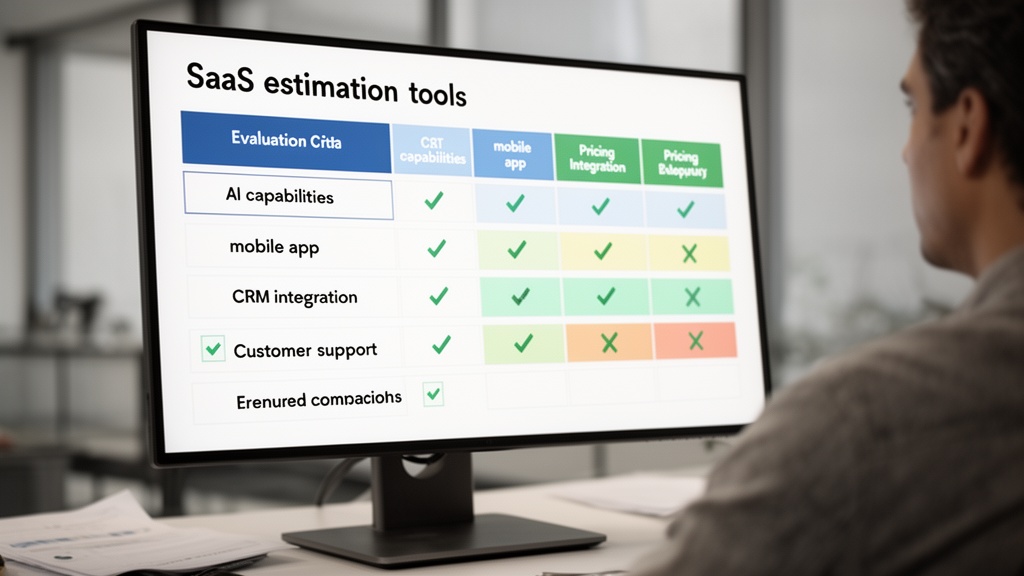
| Platform | Mobile Estimator | AI Pricing | CRM Integration | Dispatch Sync | Starting Price/mo |
|---|---|---|---|---|---|
| Supermove | Native app | Yes | Built-in | Yes | ~$149 |
| SmartMoving | Native app | Partial | Built-in | Yes | ~$99 |
| MoveitPro | Web-based | No | Third-party | Partial | ~$79 |
| MoversSuite | Native app | Yes | Built-in | Yes | Custom |
| Vonigo | Native app | Partial | Built-in | Yes | Custom |
This moving company software comparison reflects current general feature positioning — verify specific capabilities directly with each vendor before purchasing, as platforms update frequently.
Supermove and SmartMoving lead the market for mid-size operations. Both provide native mobile estimator apps, integrated CRM, and dispatch synchronization in a single platform. For a detailed feature breakdown, the Supermove features, pricing, and alternatives guide covers its capabilities and how it stacks up against its closest competitors.
MoveitPro offers the lowest published entry price, making it viable for solo operators and small crews. However, its web-based mobile interface creates friction during live customer walk-throughs compared to native app competitors. MoversSuite and Vonigo serve regional and enterprise operators where advanced configuration takes priority over out-of-the-box simplicity.
Pro Tip: When evaluating any moving estimate SaaS platform, request a live demo using your own actual job data — not the vendor's pre-configured demo scenario. Enter a real job from last month and measure how long it takes to produce a client-ready, signable estimate. The operational gap between platforms becomes clear within 20 minutes of hands-on use.
The top moving estimate platforms share a defining characteristic: when configured correctly, they reduce the time from walk-through to signed contract to under 15 minutes. That compression directly improves conversion rates, particularly for customers comparing multiple quotes simultaneously.
SaaS vs. On-Premise Estimation Software: What Actually Matters for Movers
The structural differences between SaaS and traditional software have direct operational consequences for moving companies. Understanding these differences clarifies why the transition away from on-premise tools is accelerating across the industry.
| Criteria | SaaS / Cloud | On-Premise |
|---|---|---|
| Setup time | Hours | Days to weeks |
| Software updates | Automatic, included | Manual, often paid separately |
| Remote access | Any device, anywhere | Office network only |
| IT requirements | None | Dedicated IT staff or contract |
| Data backup | Vendor-managed, redundant | Self-managed |
| Scalability | Instant seat additions | Hardware upgrades required |
| Peak-season reliability | Vendor SLA-guaranteed | Dependent on local infrastructure |
| Offline capability | App-dependent | Fully offline |
Cloud moving company software provides a structural advantage for field-intensive businesses: remote accessibility without IT infrastructure. Gartner identifies SaaS as the dominant enterprise software delivery model, and moving companies reflect this trend as cloud platforms displace legacy desktop tools at an accelerating rate across both SMB and enterprise segments.
Online estimation tools for movers running on SaaS infrastructure provide consistent performance during the industry's most demanding period — May through August — without requiring IT intervention to scale capacity. For companies managing crews across multiple cities or regions, shared cloud data eliminates the version-control problems common with locally installed software.
The one technical argument for on-premise — full offline functionality — has been largely neutralized by modern SaaS platforms with offline-capable mobile apps that cache job data locally and sync automatically when connectivity is restored. For most moving companies, the trade-off no longer favors the complexity of managing local infrastructure.
Integration Considerations: What Your SaaS Tool Should Connect With
Estimation software that operates in isolation creates more administrative work than it eliminates. The ROI of cloud-based estimation software movers adopt depends heavily on integration breadth and depth — a platform that doesn't talk to CRM, dispatch, and accounting generates manual data re-entry at every handoff.
The five integration categories that deliver the most operational value:
- CRM — estimate data should populate customer records automatically, eliminating copy-paste between systems
- Dispatch and scheduling — confirmed jobs should create crew assignments and truck reservations without a separate entry step
- Accounting software — invoices generated from accepted estimates should sync to QuickBooks, Xero, or equivalent platforms directly
- Lead management — inbound web and phone leads should auto-generate estimate drafts, reducing first-response time
- Customer communication tools — SMS and email follow-ups should trigger based on estimate status changes, not manual sending
Understanding how to build a complete moving company technology stack before selecting an estimation platform is essential. The optimal platform for a given company is often the one that integrates most cleanly with existing systems — not the one with the longest feature list evaluated in isolation.
The American Moving and Storage Association consistently identifies technology integration as a top operational priority for member companies, particularly as customer expectations for digital touchpoints continue to expand across every phase of the moving process.
Pro Tip: Before signing any SaaS contract, request API documentation and test one integration yourself — even a basic one such as creating a test estimate and syncing it to your CRM. Vendors who make API documentation difficult to access typically deliver integrations that are equally difficult to build and maintain in production.
How to Choose the Right SaaS Estimation Tool for Your Company Size
The right platform is not universal. Company scale determines which features deliver genuine value and which represent unnecessary overhead. Here is a decision framework organized by operational size.
Solo operators and small companies (1–3 trucks)
Prioritize ease of use and cost efficiency. Look for platforms with entry-level plans that include the core estimate builder, digital signature capture, and basic customer records. Avoid platforms where critical features require enterprise contracts that current job volume cannot justify.
Growing mid-size companies (4–15 trucks)
Prioritize CRM integration quality and mobile estimator performance. At this scale, automated follow-ups and integrated dispatch scheduling become significant time savers. The higher cost of a growth-tier platform pays back quickly through administrative hour reductions that scale with volume.
Regional and enterprise operators (16+ trucks)
Evaluate API flexibility, dedicated support tiers, and multi-location management capability. Large operations require configurable pricing rules by market, consolidated dashboards across branches, and data export for custom business intelligence. Standard off-the-shelf plans rarely accommodate these requirements — custom enterprise agreements are the norm at this scale.
For a structured overview of SaaS estimation solutions built for moving companies, evaluate platforms not only on feature breadth but on vendor support responsiveness — a decisive differentiator when technical issues arise during peak operating periods when delays cost real revenue.
The moving company software comparison process at any scale should include a minimum 30-day pilot using real job data. Evaluations conducted with vendor demo data consistently overestimate platform performance under actual field conditions.
SaaS Estimation Software Pricing: What to Expect at Each Tier
Pricing for SaaS mover tools follows a predictable tiered structure aligned to company size and feature requirements. Understanding the investment at each level helps moving companies allocate technology budget accurately.

| Tier | Monthly Cost Range | Core Features Included | Best Fit |
|---|---|---|---|
| Entry | $49–$99 | Estimate builder, e-signature, email delivery | Solo operators, 1–3 trucks |
| Growth | $99–$199 | Mobile app, CRM, automated follow-ups | 4–10 truck companies |
| Professional | $199–$399 | AI pricing engine, dispatch sync, multi-user | 10–20 truck companies |
| Enterprise | $400+ / custom | Custom integrations, analytics, dedicated support | 20+ trucks, multi-location |
Companies that fully integrate cloud tools into core workflows consistently see the strongest return on technology investment. For moving companies, "full integration" means the estimation platform connects to CRM, dispatch, and accounting systems — not functioning as a standalone quote generator that requires manual data re-entry at every handoff.
Pricing transparency varies significantly across the market. Platforms advertising low base prices often layer per-user fees, per-estimate charges, or feature module costs that drive actual monthly spend considerably higher than the published starting price. Always calculate total cost of ownership at your current monthly job volume — not the base plan price — before committing to any contract.
Related Articles
- How AI Is Revolutionizing the Way Moving Companies Generate Estimates — Learn how AI-powered estimation tools are cutting quote generation time and improving accuracy across the industry.
- Best Moving Company Software: Complete Buyer's Guide — A comprehensive evaluation framework covering every software category a moving company needs to run efficiently.
- AI-Driven Technology in the Moving Industry: Key Trends — Explore the most significant AI applications transforming moving operations and customer experience today.
- How to Lead a Digital Transformation at Your Moving Company — A practical roadmap for transitioning from legacy tools to an integrated cloud-based technology ecosystem.
- Best CRM for Moving Companies: In-Depth Comparison — Compare the leading CRM platforms purpose-built for moving company sales and operations management.
Recommended Resources
- Solutions Overview — Explore estimation and operations tools designed specifically for moving companies.
- Moving Company Technology Stack Guide — Build a complete connected technology ecosystem tailored to moving operations.
- Supermove Features, Pricing & Alternatives — A detailed look at one of the market's leading platforms and its closest competitors.
- SmartMoving Software Review: Features & Pricing — An objective evaluation of SmartMoving's capabilities and suitability by company size.
Ready to see it in action?
Book a free 20-minute demo and explore how Virtual Estimate can help your business.