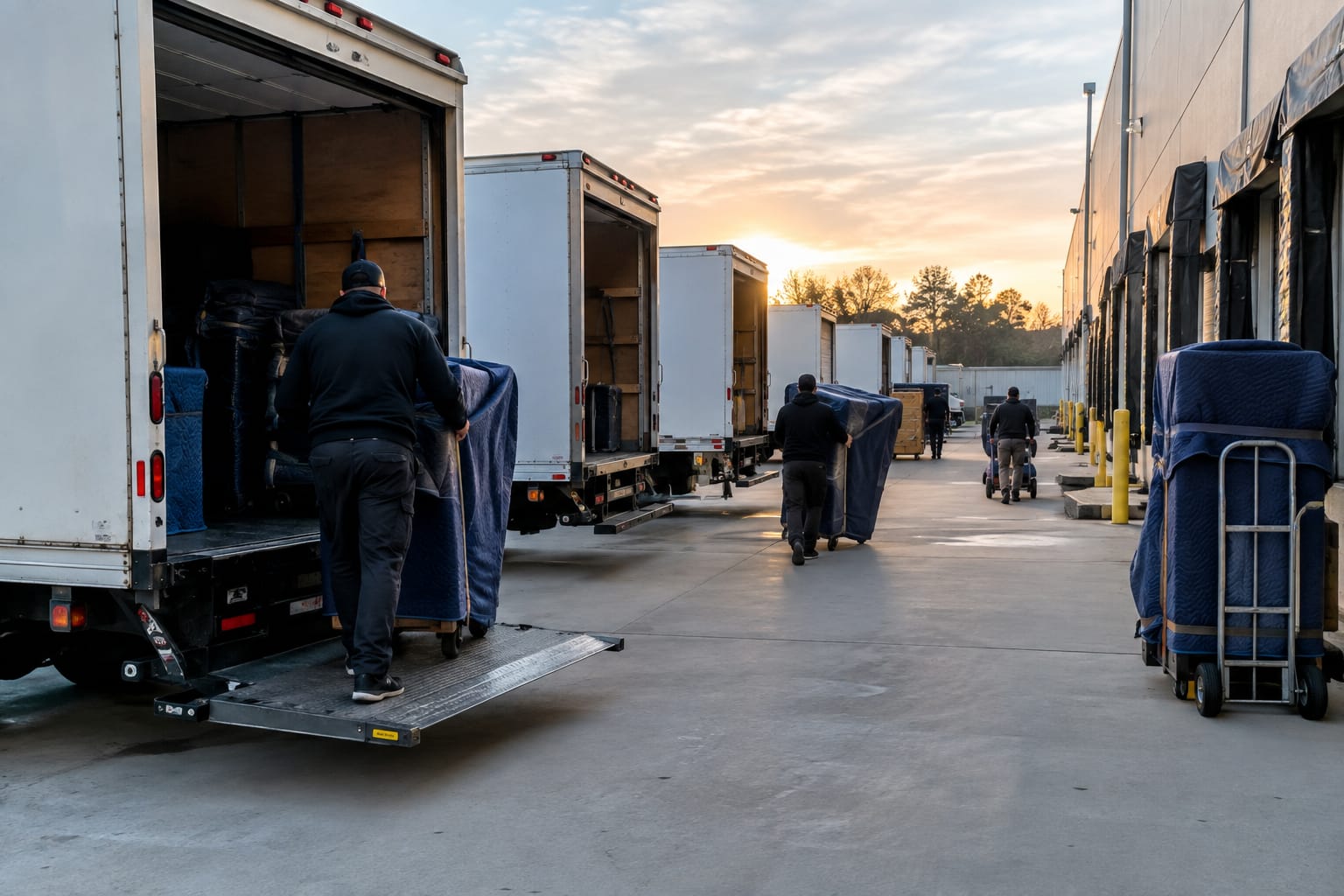

The moving industry is facing a structural workforce crisis that traditional hiring alone cannot solve. Physical labor has become harder to source, more expensive to retain, and increasingly difficult to deploy at the scale peak seasons demand. Yet some moving companies are growing — fast — despite operating in the same labor market as their competitors. The difference is not luck. It is strategy. This article outlines 7 specific, actionable ways to build a lasting competitive advantage in the moving labor market and position your company to outperform operators still running headcount-dependent models.

Key Takeaways
| Point | Details |
|---|---|
| Labor scarcity is structural, not cyclical | The BLS projects continued tight conditions in transportation and material moving occupations through the next decade due to demographic shifts and sustained physical demand |
| Technology multiplies crew output | Automating estimates, scheduling, and admin lets operators handle more job volume without proportionally increasing headcount |
| Culture drives retention, which drives margins | Replacing a single skilled mover costs 50–200% of their annual salary — retention investment pays back quickly |
| Pricing transparency wins customers | Customers who receive clear, itemized estimates are more likely to book, less likely to dispute charges, and more likely to refer |
| Overflow networks expand peak capacity | Pre-negotiated subcontractor arrangements let companies accept more volume than their permanent crew can handle |
| Retention compounds over time | Employee retention strategies for moving companies reduce the long-term cost of turnover at a rate most operators underestimate |
Why the Moving Labor Market Is More Competitive Than Ever
The moving company labor shortage is not a temporary disruption. It reflects structural shifts in the workforce that have been building for years. According to the U.S. Bureau of Labor Statistics' Job Openings and Labor Turnover Survey, the transportation and warehousing sector consistently registers more open positions than filled hires in a given month — a persistent supply-demand gap that shows no sign of closing.
The moving industry workforce challenges operators face today compound this sector-wide tightness. Moving is seasonal, physically demanding, and lacks the career narrative that attracts younger workers to other industries. Turnover in hourly physical labor roles runs high — and every departure costs real money before the replacement is productive.
Here is the critical insight: labor constraints function as a competitive filter. Companies with better systems, better culture, and smarter workflows absorb more demand with the same or fewer people. Companies without those systems hit a ceiling — and their ceiling is where your growth opportunity lives.
| Challenge | Legacy Operator Response | Strategic Operator Response |
|---|---|---|
| Seasonal demand spike | Emergency seasonal hiring | Overflow partnerships + scheduling optimization |
| Estimator shortage | Reduce booking volume | Virtual surveys + automated estimates |
| High crew turnover | Constant rehiring cycle | Culture investment + structured retention programs |
| Admin overload | Add office headcount | CRM and workflow automation |
| Rising wages | Accept margin compression | Efficiency gains + premium service positioning |
#1: Use Technology to Reduce Your Dependency on Labor Volume
The single most durable lever in a labor-constrained market is reducing the person-hours required to deliver each job. In moving, the highest-impact targets are tasks that consume people-time without contributing directly to the move itself.
Virtual pre-move surveys are one of the clearest examples. Rather than dispatching an estimator to a customer's home — consuming 60 to 90 minutes per visit including travel — a video-based survey captures the same inventory in 15 to 20 minutes. That savings compounds across every estimate a company generates each week.
Automation solutions for moving companies extend this principle further into the back office. Dispatch routing, job confirmation messages, post-move review requests, and invoice delivery can all run through workflow automation with minimal human involvement. The result is not headcount reduction — it is headcount reallocation. Experienced people spend their time on judgment-heavy, billable work.
Pro Tip: Audit the last 20 jobs your team completed and log every non-billable hour: drive time for on-site estimates, manual data entry, follow-up calls that followed a fixed script. That total is your first automation target. Most companies find 8–12 hours of recoverable time per week per admin equivalent.
#2: Build a Culture That Attracts and Keeps Skilled Movers

Moving company staffing solutions are most effective when they address the reason workers leave — not just the mechanics of replacing them. SHRM research on employee retention consistently identifies that replacing an hourly employee in a physical labor role costs between 50% and 200% of their annual compensation when accounting for recruiting, onboarding, and lost productivity during transition.
The moving industry workforce challenges that most operators attribute to "the market" are frequently internal culture problems in disguise. Unpredictable scheduling, inconsistent management, inadequate equipment, and no clear path to advancement all drive turnover at rates that dwarf any external labor market effect.
The companies winning the talent competition share several operational characteristics. They schedule crews consistently rather than on short notice. They invest in matching uniforms, reliable trucks, and proper equipment — because workers take pride in a professional setup. They define career pathways, even informal ones like crew member to team lead, that give long-tenured workers something to stay for.
Explore employee retention strategies for moving companies that have proven to reduce turnover even in tight labor markets.
| Retention Driver | Impact on Turnover | Implementation Effort |
|---|---|---|
| Consistent, predictable scheduling | High | Low |
| Above-market base wages | High | High |
| Performance-based bonuses | High | Medium |
| Structured onboarding program | Medium | Medium |
| Clear advancement pathways | High | High |
| Team recognition practices | Medium | Low |
#3: Use Scheduling Data to Deploy Your Team More Efficiently

Most moving companies have more scheduling data than they use. Job completion time records, crew performance by job type, and geographic patterns in job locations all exist in dispatch logs and job management systems. The operators using that data to make decisions hold a measurable efficiency advantage over those who schedule from gut instinct alone.
Scheduling software that captures actual versus estimated job duration surfaces patterns that are invisible in manual systems. If three-person crews consistently run 25% over on elevator-building jobs, that gap belongs in both the estimating model and the crew deployment logic. Ignoring it means giving away margin on every job of that type.
Smarter deployment also means matching crew size and skill composition to job complexity. Sending a five-person crew to a studio apartment move wastes labor. Sending a two-person crew to a full four-bedroom relocation creates stress, delays, and a higher rate of damage claims. Both scenarios are revenue problems disguised as operational ones.
Pro Tip: Build a simple weekly heat map of job locations across your service area. Geographic clustering of same-day jobs reduces total drive time — often by 30 to 50 minutes per crew per day. Over a full month, that recovered time translates directly into additional job capacity without additional payroll cost.
#4: Differentiate on Service Quality, Not Just Price

Moving company differentiation is the strategic answer to price commoditization. When customers can collect 10 quotes in under 20 minutes via lead marketplaces and search engines, price becomes the default decision variable — unless operators give customers a more compelling basis for comparison.
Service quality differentiators that consistently influence booking decisions include:
- Uniformed, background-checked crews that signal professionalism before the first box is lifted
- Damage policies explained clearly before the job starts — not buried in fine print on a contract page
- Real-time updates via SMS or app so customers are never left wondering about arrival time
- Consistent truck presentation — clean, branded vehicles communicate operational standards across every job
- Post-move follow-up with a satisfaction check that creates a natural and timely review opportunity
Research from Harvard Business Review on the Customer Effort Score shows that reducing friction in service interactions is a stronger predictor of customer loyalty than exceeding expectations. In moving, that means no surprise charges, arrival within the promised window, and complete clarity about what is and is not included in the job scope.
Moving company differentiation does not require a premium price point. It requires operational consistency — delivering a predictable, professional experience on every job. That consistency is harder to fake and harder to copy than a low number on a quote.
#5: Offer Transparent Pricing and Flexible Booking Options
Pricing opacity is one of the most persistent trust barriers in the moving industry. A customer who receives a vague hourly estimate feels exposed to unpredictable cost — and that anxiety is a direct conversion barrier. Competitive moving company strategies that win on pricing are not always the cheapest option; they are the clearest.
Detailed, itemized estimates that break out labor hours, materials, travel charges, and liability coverage options give customers the information they need to make a meaningful comparison. When a customer understands exactly what they are paying for, the bottom-line number stops being the only deciding factor.
Flexible booking structures matter equally. Consumer behavior research consistently shows that customers who feel in control of their purchase decision convert at higher rates and report higher post-service satisfaction. Online booking options, flexible deposit terms, and transparent cancellation policies remove the hesitation that kills bookings before they happen.
| Pricing Model | Customer Perception | Conversion Impact |
|---|---|---|
| Vague hourly estimate | High risk, low trust | Lower conversion rate |
| Flat-rate binding estimate | Predictable, low perceived risk | High conversion |
| Itemized non-binding estimate | Transparent, moderate risk | Medium-high conversion |
| Online instant quote tool | Convenient and modern | Higher conversion in the under-40 segment |
| Phone-only quoting process | Traditional, friction-heavy | Lower conversion among digital-first buyers |
#6: Automate Estimates and Admin to Free Up Your Best People
Administrative burden is one of the least-discussed moving industry workforce challenges — yet it consumes a disproportionate share of skilled labor time. When a capable estimator spends two hours per day on data entry, lead follow-up, and invoice generation, that is capacity subtracted directly from billable activity.
Workflow automation platforms built for moving operations handle the full administrative cycle: intake form processing, estimate generation and delivery, follow-up sequences, invoice creation, payment reminders, and post-move review requests. None of these tasks require human judgment in their routine form — making them ideal automation candidates.
This is one of the clearest moving company growth strategies available right now. The companies automating their back-office workflows are processing more jobs per team member, per month. That is a structural efficiency gain that compounds over time, widening the gap with competitors who continue staffing for manual processes.
How to compete in the moving industry has fundamentally changed. The answer is no longer "hire more people." It is "make the people you have significantly more effective." Automation is the primary mechanism for that shift.
Pro Tip: Map your lead-to-booking process step by step. Identify every point where a human is performing a task that follows a predictable rule — sending a follow-up email 24 hours after a quote, generating an invoice when a job is marked complete. Each of those points is an automation candidate. Most moving companies identify 5 to 7 such tasks in the first review.
#7: Build Overflow Partnerships to Handle Demand Without Overextending
Peak demand in moving is predictable. Late spring through summer, end-of-month periods, and major holidays consistently generate volume spikes that exceed what permanent crew capacity can handle. The traditional response — seasonal hiring — is expensive, administratively burdensome, and slow to deploy. A structured overflow partnership network is a more flexible and scalable alternative.
Pre-negotiated subcontract or referral agreements with trusted local operators allow a company to accept more bookings than its permanent crew can absorb, without carrying the fixed cost of excess staffing year-round. This is a moving business competitive edge that smaller operators are particularly well-positioned to build — local market relationships are their natural structural advantage.
FMCSA carrier registration data confirms that the household goods moving sector is dominated by small carriers, most operating fewer than ten power units. That fragmentation creates natural opportunities for collaborative capacity networks where partners refer overflow to each other under agreed quality, pricing, and accountability standards.
Overflow partnerships require upfront investment: clear written agreements on service standards, pricing structures, liability, and customer communication protocols. The operators who build this infrastructure before peak season are the ones who can say yes when competitors are turning away jobs.
Related Articles
- Moving Company Operational Efficiency: A Complete Playbook — Learn the full operational framework for running a more profitable and efficient moving company.
- Accurate Moving Estimates: Why Speed and Precision Drive More Leads — Discover how estimate accuracy and turnaround speed directly affect your booking conversion rate.
- Employee Retention Strategies for Moving Companies — A practical guide to reducing crew turnover and building a team that stays through peak season.
- Digital Marketing Strategies for Moving Companies: A Complete Guide — How to build a consistent inbound lead pipeline using the most effective digital channels.
- Best CRM for Moving Companies: In-Depth Comparison — A detailed breakdown of CRM platforms built for or adapted to moving company operations.
Ready to see it in action?
Book a free 20-minute demo and explore how Virtual Estimate can help your business.