

Moving customers don't just want their belongings delivered safely — they want to know what's happening at every stage. In an industry where pricing disputes, missed windows, and communication failures are among the most common consumer complaints, enhanced customer transparency is the fastest route to differentiation. This five-step framework translates transparency from a vague organizational value into a repeatable operational process — one tied directly to the specific touchpoints of the move lifecycle.

Key Takeaways
| Point | Details |
|---|---|
| Transparency prevents disputes | Itemized estimates and clear policies address the root cause of most post-move billing complaints before they arise. |
| Proactive updates drive satisfaction | Customers who receive status updates without asking report higher satisfaction than those who receive the same information only after inquiring. |
| Communication must be systematized | Pre-move outreach sequences — not ad-hoc calls — produce consistent satisfaction regardless of job volume or which coordinator is on shift. |
| Feedback is operational data | Systematic post-move feedback loops surface recurring process failures, not just isolated service incidents. |
| Technology enables consistency | Customer-facing tools built for moving companies automate communication touchpoints so quality doesn't depend on manual follow-through. |
Why Customer Transparency Is Now a Competitive Differentiator in Moving
The moving industry consistently ranks among the most complained-about service sectors in the country. The FMCSA's Protect Your Move program exists specifically to address a documented pattern of consumer harm — pricing surprises, abandoned shipments, and failure to honor quoted estimates. That pattern is an opportunity for operators willing to build transparency into their standard process.
Customer trust moving company relationships are built or broken in the information gaps: between booking and confirmation, between confirmation and move day, between move day and the final invoice. When customers lack information, they default to anxiety. Anxiety converts into complaints, chargebacks, and negative reviews at a rate that no marketing budget can fully offset.
Moving companies that proactively fill those gaps don't just avoid complaints — they generate referrals. PwC's consumer intelligence research identifies convenience and consistent communication as the two factors most likely to drive repeat business in service industries. Both are operationally achievable for any moving company willing to systematize them.
Step 1: Send Real-Time Job Status Updates Customers Actually Want

Move day is the peak anxiety point in the customer relationship. The crew is either on time or they're not — and when they're running late, silence transforms a minor delay into a perceived service failure. Real-time moving job updates are the single most effective tool for managing that anxiety before it becomes a complaint.
The implementation is straightforward: automated SMS or push notifications triggered by job status milestones. Crew dispatched, en route with ETA, on-site, job complete. Each message takes seconds to generate through any modern job management platform and eliminates the most common source of moving company customer communication failure.
A minimum viable update cadence:
- 48 hours before: Date, time window, crew lead name and direct contact number
- Morning of move: Confirmation crew is en route with estimated arrival time
- On arrival: Job start notification
- On completion: Hours logged, any add-on charges, and payment instructions
Pro Tip: Include the crew lead's first name in every status message — "Marcus is 10 minutes away." This single detail converts an abstract logistical event into a personal interaction and measurably reduces customer apprehension on move day.
Moving company customer experience research consistently confirms the asymmetry: proactive communication produces higher satisfaction than reactive communication for identical service outcomes. The customer who received updates before asking never had a chance to worry.
Step 2: Use Itemized, Plain-Language Estimates That Customers Understand

Transparent moving estimates are the operational foundation of dispute prevention. The majority of post-move complaints trace to a single root cause: the final invoice doesn't match what the customer believed they agreed to pay.
Itemized estimates written in plain language close that gap before it opens. Every estimate should break down:
| Line Item | What to Include |
|---|---|
| Labor rate | Hourly rate per mover, minimum hours, overtime threshold |
| Travel/fuel charge | Flat fee or per-mile calculation, origin and destination zones |
| Specialty item fees | Piano, safe, oversized furniture — itemized individually |
| Packing materials | Per-box or per-roll rates if materials are provided |
| Total estimate range | Realistic low and high based on confirmed inventory |
Estimates structured this way double as customer education. When a fuel surcharge appears as a line item before signing, it cannot become a disputed charge after delivery. Moving company pricing transparency isn't just an ethical posture — it's operationally efficient because it eliminates the escalations that consume coordinator time and damage online reputation.
The FMCSA mandates written estimates for interstate household goods moves as a consumer protection baseline. Intrastate movers who adopt itemized, plain-language estimates voluntarily — going beyond the regulatory minimum — earn a measurable advantage in customer confidence and retention.
Pro Tip: Structure estimates as a two-page document. Page one shows the total range and key line items. Page two shows full itemization. Decision-makers read page one; detail-oriented customers read both. This format reduces pre-booking follow-up questions significantly by addressing both customer segments simultaneously.
Step 3: Build Pre-Move Communication Into Your Standard Process
Most moving companies communicate reactively — a customer asks a question, the company responds. That model places the cognitive burden on the customer and creates friction that erodes satisfaction before the truck ever leaves the depot.
How to build trust with movers begins before the truck arrives. A structured pre-move outreach sequence, embedded directly into a CRM or job management workflow, ensures every customer receives the same quality of information regardless of who handled the booking.
A standard pre-move communication sequence:
- Booking confirmation (immediate): Written summary of date, time window, services booked, estimate total, and cancellation policy
- Inventory verification (72 hours before): Brief call or video pre-move survey to confirm items and flag specialty pieces
- Day-before reminder (24 hours before): Arrival window confirmation, parking access request, crew lead contact details
- Morning-of dispatch (move day): ETA notification with crew lead name and direct number
This sequence is the operational backbone of moving company customer communication. Customers who feel informed arrive at move day with realistic expectations — and realistic expectations are the most reliable predictor of post-move satisfaction.
For a deeper look at how pre-move surveys fit into this communication workflow, customer experience excellence in moving services covers the full job lifecycle in detail.
Step 4: Make Your Pricing and Policies Easy to Find Before They Ask
Moving company pricing transparency starts before the estimate is ever delivered. If a prospective customer has to call or email to understand basic rate structure, cancellation terms, or the damage claim process, that friction costs bookings to competitors who surface the same information instantly.
Moving company dispute prevention begins at the information architecture level. Every customer-facing channel — website, estimate email, booking confirmation — should proactively answer the five questions customers ask most often:
- What does the hourly rate include?
- What is the cancellation or rescheduling policy?
- How are damaged items handled and documented?
- What payment methods are accepted?
- Are there charges that may not appear in the base estimate?
| Customer Question | Where to Surface the Answer |
|---|---|
| What does hourly include? | Website FAQ and estimate cover page |
| Cancellation/rescheduling | Booking confirmation email and website |
| Damage claims process | Website FAQ and post-move follow-up |
| Payment methods | Estimate document and final invoice |
| Potential add-on fees | Estimate itemization and website |
Customer-facing tools built for moving companies can automate the delivery of this information at precisely the right moment — estimate delivery, booking confirmation, pre-move reminder — so customers receive answers proactively rather than hunting for them.
Step 5: Create a Systematic Loop for Collecting and Acting on Feedback
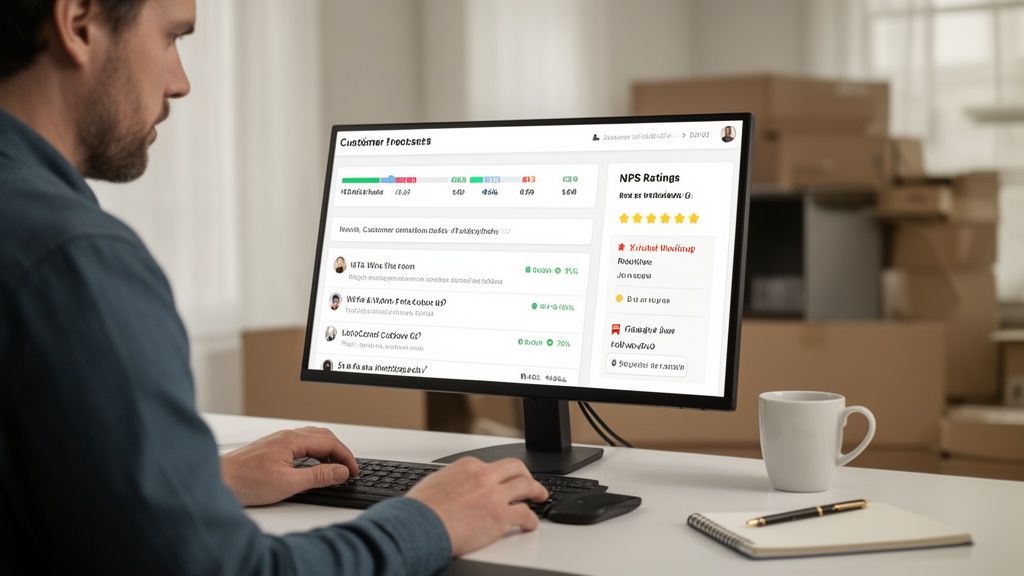
The majority of moving companies collect feedback informally — when a customer volunteers praise or files a complaint. That's not a system. It's a reaction. A systematic feedback loop means every completed job generates a data point, and that data shapes operations over time.
The structure:
- Post-move survey (within 2 hours of completion): Net Promoter Score, overall rating, and one open-ended field
- Review request (24 hours later, for customers who rated 8 or above): Direct link to Google or Yelp review page
- Service recovery outreach (for customers who rated 6 or below): Manager call within 48 hours
- Monthly aggregate review: NPS trend analysis, recurring complaint categories, top crew performance data
Salesforce's State of the Connected Customer research consistently shows that customers who feel heard — even when their issue isn't fully resolved — report higher loyalty than customers who had a flawless experience with no post-service follow-up. The follow-up itself is a service differentiator.
Moving company customer experience improves measurably when feedback is treated as operational intelligence rather than a reputation management task. Repeated complaints about billing clarity or arrival windows are process failure signals, not isolated incidents.
Pro Tip: Close the feedback loop explicitly. When a complaint is resolved, send a one-sentence follow-up to the customer confirming the resolution. This single step converts a dissatisfied customer into a potential advocate — and demonstrates the kind of accountability that generates referrals organically.
Tools That Help Moving Companies Deliver Transparency at Scale
The five steps above are straightforward in theory. The challenge is consistency — executing each touchpoint across every job, at every volume level, regardless of which coordinator is on shift. Purpose-built software is what makes consistency achievable.
Modern moving company platforms integrate job management, customer communication, and estimate delivery into a single workflow. Automated status messages fire when job milestones are logged. Estimates generate from pre-built line items. Feedback surveys deploy on schedule after job completion. None of it requires manual intervention once the workflow is configured.
| Capability | Manual Process | Software-Enabled |
|---|---|---|
| Job status updates | Dispatcher phone calls | Automated SMS at milestone triggers |
| Estimate delivery | PDF email attachment | Digital estimate with e-signature |
| Pre-move outreach | Coordinator-initiated calls | Automated sequence with reminders |
| Feedback collection | Ad-hoc customer request | Triggered post-job survey and review link |
| Dispute documentation | Paper trail if retained | Timestamped digital record per job |
The operational argument for technology isn't efficiency alone — it's quality control. Harvard Business Review's analysis of service loyalty drivers found that reducing customer effort — making it easy for customers to get information — is the primary lever for loyalty in service businesses. Automation reduces customer effort at scale in ways that manual processes cannot sustain.
For companies evaluating their operational software, the moving company technology stack guide provides a category-by-category breakdown of tools and their impact on customer-facing outcomes.
Related Articles
- Transforming the Moving Industry with AI: What's Changing Now — Learn how AI-powered tools are reshaping the way moving companies communicate, estimate, and operate at scale.
- Best CRM for Moving Companies: In-Depth Comparison — A detailed breakdown of CRM platforms built for moving operations, comparing features and operational fit.
- Digital Marketing Strategies for Moving Companies: A Complete Guide — How to turn transparency and reputation into measurable lead generation through digital channels.
- Pricing Strategies for Moving Companies: Maximizing Profitability — How to structure pricing models that support both profitability and the transparency customers demand.
Ready to see it in action?
Book a free 20-minute demo and explore how Virtual Estimate can help your business.